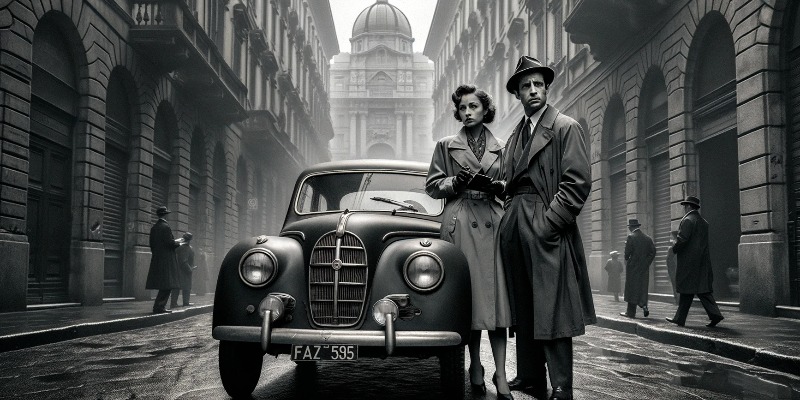
In the third chapter of Ombre di Ambizione, entitled Labyrinths of the Past, Marini and Conti’s investigations delve into the darkest areas of the professional and personal relationships of MilanTech’s collaborators. At the center of the narrative is Enrico Sartori, a brilliant but isolated researcher, whose life and ambitions intertwine with the mysterious theft of Professor Ferrari’s formula.
While exploring Sartori’s home, a place that reflects his inner state of solitude and obsession, Marini and Conti confront a man apparently consumed by his own ambitions. Through intense dialogue and a tense environment, details emerge that indirectly connect him to the theft, but leave many questions unanswered.
The testimonies collected by Sartori’s colleagues add further nuances to his character: a man dedicated to research but increasingly distant and suspicious, driven by an almost desperate desire to leave an indelible mark. However, while suspicions about him grow, his motivations remain shrouded in mystery.
A turning point comes with the search of his apartment, where documents and notes are found that demonstrate an in-depth knowledge of the stolen formula. The evidence begins to paint a more complex picture: Sartori is not just a suspect, but an ambiguous figure, poised between being a tormented genius and a man capable of questionable actions.
The chapter ends with growing tension, as Marini and Conti reflect on what has emerged and how each new clue brings them closer to the truth, without however dispelling the shadows that surround the case. Sartori, with his ambition and his silence, represents an enigma that promises to be crucial to the investigation. The labyrinth of suspects and secrets seems to become increasingly intricate, leaving readers with the feeling that each step forward reveals further complexities.
See all chapters:
- Chapter 1: The Theft
- Chapter 2: Shadows and Suspicions
- Chapter 3: Labyrinths of the Past
- Chapter 4: The Arrest
- Chapter 5: Hidden Truths
- Chapter 6: The Incomplete Puzzle
- Chapter 7: Mysteries in Corenno Pliny
- Chapter 8: Twists and Surprises
- Chapter 9: Night Patrols
- Chapter 10: Shadows and Blood under the Castle
- Chapter 11: The Swiss Track
- Chapter 12: The Harsh Law of Investigation
- Chapter 13: Revelations in St. Moritz
- Chapter 14: Hidden Connections
- Chapter 15: Shadow Operations
- Chapter 16: An Afternoon in Lambrate
- Chapter 17: The Renunciation
- Chapter 18: The Decisive Encounter
- Chapter 19: The Trap


The Case of the Lost Polypropylene Formula in Milan
by Marco Arezio
Stories. Shadows of Ambition. Chapter 3: Labyrinths of the Past
As the sun began to set, tinging the facades of Milan’s ancient buildings with gold, Commissioner Lucia Marini and Inspector Carlo Conti continued their investigation, wrapped in a conversation that extended beyond the current case, venturing into personal reflections and professional dilemmas.
“I can’t stop thinking about what Marta said,” Conti mused, slowing his pace and allowing his words to flow more gently. “How science—or any successful field—can be so permeated by egos and ambition that it ends up destroying even the most genuine relationships. Sometimes I wonder if it’s really worth it.”
Lucia kept her gaze fixed on the road before them, her eyes alert yet lost in thought. She nodded slowly. “It’s a bitter lesson, Carlo. But I believe it teaches us that success, when it’s built at the expense of others, loses all its value. We have to remember to see people for who they really are, not just for what they can do for us.”
Their conversation paused as they arrived at the next stop in their investigation: the home of Enrico Sartori, a former colleague of Ferrari, known for his revolutionary theories and solitary nature.
The building was an old apartment house, its walls chipped, and the stairs creaked with every step—a sign of a Milan that proudly bore the scars of time.
The inner courtyard was nearly deserted, aside from a few potted plants left by the residents and an old rusty bicycle propped against the wall. The door, heavy and bearing a small, oxidized brass plate, looked like an entrance that had long guarded forgotten stories. Standing before the apartment door, Lucia turned to Carlo, the sound of neighbors’ voices drifting through the thin walls.

“Ready?” she asked with a half-smile, her eyes reflecting a hint of determination as she paused briefly on the worn handle, as if trying to predict what they would find behind that door.
Carlo nodded, and together they knocked. The door opened slowly, revealing Enrico Sartori: a middle-aged man with a neglected appearance. His graying hair was messy, as though it hadn’t seen a comb for days, and a scruffy beard gave him an even more disheveled look.
He wore a faded old wool robe, stained in places, a sign of poor personal care. His eyes, however, sparkled with intelligence from behind thick lenses, betraying both a keen mind and a latent tension, as though he were always on guard.
“Ah, the police,” he exclaimed with a mix of surprise and irritation, his lips tightening into an expression somewhere between sarcasm and annoyance. “I imagine you’re here about Ferrari and his precious formula.”
Marini spoke in her usual calm but authoritative tone. “Exactly, Dr. Sartori. We’d like to know whether you’re aware of anything that might have happened in the days leading up to the theft, or if you had any contact with Ferrari or any of his collaborators. Also, would it be possible for us to come inside and talk more comfortably?”
Sartori stayed silent for a moment, scrutinizing Marini and Conti with a combination of suspicion and resignation. At last, he gestured with his head and moved aside from the door, letting the two investigators enter.
The inside of the house was dark and austere. A musty scent of dust and old books filled the air. The walls were lined with shelves packed with worn volumes, their titles nearly illegible. A crystal chandelier, now cloudy and missing several of its drops, hung from the center of the ceiling. The furniture—heavy and dark—seemed from another era, with armchairs upholstered in faded velvet and a low table covered with scattered papers and documents. The only light came from a small side window, its thick curtains barely letting in a few rays.......
© Reproduction Prohibited