- The Evolution of Urban Mobility: From Rails to an Ecological Future
- The First Trams and the Concept of Electric Mobility
- Development of Lines and Power Supply
- Trams and the Evolution of Italian Cities
- The Challenge of Thermal Buses
- The Return of Trams as a Symbol of Sustainability
- Trams between Past and Future
The Evolution of Urban Mobility: From Rails to an Ecological Future
by Marco Arezio
The history of electric trams in Italy represents one of the first steps toward sustainable urban mobility, foreshadowing the environmental awareness that is now at the forefront of public debate.
This mode of transportation marked a significant shift in the daily life of Italian cities, offering a viable alternative to more polluting forms of transit and contributing to urban development over the years.
Early Trams and the Concept of Electric Mobility
The idea of public rail transport emerged in the late 19th century, a time when European cities began recognizing the need to improve urban mobility to foster economic and social growth.
The first horse-drawn tram in Italy was introduced in Turin in 1871, and it was soon replaced by electric trams starting in the late 1880s. The first cities to adopt electric technology were Milan and Rome, followed by other major cities like Naples, Florence, and Turin.
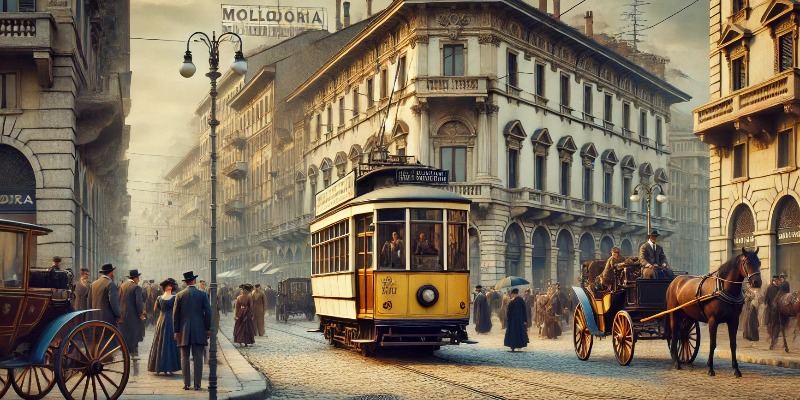
In 1893, Milan saw the arrival of the first genuine electric tram, inaugurated on the line connecting Porta Venezia to Monza. This line was a technological breakthrough, connecting the city center with its outskirts, thus promoting urban and social growth in previously isolated neighborhoods.
In Rome, electric trams also began appearing along main roads, with an ever-expanding network that promised to transform the capital’s mobility.
The Development of Tram Lines and Electric Power
The development of electric tram lines progressed rapidly, driven by increasing industrialization and advancements in electrical technology.
Tram power was supplied through what was known as the "overhead line," a system of wires suspended above the tracks, allowing the transfer of electric power to the tram via a "trolley pole."
This technical solution remained largely unchanged for decades, adapting to technological improvements and making trams reliable and economical.
In Milan, the Edison company played a pivotal role in distributing the electricity needed to power the tram network, making the system especially efficient.
In other cities, tram lines began connecting central districts to suburbs, facilitating easier mobility and improving citizens’ quality of life. For instance, in Naples, the tram network helped link the port to the urban center, facilitating the transportation of people and goods.
Trams and the Evolution of Italian Cities
The expansion of electric tram networks coincided with a period of significant urban renewal. Italian cities of the early 20th century were evolving, and trams became a symbol of modernity, transforming the urban landscape.
City squares were redesigned to accommodate tracks, main roads were adapted for trams, and suburbs began to flourish thanks to the increased accessibility provided by the new lines.
Among the historic lines, the Milan-Monza tramway is particularly noteworthy; it is one of Italy’s oldest and was a crucial link for the economic and social life of Lombardy.
In Rome, the tramline along Via Flaminia became emblematic for its ability to serve peripheral areas and connect them to the historic center, enhancing urban integration and facilitating tourist flows to historical monuments.
The Challenge of Thermal-Powered Buses
After World War II, economic growth and the spread of motor vehicles posed a significant challenge to trams.
The bus, with its combustion engine and greater flexibility, began to emerge as a more modern and versatile alternative to rail-bound trams. From the 1950s onward, many Italian cities saw the gradual replacement of trams with buses.
This shift was due to the advancement of internal combustion engines and the need to reduce the maintenance costs of fixed infrastructure like tracks and electric lines.
In some cities, such as Naples and Palermo, trams were completely eliminated, while in other cities, such as Milan and Turin, they managed to survive and coexist with buses.
In Milan, in particular, the decision to maintain an extensive tram network proved to be farsighted: today, the city boasts one of the largest tram networks in Europe, a symbol of sustainable urban mobility that looks to the future without forgetting its past.
The Return of Trams as a Symbol of Sustainability
In recent decades, with growing attention to environmental issues and the need to reduce polluting emissions, trams have re-emerged as a sustainable and efficient mode of transport.
Many Italian cities have reconsidered the possibility of restoring old lines or creating new ones. In Florence, for example, the new tram system, inaugurated in 2010, revolutionized urban mobility, reducing pollution and improving the quality of life for residents.
Rome, too, has invested in the restoration and enhancement of its tram network, aiming to ease car traffic and improve connectivity in peripheral areas.
Thus, today, trams are not only a reminder of the past but also a modern answer to the needs for sustainable and efficient urban transportation.
Conclusion
The history of electric trams in Italy is a tale of innovation, growth, and resilience. As pioneers of electric and sustainable mobility, trams have played a crucial role in transforming Italian cities, making public transport more accessible and efficient.
Despite competition from combustion-engine buses, trams have managed to endure and are now making a comeback thanks to their ecological value and their ability to offer truly sustainable urban mobility.
© Reproduction Forbidden