- Riccardo Cassin and the birth of a mountaineering dream
- The journey from Lecco to Pizzo Badile in 1937
- Preparation and departure from the base of the Sasc Furä refuge
- The historic climb of the north-east face of Badile
- Arriving at the summit: three days suspended on granite
- The tragedy during the descent towards the Sciora Hut
- The return to Lecco and the mourning for Molteni and Valsecchi
- The legacy of Riccardo Cassin and the immortal route of Badile
One of the most heroic feats of classic mountaineering, between extreme courage, broken brotherhood and an unforgiving mountain
by Marco Arezio
It was July 1937, and Lecco was blazing under the sun. Riccardo Cassin , 28, a laborer and self-taught mountaineer, looked north with a clear objective: the northeast face of Pizzo Badile, a slab of compact, vertical, and unclimbed granite in the harsh heart of the Bregaglia Valley. It wasn't just a mountaineering project: it was a dream to be conquered with bare hands, a clear mind, and a steadfast heart.
Four friends set out with him: Vittorio Ratti, Luigi Esposito, Mario Molteni, and Giuseppe Valsecchi . All from Lecco, all young, and with that hunger for the sky that often arises in those who have known hard work since childhood. They reached Bondo, Switzerland, using the means of transport of the time: probably by train to Chiavenna and then on foot along the valley, laden with equipment and expectations. The approach itself was part of the conquest. They slept where they could, ate little, spoke less. The mountains were in their minds.
The village of Bondo marked the edge of the inhabited world. From there, they began the climb toward the Sasc Furä refuge, a simple stone shelter nestled between sparse pastures and wind-sculpted rocks. Before them, Pizzo Badile rose like a stone obelisk, elegant and merciless. The northeast face, still untouched, awaited.
The attack on the wall
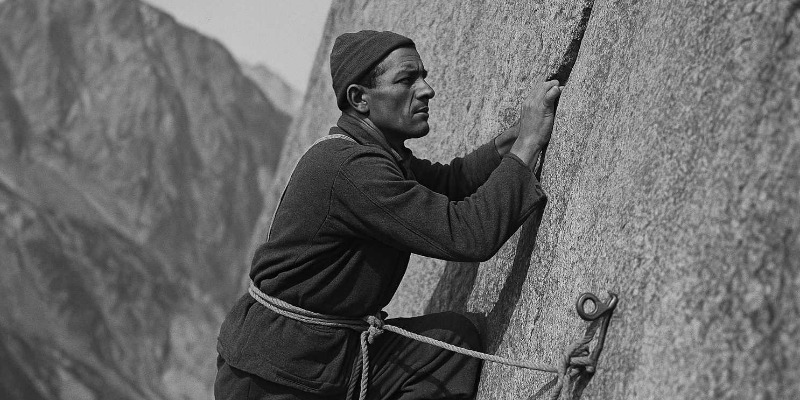
On July 14, 1937, at first light, the roped party left the refuge. Their gear was basic: hemp ropes, iron nails, a hammer, and hobnailed boots. No modern harnesses, no technical clothing. Just experience, courage, and a deep understanding.
Cassin led the way. He had already tackled daring walls, but nothing compared to the sheer granite expanse that loomed above them. The climb was an exercise in clarity and calculated risk. They climbed in opposition, splitting, on cracks barely large enough to fit a hand or a piton. Rests were brief, meals nonexistent. They slept huddled on narrow ledges, tied to each other to avoid falling into the void.
The wall seemed endless. The tension was constant. With every pitch, a mystery. With every move, the knowledge that a mistake would cost his life. Cassin searched for the route with instinct and intelligence, placing pitons wherever the rock allowed, often where no one else should have done so.
Molteni and Valsecchi began to slow down. Accumulated fatigue, the lack of food, and the altitude began to undermine their balance. But no one stopped. They ascended as if holding their breath, their gaze fixed on the rock.
The summit
On July 16, after three days of almost inhuman effort, the group reached the summit. It was done. The 3,308-meter Pizzo Badile had been conquered via a new, elegant, and dangerous route. No one shouted. The mountain was silent, and so were they.
Clasped in a silent embrace, they watched the Alps stretch out beneath them. But they already knew: it wasn't over. The clouds were gathering. The wind had shifted direction. The descent would be another battle.
The Badile Tragedy: When Courage Isn't Enough
They decided to descend from the Swiss side, towards the Sciora Hut. But the weather was worsening. Fog, rain, wind. Their bodies were exhausted. The altitude, hunger, and cold were sapping their last strength.
Mario Molteni was the first to collapse. He began to stagger, losing his lucidity. Cassin and Ratti tried to support him, feed him, motivate him. But it wasn't enough. The young man collapsed on a rock and never got up again. He died in the arms of his friends. He was only 25 years old. His face, gaunt and immobile, remained forever etched in Cassin's memory.
Shortly afterward, Giuseppe Valsecchi also stopped. Molteni's death had devastated him, drained him. He couldn't continue. He let himself fall, exhausted. Silently, without anger. Perhaps he gave up, perhaps he understood that the mountain would not allow him to return.
Two strong young men, broken by the mountain after giving it everything.
Cassin and Ratti continued their descent, burdened by grief. Their scarred faces held no tears: they were frozen by the wind and fatigue. They reached the Sciora Hut, exhausted and silent. More than victors, they seemed like survivors.
The return and the pain
The bodies of Molteni and Valsecchi were recovered in the following days. It was a complicated operation, in pouring rain. Cassin wanted to participate. For him, it wasn't just a humane gesture, it was a promise to be kept. No one would leave the mountain without bringing back those who had died.
In Lecco, the funeral was solemn. An entire city mourned two of its finest sons. The crowd accompanied the coffins in a silence as thick as fog. Tears and pride were evident on their faces. No rhetoric, only respect.
Cassin didn't say much. He wasn't one for long speeches. But from that day on, every time he looked at a mountain, he would also see the faces of Mario and Giuseppe. Every future climb would also be a silent tribute to them.
A man and an era
Riccardo Cassin was a poor and hardworking child of the twentieth century. Raised without a father, educated between the factory and the mountains, he built his strength through sacrifice. For him, mountaineering was never a pastime. It was a calling.
His figure emerged discreetly but forcefully. He wasn't charismatic in the theatrical sense, but he possessed that calm authority that comes only from those who know the hard way. The respect he commanded was natural, never forced. He was a leader without arrogance.
In the years that followed, he would climb legendary walls, from Lyskamm to Gasherbrum IV. But the Badile remained his iconic peak forever. The one that consecrated him, but which asked something too dear in return.
Rock Legacy
Today, the Cassin route on Pizzo Badile is one of the great classics of world mountaineering. Technical, logical, elegant, cruel. Every team that climbs it relives that story: the dream, the effort, the loss.
Riccardo Cassin died in 2009, at the age of one hundred. But his spirit, his style, his silent respect for the mountains live on among the granite slabs that rise toward the sky.
And up there, where the air is thin and the world disappears, a thought always flies to those two young men who never returned. The shovel welcomed them. And never let them go.
© Reproduction Prohibited