- The Origins of Henry David Thoreau: Childhood and Education
- The meeting with Emerson and Transcendentalism in Concord
- Walden: Retreat to the Woods as a Life Choice
- The Value of Intimacy and Simplicity in Human Existence
- Thoreau and Ecological Thought: Man and Nature
- Civil Disobedience: Ethics and Social Responsibility
- The Legacy and Relevance of Thoreau's Message Today
- Thoreau's Essential Books: Recommended Reading
Thoreau's lesson on intimacy, radical choices, and nature: why his message is more alive today than ever
by Marco Arezio
There are lives that pass through history leaving a silent, apparently marginal trace, but which, decades later, reveal a disruptive force and a radical nature capable of inspiring entire generations.
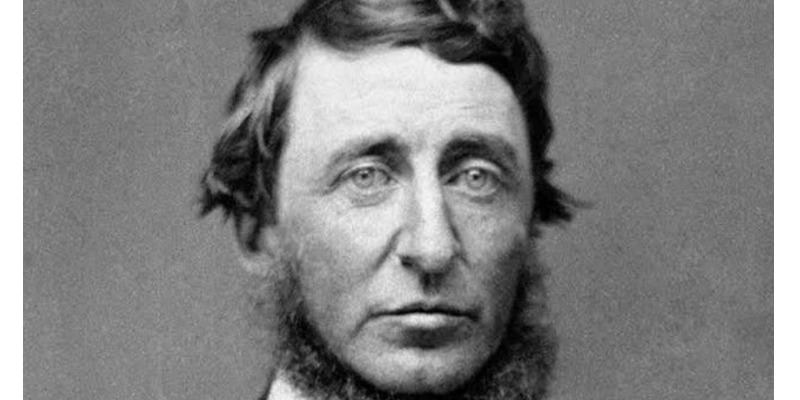
Henry David Thoreau (1817-1862) is one of these . Born in Concord, Massachusetts, the son of a pencil manufacturer, Thoreau lived most of his life in that small New England town, in a rapidly changing America, on the threshold of the Industrial Revolution and the great social transformations that would change the face of the United States. Yet, what made him famous and still relevant today was his choice to escape the rush toward material progress, embracing nature, solitude, reflection, and a life stripped down to the essentials.
The Roots of a Choice: Childhood and Education
Thoreau's childhood was marked by a precocious sensitivity to the natural world. He attended Harvard University, where he distinguished himself for his intellectual independence, his disdain for academic conventions, and his curiosity about philosophy and classical literature. Already during these years, he developed a desire for an authentic life, far from the artifices of modern society, and the conviction that true knowledge is acquired not only from books, but through direct experience of the world.
It was in Concord that Thoreau met Ralph Waldo Emerson, already a celebrated philosopher and poet, who became his friend and mentor. Through Emerson, Thoreau became interested in Transcendentalism, a philosophical movement that extolled individual spirituality, direct contact with nature, and the rejection of social constraints. Nature, in the Transcendentalist vision, is the source of all truth and inspiration, a sacred temple in which every man can rediscover himself.
Walden: Return to the Origins
Thoreau's most famous gesture was undoubtedly that of retreating for two years, from 1845 to 1847, to the shores of Walden Pond , where he built a small cabin with his own hands. Here he lived in complete self-sufficiency, dedicating himself to writing, observing nature, manual labor, and long, solitary meditation. This experience is recounted in his most famous book, Walden; or, Life in the Woods (1854) , an authentic manifesto of a new relationship between man and the environment.
Thoreau's choice was not a passive escape, but an act of conscious rebellion against conformism, the alienation of city life, and the growing commodification of existence. In the pages of Walden, a strong desire to rediscover the simplicity and fullness of life emerges, the value of small things, the joy of a life lived slowly, observing the changing seasons, the flight of birds, the rhythm of days that pass outside the time of the market and productivity.
Lessons in intimacy and ecology
What did Thoreau want to teach us? First and foremost, the value of authenticity. In a world dominated by appearances, fashion, and the compulsive pursuit of success, his voice invites us to rediscover our deepest selves, to have the courage to listen to our desires and shape a life that is personal and not conformed to the expectations of others. In this sense, the stay at Walden becomes an inner journey, an experiment in self-knowledge and the rediscovery of our authentic human needs.
But there's more. Thoreau was one of the first to understand that humankind's destiny is inextricably linked to that of nature. His life in the woods is also an invitation to rediscover respect for the Earth, to live in harmony with the environment, limiting our material needs and cultivating a reciprocal relationship with our surroundings. From here comes one of the first forms of ecological thought in modern times: nature is not a resource to be exploited, but a traveling companion, a mother to be listened to and protected.
Civil Disobedience: The Ethics of Responsibility
Thoreau's contribution, however, is not limited to his relationship with nature. Another of his key texts, Civil Disobedience (1849) , was born from his refusal to pay taxes to a state that supported slavery and fought the Mexican-American War.
This act of individual resistance became a pamphlet that, decades later, would inspire figures like Gandhi and Martin Luther King in the fight for civil rights and social justice.For Thoreau, moral conscience comes before the laws of the state. Every citizen must assume the responsibility of opposing injustice, even at the cost of marginalization or persecution. Civil disobedience is not an act of anarchy, but an ethical duty in the face of corrupt or inhuman governments. Thus, Walden's personal experience and the political reflections of Civil Disobedience merge into a comprehensive vision of man, free and responsible, capable of choosing his own path.
The relevance of Thoreau's thought
More than one hundred and sixty years after his death, Thoreau's lesson seems extraordinarily timely today. Faced with an unprecedented ecological crisis, a society marked by the rush to consume, a loss of meaning, and urban alienation, his choice to slow down, to return to nature, to reduce the superfluous to cultivate what truly matters, resonates like a prophecy. The idea that happiness lies not in possessions but in the quality of time, in the richness of relationships, and in the depth of experience, appears more valid today than ever.
Many of the practices that are coming back into fashion—from low-impact living to minimalism, from the rediscovery of slow living to the pursuit of green spaces in cities, from the fight for civil rights to environmental volunteering—find in Thoreau a lucid and passionate pioneer. His life teaches us that changing the world begins with an inner revolution, a personal choice of consistency, responsibility, and openness toward others and the Earth.
Thoreau's fundamental books
In addition to Walden and Civil Disobedience, Thoreau left behind other fundamental writings that testify to his extraordinary depth of thought. Among these are:
" A Week on the Concord and Merrimack Rivers " (1849), a poetic and philosophical journal of a river voyage that is also a meditation on America and spirituality.
" Walking " (1862), a eulogy of walking as a philosophical and spiritual practice, a hymn to freedom and deep connection with nature.
" The Maine Woods " (1864), a chronicle of travels in the rugged American North, reflecting on the relationship between man and wilderness.
" Cape Cod " (1865), another travelogue that combines naturalistic observation, history and philosophy.
Many of his reflections are also found in his posthumously published Journals, which collect decades of observations, thoughts, and annotations, often of rare beauty and depth.
A legacy for our time
Rereading Thoreau today means questioning the meaning of our daily choices. We live in a society where the clamor of progress seems to leave no room for listening, where the rush to consume risks emptying our existence of authentic content. Thoreau reminds us that true change comes from the ability to pause, to observe, to return to simple things. His lesson is not one of a naive escape from reality, but the search for a new balance between the individual and the world, between intimacy and collective responsibility.
Choosing to live "according to nature" doesn't mean isolating yourself, but rediscovering the profound dimension of our humanity. It's an invitation to look at the world with new eyes, to believe that, even in the solitude of a cabin in the woods, you can build a life full of meaning, capable of leaving a mark on history.
Henry David Thoreau, with his ancient yet very modern voice, still accompanies us today on the difficult path towards a more aware, respectful, and harmonious existence with the Earth we inhabit.
© Reproduction Prohibited