- The race to the South Pole between imperial glory and personal ambition
- The logistical choices of the Terra Nova expedition
- Robert Falcon Scot's Chain of Command Mistakes
- The comparison between the British and Norwegian expeditions
- The dramatic return journey and the death of the explorers
- The ideological context of the age of great explorations
- Scott between heroic myth and historical responsibilities
- Modern Lessons from a Failed Expedition
A historical reconstruction of the strategic mistakes and cultural rigidities that led to the deaths of Scott and his crew in the race to the South Pole
by Marco Arezio
At the beginning of the twentieth century, the exploration of the polar regions represented one of humanity's last great horizons. The planet, now almost completely mapped, still held two unconquered territories: the North Pole and the South Pole. Antarctica in particular, remote and inhospitable, fueled the dreams of glory of empires, scientists, and officials. The race to the South Pole thus became the symbol of an extreme challenge against nature and one's own limits. It was against this epic backdrop that the British expedition led by Robert Falcon Scott took place, destined to go down in history not for its success, but for its tragic end.
Scott set out in 1910 with the goal of reaching the geographic South Pole and claiming its conquest on behalf of the British Empire. The expedition, dubbed Terra Nova, was well-equipped and ambitious. But behind the apparent organization lay poor logistical choices, tactical errors, and above all a rigid cultural attitude unwilling to adapt. The result was a disaster waiting to happen, leading to the death of Scott and his companions in the freezing Antarctic.
An organization marred by bad choices
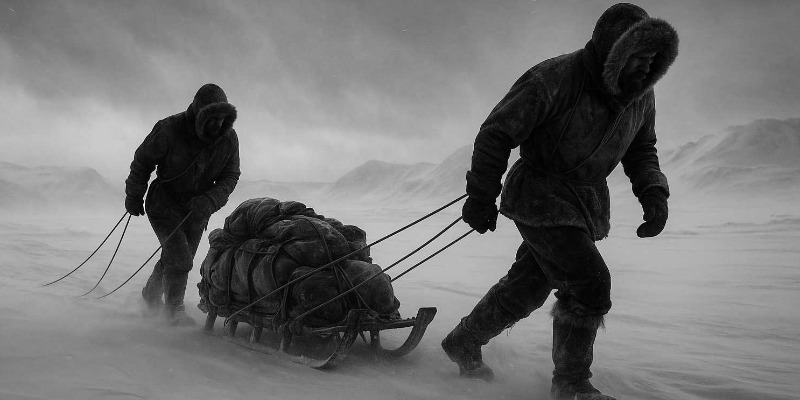
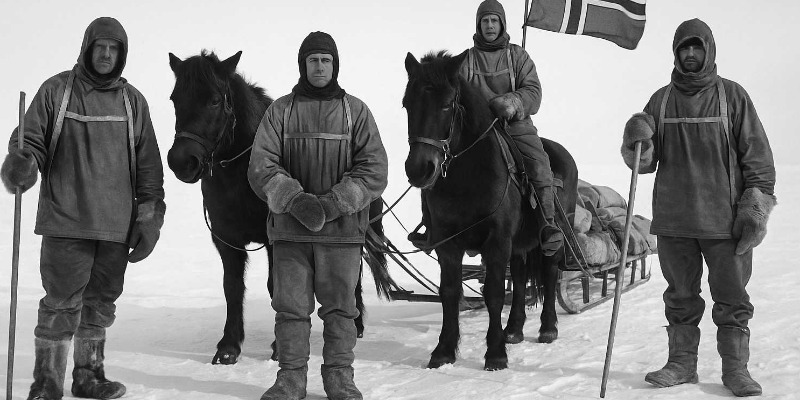
One of the expedition's critical points was the selection of means of transport for supplies and supplies. Instead of relying primarily on sled dogs—as other explorers had done—they employed animals poorly adapted to the terrain and extreme weather conditions, along with unreliable experimental snowmobiles. The belief that organization and tenacity could replace environmentally appropriate logistics led to dire consequences. Pack animals gradually gave out, while the machines quickly broke down, leaving the men to pull the sleds by hand for hundreds of kilometers, in freezing winds and freezing temperatures.
Furthermore, the supply choices were underestimated compared to actual needs. Intermediate depots were poorly marked and food supplies were insufficient, also due to incorrect distribution decisions and overly optimistic calculations of the distances that could be covered in a day.
A chain of command that is too rigid
Robert Falcon Scott was a determined man, but also a commander trained in a martial environment that favored discipline over flexibility. The expedition's organization reflected a rigid hierarchical structure, little inclined to peer discussion. Several key decisions were made unilaterally, without considering the input of the men with more experience in the field.
A prime example was the composition of the final group to reach the Pole. Initially planned for four members, Scott decided to include a fifth man shortly before the final departure. This created immediate practical problems: the food rations, tents, and even the equipment had been designed for four people. The change was not accompanied by a recalculation of supplies, exacerbating fatigue and risk for everyone.
The comparison with Amundsen: pragmatism versus ideology
Around the same time, another explorer was heading for the South Pole: the Norwegian Roald Amundsen. Unlike the British, Amundsen planned his expedition according to criteria of adaptability and efficiency. He chose sled dogs, fur clothing, and followed the practices of Arctic peoples. His approach was scientific, but also profoundly humble: he knew he had to learn from the experiences of others, especially those who had lived in similar climates for centuries.
Setting out weeks ahead of Scott, Amundsen reached the South Pole on December 14, 1911, leaving a tent with a flag and a message.
Scott and his men arrived 34 days later, on January 17, 1912, only to discover they had been defeated. The disappointment was profound, but the worst was yet to come.The return: hunger, cold and despair
The return journey was devastating. The five men were exhausted, the weather became increasingly adverse, and their food supplies rapidly dwindled. One of their companions, Edgar Evans, died from the effects of a fall. Lawrence Oates, suffering from frostbite and aware of being a burden to the group, left the tent with the words: "I'm just going out. I might be a while."
Scott, Henry Bowers, and Edward Wilson continued until their strength completely abandoned them. They were stranded by a blizzard, less than twenty kilometers from a food depot. Their bodies were found months later, along with diaries that recounted their final days with moving clarity and dignity. The notebooks, now preserved in museums and archives, became the basis for constructing the heroic myth of the expedition.
An age of myths, flags and nationalisms
Scott's feat must be read in the context of a historical period in which exploration was closely tied to national prestige. European imperial powers vied for the last blank spaces on the map as symbols of their scientific, cultural, and political dominance. Conquering the Pole meant not only bringing home a geographical trophy, but also affirming an identity: that of Western man as the master of nature.
This ideological climate strongly influenced the mentality of Scott and his command. Exploration was seen more as a demonstration of moral strength than as an exercise in intelligent adaptation. The culture of discipline and sacrifice ultimately prevailed over the ability to observe and learn from the surrounding environment.
A timeless lesson
In hindsight, Scott's expedition appears as a prime example of flawed leadership, inadequate planning, and a failure to recognize the limitations imposed by the context. But it would be unfair to reduce it all to incompetence. Scott was a man of his time, guided by ideals shared by many of his contemporaries. He was a patriot, a scientist, and a courageous explorer. But his story teaches us that courage alone is not enough. In extreme conditions, those who survive are those who know how to read the environment, those who accept their limitations, and those who are willing to change their approach.
Many modern scholars have compared Scott's story to the challenges of contemporary space missions or ocean exploration. His tragedy remains a powerful example of what happens when ambition and the dominant culture overshadow common sense and experience.
Epilogue: the echo of an era and the face of the unknown
Robert Falcon Scott's epic continues to fascinate because it embodies a profound tension between the spirit of conquest and human frailty. Antarctica, with its absolute silence and eternal light, became the stage for a drama that still challenges us today. It was a story of shattered dreams, fatal mistakes, and dignity. But it was also the hallmark of an era, of a world that sought confirmation of its greatness in extreme lands.
Today, rereading those yellowed diaries and those letters written with trembling hands, we can understand that the true conquest was not the South Pole, but the awareness of one's own limitations. And in this, perhaps, Scott was truly a pioneer.
© Reproduction Prohibited