- Introduction to Smart Polymers: Characteristics and Operation
- Response to External Stimuli: pH, Temperature and Pollutants
- pH-Sensitive Polymers for Water Quality Monitoring
- Thermoresponsive Polymers for Climate Change Detection
- Smart Polymers for Chemical Pollutant Detection
- Advanced Applications of Smart Polymers in Environmental Sensors
- Future Prospects for Smart Polymers in Environmental Sensing
- Smart Polymers as Key Tools for Environmental Protection
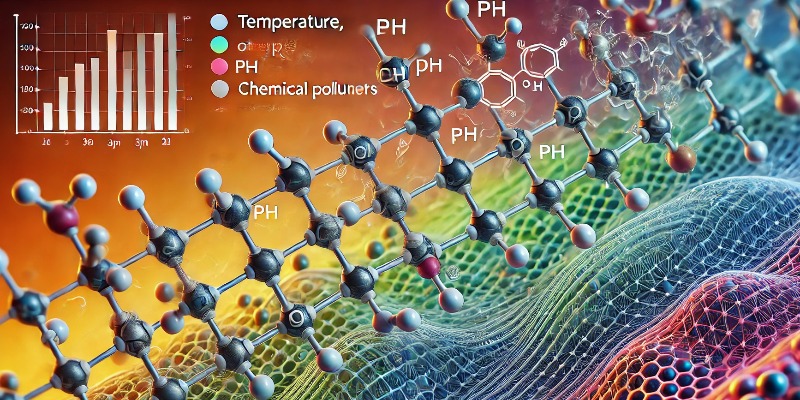
Advanced materials capable of reacting to external stimuli such as pH, temperature, and chemical pollutants, for more efficient and accurate environmental management
by Marco Arezio
In recent decades, advancements in materials science have led to the development of smart polymers, also known as stimuli-responsive polymers.
These materials can respond in a controlled manner to external stimuli such as pH, temperature, light, electric and magnetic fields, and specific chemicals, including pollutants.
These unique characteristics have opened new horizons in environmental sensing, allowing for the creation of devices capable of real-time monitoring of environmental conditions, with applications ranging from water quality control to air analysis.
Smart polymers stand out for their ability to undergo significant changes in their physico-chemical properties in response to specific stimuli, a process that can be harnessed for the precise and sensitive detection of pollutants or environmental changes.
In this article, we will explore how these materials work, the main stimuli they respond to, and their applications in environmental sensing.
Characteristics of Smart Polymers
Smart polymers are macromolecules that can reversibly change their properties in response to external stimuli.
These changes may affect their conformation, solubility, electrical conductivity, or other physico-chemical properties. Materials designed to respond to specific stimuli find applications in fields such as medicine, electronics, and more recently, environmental sensing.
The main types of responses include:
pH Response: Some polymers change conformation or solubility based on the pH of the environment. These materials can be used to monitor water or soil acidity, a critical parameter for ecosystem health.
Temperature Response: Thermoresponsive polymers change structure or phase at specific transition temperatures, allowing the creation of sensors to detect thermal variations in ecosystems or industrial processes that may contribute to global warming.
Response to Chemical Pollutants: Some smart polymers are designed to interact selectively with pollutant molecules, altering their optical or electrical properties, making them useful for detecting hazardous substances in the air or water.
External Stimuli and Polymeric Responses
pH
pH-sensitive polymers detect changes in environmental acidity through the presence of ionizable groups along the polymer chain.
In acidic or basic environments, these groups can protonate or deprotonate, changing the polymer’s solubility or conformation.
For example, polymers with carboxyl or amine groups can respond significantly to small pH variations, making them ideal for monitoring water quality in industrial or agricultural settings.
An example is poly(methacrylic acid), which behaves as a rigid molecule in acidic environments but extends in basic conditions, altering its optical properties or its ability to bind specific compounds.
Temperature
Thermoresponsive polymers undergo structural changes at specific temperatures, known as upper or lower critical solution temperatures (LCST or UCST).
Above or below these temperatures, polymers can switch from a soluble to insoluble state or vice versa, modifying their configuration.
This behavior is useful in contexts where temperature is an indicator of climate change or uncontrolled industrial processes.
An example of a thermoresponsive polymer is poly(N-isopropylacrylamide) (PNIPAM), which has an LCST around 32°C.
Above this temperature, PNIPAM shifts from a hydrated (water-soluble) state to a dehydrated (insoluble) state, a property exploited in sensors to monitor the temperature of water and atmospheric systems.Chemical Pollutants
Polymers designed to react to specific pollutants, such as heavy metals or volatile organic compounds, offer a unique opportunity for real-time pollution monitoring.
These polymers can be functionalized with groups that selectively interact with a target pollutant, causing changes in the material's optical, electrical, or mechanical properties.
For example, polymers containing metal chelators can bind heavy metals like lead or mercury, resulting in color or electrical conductivity changes that can be measured to detect contamination in water or soil.
Applications in Environmental Sensing
Smart polymers are already being used in various advanced environmental monitoring devices to quickly and accurately detect critical changes in ecosystems and natural resources.
Here are some of the most promising applications:
Water Quality Monitoring: Sensors based on smart polymers detect chemical and biological pollutants such as heavy metals, pesticides, and pathogenic bacteria, quickly and accurately.
For example, pH-sensitive polymers can monitor water acidity, a crucial indicator of the quality and safety of water resources.
Pollutant Gas Detection: Polymers designed to respond to volatile organic compounds or harmful gases such as nitrogen dioxide or carbon monoxide are used in sensors to monitor air quality. These devices are essential for tracking industrial emissions and urban pollution levels, providing critical data for air pollution management.
Industrial Process Monitoring: The sensitivity of smart polymers to temperature and chemical pollutants also makes them ideal for monitoring industrial processes.
For example, thermal sensors can detect changes in heating processes, while chemical sensors can monitor the presence of contaminants in industrial wastewater.
Future Perspectives
The development of smart polymers for environmental sensing is rapidly advancing, with growing interest in creating more selective and sensitive materials capable of functioning in complex environmental conditions and detecting a broader range of pollutants.
Future research will focus on optimizing the performance of polymers in extreme environments, such as high temperatures or low humidity levels, and on integrating them with real-time data collection and analysis systems.
Another promising area involves the use of biodegradable polymers, which can minimize the environmental impact of monitoring devices themselves, a crucial aspect in a circular economy and sustainability perspective.
Conclusion
Smart polymers represent an emerging technology with great potential in environmental sensing.
Their ability to respond to external stimuli such as pH, temperature, and chemical pollutants makes them ideal for the development of advanced sensors capable of monitoring and protecting the environment in an efficient and sustainable way.
Research in this field will continue to enhance these materials, enabling greater integration between materials science and environmental protection.
© Reproduction Prohibited