- Regulation (EU) 2023/2055: what changes for the plastics supply chain
- Microplastics: definitions, scope and exclusions
- Pellets, flakes, and powders: stakeholders and responsibilities along the supply chain
- Obligations and deadlines: labelling, instructions for use and ECHA reporting
- Loss Prevention: Best Practices in Production, Storage and Transportation
- Operational and economic impacts: ESG costs, risks and opportunities for companies
- Compliance roadmap: from gap analysis to audits and continuous monitoring
- Future prospects: European regulation on pellet waste and adaptation strategies
The New European Regulation on Microplastics Changes How Plastic Companies Must Manage the Production, Use, and Transport of Pellets, Flakes, and Powders
by Marco Arezio
With the adoption of Regulation (EU) 2023/2055, the European Union has introduced one of the most significant measures in recent years in the fight against microplastic pollution. The regulation amends Annex XVII of the REACH Regulation, adding a restriction that directly affects all operators involved in the production, distribution, or use of plastic pellets, flakes, and powders.
Its goal is to prevent the accidental release of microplastic particles into the environment and to improve traceability along the industrial supply chain. This represents a crucial step toward the sustainability of the plastics sector, as it is the first time that direct responsibility is assigned to those who handle or transform polymers in granular or powdered form.
Starting in 2025, the regulation will become fully operational, introducing concrete obligations for information, prevention, control, and data communication to European authorities.
What the Microplastics Restriction Provides
The regulation defines synthetic polymer microparticles as falling within its scope when they are smaller than 5 millimeters and contain at least 1% solid polymer content.
Included are spherical particles, flakes, and powders resulting from plastic material production, cutting, or grinding processes.
The objective is to reduce microplastic emissions—both intentional (such as those added to cosmetic or abrasive products) and unintentional, generated during the industrial handling of pellets or production scraps.
Companies will therefore need to adopt technical and organizational measures to minimize material losses and document every stage of the process to ensure transparency of information shared with customers and competent authorities.
Who Is Involved in the Plastics Supply Chain
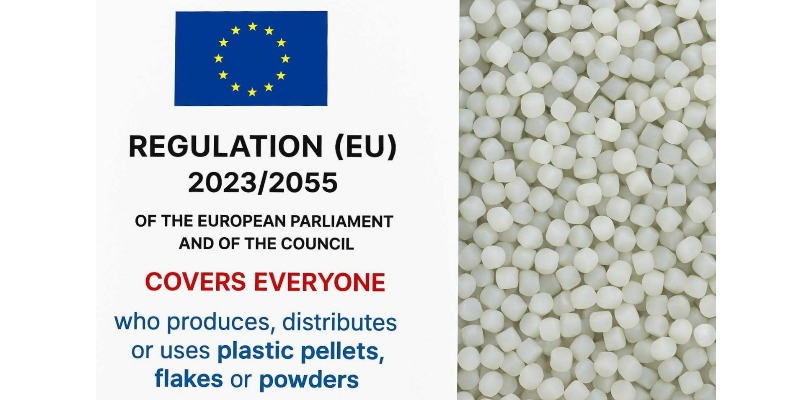
Regulation (EU) 2023/2055 applies to all operators in the plastics value chain, regardless of company size or specific role in the production process.
- Manufacturers of plastic pellets, flakes, or powders: must provide customers with clear instructions for use and disposal, indicating any risks of dispersion.
- Industrial users (converters, compounders, molders, recyclers): must collect data on quantities used, estimate environmental losses, and report annually to the European Chemicals Agency (ECHA).
- Distributors and importers: must ensure that all supplies are accompanied by the proper documentation and comply with the requirements of the regulation.
- Transporters and logistics operators: must adopt safe handling practices to prevent losses during transport or storage.
The entire value chain will thus be subject to new forms of shared responsibility, with particular focus on the traceability of plastic materials throughout every stage of their operational cycle.
Obligations, Deadlines, and New Operational Procedures
The regulation provides a series of progressive deadlines. From October 17, 2025, suppliers of microparticles will be required to provide customers with specific information on the quantity, composition, and handling of plastics in granular or powdered form.
They must also include a standard declaration indicating compliance with Regulation (EU) 2023/2055.
Starting in 2026, the annual reporting obligation to ECHA will come into effect, requiring the collection and transmission of data on:
- quantities of microplastics produced or used
- types of polymers employed
- estimated environmental losses
- mitigation measures adopted
The goal is to establish a European monitoring system for the management of plastic microparticles, capable of identifying operational weaknesses and progressively reducing unintentional emissions.
How to Prevent Pellet and Powder Losses
To comply with the regulation, companies will need to adopt a systematic approach to loss prevention. The most critical areas include material loading and unloading, storage, silo cleaning, and internal handling.
Among the most effective measures are:
- installation of containment and collection systems during material handling
- personnel training on proper material management
- use of closed systems for pneumatic pellet transport
- preparation of emergency procedures for accidental releases
- installation of filters and barriers at discharge points to prevent release into sewer networks
The implementation of these practices will soon become an essential requirement under the forthcoming EU Regulation on Pellet Loss, currently under discussion.
Economic and Managerial Impacts for Companies
Compliance with Regulation 2023/2055 entails a significant transformation in the management of industrial activities.
Companies will need to invest in control systems, data collection, and monitoring technologies—initial costs that may be offset over time by greater operational efficiency and reduced environmental risks.
The main consequences include:
- increased technical documentation requirements for customers and authorities
- the need for periodic internal audits and, in the future, certifications from third-party bodies
- greater contractual responsibility toward suppliers and transporters
- competitive opportunities for those demonstrating early compliance and sustainable material management
In the long term, the most forward-thinking companies will be able to leverage compliance as an asset for environmental reputation and commercial advantage, especially in sectors that prioritize transparency and ESG sustainability.
Roadmap for Compliance
To manage the regulatory transition effectively, companies can follow a five-step operational roadmap:
- Initial analysis (gap analysis) – Map pellet usage and handling points, assess risk areas, and review available data
- Data collection and loss estimation – Identify emission sources, install measurement systems, and establish control logs
- Technical documentation – Draft the required declarations, labels, safety data sheets, and operating instructions
- Plant and training adaptation – Upgrade containment systems and train staff on new procedures
- Continuous auditing and monitoring – Periodically verify compliance, update reports, and improve environmental performance
This step-by-step plan allows companies to manage regulatory complexity without interrupting production activities and to prevent potential future non-compliance.
Toward Responsible and Traceable Plastics
Regulation (EU) 2023/2055 represents a paradigm shift for the plastics sector: from a production-centered approach to one based on integrated environmental responsibility.
The focus is no longer limited to the transformation or recycling phases but extends to the entire life cycle of materials—including process scraps and fine dust from manufacturing.
For companies, this means developing an industrial model grounded in prevention, traceability, and transparency, principles aligned with the foundations of the circular economy.
Those who can anticipate these changes will turn a regulatory obligation into a strategic opportunity: to reduce losses, improve efficiency, and strengthen market trust in a cleaner, more controlled, and sustainable plastics industry.
© All rights reserved – Reproduction prohibited