




- How seamless metal pipes are produced
- The main technologies for the manufacturing of seamless tubes
- What metals are used in seamless pipes and why?
- Differences between carbon steels, stainless steels, copper alloys and titanium
- Where are seamless metal pipes used in industry?
- Technical advantages of seamless metal pipes compared to welded ones
- The role of seamless pipes in industrial sustainability
- Why seamless tubes are essential for the industry of the future
- The main European companies that produce seamless metal pipes
From production to the alloys used, from strategic uses to environmental implications: a journey into the world of seamless metal tubes, a symbol of reliability and industrial sustainability
by Marco Arezio
There is something extraordinarily elegant and powerful about a seamless metal tube. At first glance it looks like a simple cylinder, but inside it contains an enormous technical complexity and a long chain of design, production and environmental decisions. This type of tube does not start from a sheet rolled and welded along the longitudinal line, as happens with many standard pipes: it takes shape directly from a single solid block of metal that, through an ingenious process, is transformed into a hollow structure, without visible joints. A physical continuity that translates into resistance, reliability, purity.
The seamless tube is much more than a technical component: it is the symbol of an industry that aims for precision, safety and – increasingly – sustainability.
How a seamless tube is born: the heart of modern metallurgy
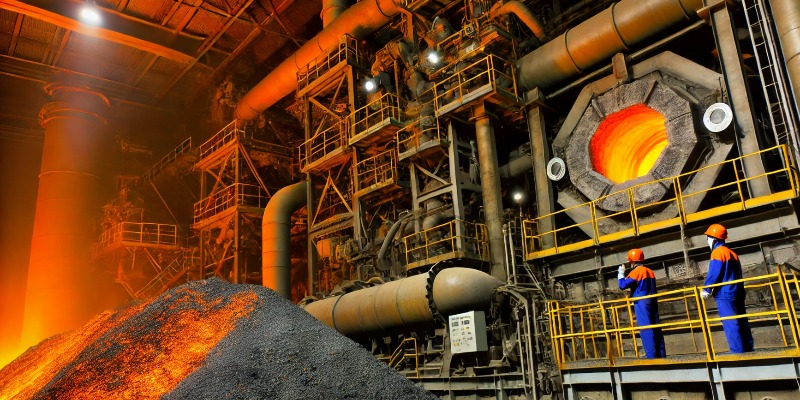
To understand the intrinsic quality of a seamless tube, you have to start from its production process, which represents excellence in metallurgical technology. It all begins with a solid metal billet, a sort of compact cylinder that is heated until it becomes incandescent – often over 1,200 degrees – and then crossed by a mandrel that pierces the center while the metal is rotated. It is as if a perfectly centered tunnel were opened inside the material itself, maintaining its integrity.
This drilling phase is followed by an elongation and shaping process, which defines the final dimensions of the tube. In some cases, cold drawing is then performed, a process that allows for thinner thicknesses, smoother surfaces and extremely tight dimensional tolerances. Finally, the tube can be subjected to heat treatments – such as annealing or normalization – which balance the internal tensions and optimize its mechanical properties.
The result is a product that does not have welds, therefore free from those structural discontinuities that in welded pipes can constitute points of weakness, especially under high pressures, in corrosive environments or in the presence of cyclic vibrations.
Seamless metals: each alloy for a specific use
Not all metals are suitable for this type of processing. The choice of alloy depends on the conditions in which the tube will operate. In the industrial field, the versatility of seamless tubes is expressed through a very wide range of metals and alloys:
- Carbon steel is often used in general systems, where the environment does not present particular criticalities of corrosion. It is economical, resistant and easy to work.
- Alloy steel, with the addition of elements such as chromium or molybdenum, is used in high temperature and pressure applications, offering greater mechanical resistance.
- Stainless steels, such as 304 or 316, are chosen for chemical, pharmaceutical or marine environments, where corrosion is a constant threat.
- Copper and its alloys are perfect for heating systems, thanks to their conductivity and resistance to internal corrosion.
- Titanium is reserved for the most extreme missions: from aerospace to nuclear power plants. Lightweight, rustproof and incredibly resistant.
- Nickel alloys, such as Inconel or Hastelloy, are irreplaceable when it comes to transporting highly corrosive fluids at extreme temperatures and pressures, for example in deep geothermal wells or high-risk chemical plants.
In any case, the choice of alloy is never casual: each environment imposes its own laws and each tube is designed to respond precisely to a specific technical challenge.
Applications: Where Perfection Is Needed
If there is one trait that all sectors in which seamless pipes are used have in common, it is the need for absolute reliability. When a pipe transports gases under pressure, corrosive fluids or is subjected to strong thermal and mechanical stresses, even a microscopic imperfection can cause incalculable damage. This is why seamless pipes are the first choice in critical contexts.
In the energy sector , for example, seamless pipes run through the beating hearts of power plants, from nuclear reactors to heat exchangers, to hydrogen production plants. In oil & gas, they face conditions at the limit of the extreme: ocean depths, salinity, high pressures and temperatures. In the chemical and pharmaceutical sectors, however, the purity of internal surfaces is vital to avoid contaminating reactions or losses of active ingredients.
The automotive and aerospace industries also rely on these components to ensure lightness and resistance: just think of the braking systems of sports cars or the pressurized ducts of airplanes. Even in industrial construction , seamless pipes play a key role in the construction of offshore structures or fire-fighting systems.
Sustainability is also measured in metal
If it is true that every tube is a technical product, it is equally true that today no industrial production can be evaluated without considering its environmental impact.
Seamless tubes, in this sense, offer numerous advantages:- They last longer. Their greater structural integrity reduces failures and replacements, avoiding the production of new pipes and reducing the consumption of resources
- By reducing defects, they improve efficiency. A hose that does not leak pressure or degrade in a chemical plant saves energy and prevents harmful spills
- They are recyclable. The metals used are among the easiest to remelt and reuse. A stainless steel tube, for example, can be recovered almost entirely, maintaining its original properties
- Optimized production. New production technologies, based on digital sensors, artificial intelligence and energy recovery, allow the production of seamless pipes, reducing waste, containing consumption and improving the overall environmental balance of the plant
It should not be forgotten that a well-designed seamless tube allows for the construction of more compact, lightweight and high-performance systems. And this ultimately means fewer materials used, less energy required and greater efficiency along the entire industrial chain.
In conclusion: when precision becomes sustainable
Seamless metal tubes are the perfect synthesis between advanced engineering and industrial responsibility. Their production requires skills, specialized facilities and a deep knowledge of materials, but what they give back to the industry is unmatched: reliability, safety, durability.
In a historical moment in which the industry is called to change its skin – becoming more sustainable, efficient and circular – seamless is no longer just a technical option: it is a statement of vision. Choosing it means investing in a future where every component, even the simplest, contributes to building a more intelligent, resilient and respectful economy for the planet.
The main European companies producing seamless metal tubes
Vallourec (Germany/France)
One of the world's leading multinationals in the production of seamless steel tubes. With plants in Germany and France, Vallourec specializes in solutions for the oil & gas, energy, mechanical industry and infrastructure sectors.
It is strongly committed to the decarbonisation of production processes and the adoption of low-emission steels.
Tenaris Dalmine (Italy)
Part of the Tenaris group, the Dalmine (BG) plant is one of the most advanced in Europe for the production of seamless steel tubes, used in the energy, automotive, mechanical and structural sectors.
Tenaris is investing in the energy transition, developing hydrogen products and promoting the use of renewable energy in its plants.
Voestalpine Tubulars (Austria)
Located in Kindberg, it is one of the leading companies in Europe for seamless tubes for oil & gas, mechanical engineering and heavy industry.
It is part of the voestalpine Group, known for metallurgical innovation and its commitment to climate neutrality by 2050.
ArcelorMittal Tubular Products (France/Europe)
The ArcelorMittal group has several plants for the production of seamless tubes, particularly for the automotive, construction and energy industries.
Promotes the use of recycled steel and short-cycle production technologies to reduce the carbon footprint.
Tubacex (Spain)
Specializing in seamless stainless steel and specialty alloy tubes, Tubacex serves customers in the petrochemical, nuclear, aerospace and green hydrogen industries.
The company is known for its sustainability strategy, with significant investments in circular economy and low-carbon manufacturing.
Železárny Hrádek – ZH Třinec (Czech Republic)
Belonging to the Třinecké Železárny Group, it is one of the leading Central European producers of seamless carbon and alloy steel tubes for industrial, energy and structural applications.
Huta Batory (Poland)
Historic manufacturer of seamless pipes for heavy industry and infrastructure, now integrated into international groups and active in the green modernization of plants.
© Reproduction prohibited