- What is sustainable metal cataphoresis?
- How the ecological cataphoresis process works
- Water-based paints and the role of energy
- Environmental advantages of cataphoresis compared to traditional treatments
- Sustainable management of sludge and process water
- Industrial applications of green cataphoresis
- The use of cataphoresis in the automotive, furniture and construction sectors
- Why choose sustainable cataphoresis for metal treatment
From Anti-Corrosive Coating to Environmental Efficiency: Sustainable Cataphoresis Is Revolutionizing Metal Treatment in the Automotive, Construction, and Furniture Sectors
by Marco Arezio
In recent decades, the metalworking industry has undergone significant evolution, driven by increasingly demanding requirements in terms of quality, durability, and sustainability. Among the technologies that have adapted to meet these challenges, cataphoresis stands out — an electrochemical painting process that has found renewed application through an environmentally conscious lens.
But what exactly is sustainable cataphoresis for metals, how does it work, and why is it now seen as a cutting-edge solution for anti-corrosion treatment?
A Natural Evolution Toward Sustainability
Originally developed to protect metal surfaces from corrosion and ensure optimal paint adhesion, cataphoresis is based on a simple yet effective principle: using electrophoresis to apply a uniform coating.
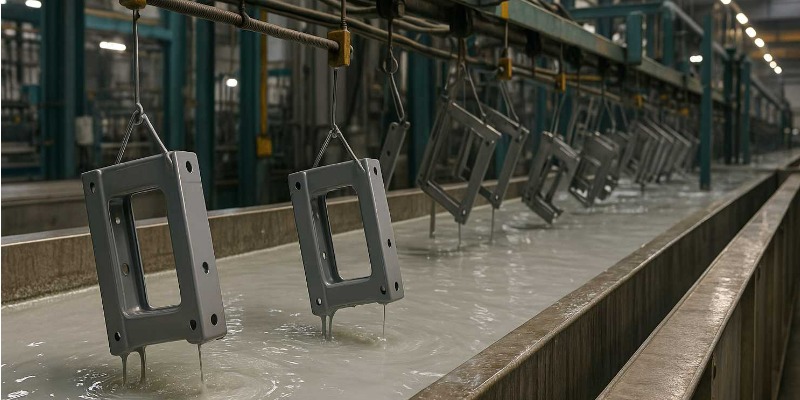
Metal parts are immersed in a tank containing a water-based paint. The application of a direct current causes negatively charged paint particles to migrate toward the positively charged metal part. The result is a homogenous coating, even in recessed or hard-to-reach areas.
The sustainable version of this process retains its core chemical and physical principles but introduces significant environmental improvements. It begins with the use of water-based paints formulated to contain little to no volatile organic compounds (VOCs) and to be free from heavy metals. It also includes closed-loop systems for recovering unused paint.
Additionally, energy consumption cycles are optimized, and wastewater management adheres to stricter criteria, reducing environmental impact and enhancing overall plant efficiency.
How the Process Works: From Electrodes to Polymerization
A sustainable cataphoresis facility involves several integrated stages. After an essential pre-treatment phase to remove contaminants and promote adhesion, metal parts are immersed in the cataphoresis bath. Direct current triggers the electrostatic migration of paint, which deposits evenly on the surface of the metal.
Once this step is complete, the part is rinsed to remove excess material and baked (typically at 160 to 200 °C) to complete the film’s polymerization. The result is a continuous, elastic, thin, yet highly resistant coating capable of withstanding harsh environments, impacts, abrasion, and chemical exposure.
In its sustainable form, all this is achieved with reduced environmental impact: energy use is optimized, emissions are close to zero, and treatment sludge is minimized and easier to manage. Moreover, the system can be designed to maximize the reuse of materials and water, following circular economy principles.
Applications: Where Sustainable Cataphoresis Is Used
The potential applications for sustainable cataphoresis are numerous and growing. The automotive sector remains its largest user: frames, chassis, structural components, and small metal accessories are all treated with cataphoresis to ensure durability and corrosion resistance, especially in humid or salty environments. Often, cataphoresis is used as a primer, onto which aesthetic finishes are later applied.
The household appliance industry also frequently employs the process, for example, to protect internal components of ovens, washing machines, or boilers. Thanks to the chemical resistance of the coating, cataphoresis is ideal for high-humidity environments or those involving aggressive detergents.
Another interesting area is outdoor furniture, where the balance between aesthetic and protective properties is crucial. Metal structures in seating, tables, railings, or canopies benefit from the longevity offered by sustainable cataphoresis treatments.
Lastly, construction and mechanical engineering sectors use this technology to safeguard structural metal components that, once installed, are no longer accessible for regular maintenance.
Cutting-Edge Technology Serving the Environment
Adopting sustainable cataphoresis means making a forward-thinking choice for many companies. The benefits go beyond environmental considerations: they also include improved product quality, reduced maintenance costs, and the ability to offer technically advanced solutions that comply with European and international standards.
Moreover, environmentally certified production cycles enhance a company’s public image and open up access to new markets aligned with green economy values.
In conclusion, sustainable cataphoresis for metals offers the perfect blend of industrial efficiency and environmental responsibility. It provides a concrete response to the needs of modern industry, combining high performance, cost optimization, and ecosystem preservation. It is an old process, reimagined through a green lens, now looking to the future with intelligence and coherence.
© Reproduction Prohibited