- Introduction to metal 3D printing
- Stainless steel in additive manufacturing
- Aluminum and its alloys for lightweight components
- Titanium: performance and biocompatibility
- Nickel alloys: extreme resistance to high temperatures
- Copper and bronze: conductivity and special applications
- Metal-compatible 3D printing technologies
- Future prospects for metals in 3D printing
A journey through the most used metal alloys in 3D printing, their physical-mechanical properties, compatible technologies and the industrial sectors in which they find application
by Marco Arezio
In recent years, 3D printing has made a significant evolutionary leap, moving from an experimental technology to a mature industrial process, especially in the additive manufacturing of metal components.
The introduction of metals in 3D printing has radically transformed production possibilities in the aerospace, biomedical, automotive, and advanced manufacturing sectors. But what metals are actually used in 3D printing? What are their specific characteristics? And how do they differ in terms of performance and technological compatibility?
This article aims to provide a technical yet accessible analysis of the main metals used in 3D printing , illustrating their characteristics, advantages, limitations, and intended uses. This article is intended for university students, production engineers, designers, and industry professionals who want to fully understand the potential of metals in additive manufacturing.
Introduction to metal 3D printing
Unlike 3D printing with polymer materials, 3D printing with metals requires a more rigorous engineering approach due to the physical and thermal nature of the materials involved. The most common technologies for 3D printing metals include selective laser melting (SLM), powder bed melting (DMLS), electron beam melting (EBM), and direct energy deposition (DED).
All these technologies share a common requirement: starting from very fine metal powders, with precise characteristics of sphericity, particle size distribution, and purity. The choice of metal is closely linked to the final use of the piece, as each alloy has specific mechanical, thermal, and chemical properties.
Stainless steel in additive manufacturing
Stainless steel is one of the most versatile and widely used materials in metal 3D printing. The most common alloys are AISI 316L, AISI 304, and, in industrial applications, high-chromium and high-molybdenum alloys for specific applications.
This metal offers a good balance of corrosion resistance, machinability, and mechanical strength. It is particularly suitable for applications in the food, medical, chemical, and marine industries. Thanks to its toughness and dimensional stability, it is also used for the production of custom tools, heat exchangers, structural brackets, and fittings.
Stamped stainless steel parts can subsequently be subjected to heat treatments or mechanical finishes to improve their performance or surface aesthetics.
Aluminum and its alloys for lightweight components
Aluminum is another key player in 3D printing, thanks to its light weight, high specific strength, and good thermal conductivity. Commonly used alloys include AlSi10Mg and AlSi7Mg, which combine good mechanical properties with ease of printing.
These alloys are widely used in the aerospace and automotive industries, where weight reduction is a strategic priority. Furthermore, stamped aluminum can be anodized, polished, or painted, offering great flexibility in terms of aesthetics as well.
Another advantage of aluminum is its relative printing speed compared to denser metals, allowing for optimized cycle times in small to medium-scale production runs.
Titanium: performance and biocompatibility
Titanium and its alloys, particularly Ti6Al4V (grade 5), represent the gold standard for aerospace and biomedical applications. This metal is distinguished by its extremely high strength-to-weight ratio, excellent corrosion resistance, and certified biocompatibility.
In the medical sector, 3D-printed titanium is used for customized bone implants, dental prosthetics, and orthopedic devices, allowing for a perfect morphological fit for the patient. In the aerospace sector, however, it is preferred for structural components subjected to high mechanical stress and extreme thermal variations.
The main difficulty in 3D printing titanium lies in controlling residual stresses and managing oxidation, which is why the entire process takes place in an inert atmosphere, often argon.
Nickel alloys: extreme resistance to high temperatures
Nickel-based superalloys, such as Inconel 625 and Inconel 718, are essential for high-temperature applications, such as those in the power generation, aircraft, and racing automotive industries.
These materials maintain excellent mechanical properties even above 700°C, resisting thermal fatigue, oxidation, and extreme corrosive environments. Inconel 718, in particular, is widely used in the production of turbines, nozzles, exhaust ducts, and combustion chambers.
3D printing with nickel alloys is more complex than other metals due to its high hardness and tendency to develop internal stresses. However, it offers unparalleled advantages in terms of free design and topological optimization of components.
Copper and bronze: conductivity and special applications
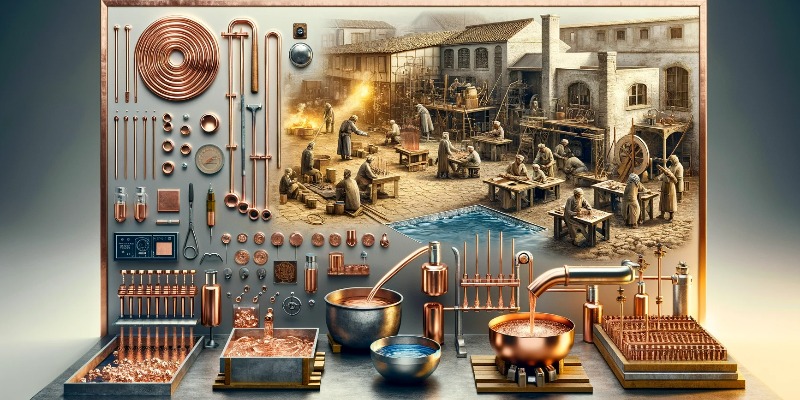
Pure copper, known for its high thermal and electrical conductivity, is becoming increasingly attractive in 3D printing, especially thanks to technological advances in electron beam melting (EBM) and DED. However, copper's reflectivity poses significant challenges in laser-based systems.
Key applications include the production of electric motor components, advanced cooling systems, heat sinks, and high-precision coils.
Bronze, an alloy of copper and tin, is used for more artistic or aesthetic applications, such as archaeological replicas, architectural elements, and jewelry, but also for bearings or bushings thanks to its good wear resistance.
Metal-compatible 3D printing technologies
In the field of additive manufacturing, talking about metals inevitably also means talking about technologies.
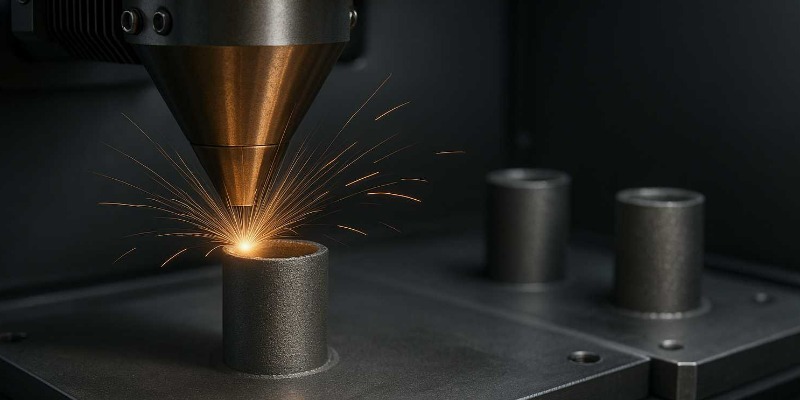
When working with metallic materials, the choice of technology isn't simply an operational issue, but a design decision that impacts the quality, time, cost, and final performance of the component. Each metal responds differently to heat, melting, sintering, deposition speed, and the geometry of the machined section. Therefore, each metal requires—or prefers—a specific technology.Among the most mature and widespread is SLM (Selective Laser Melting), a technique that has revolutionized the production of metal objects with complex geometries. In SLM, a very fine metal powder is spread in thin layers, while a high-power laser selectively melts the material according to a CAD design. The process takes place in a controlled, almost always inert, atmosphere to protect the metal from oxidation. The quality of parts produced with SLM is remarkable: high density, excellent precision and finish, and good mechanical characteristics. It is the ideal technique for steel, titanium, aluminum, and some nickel alloys. However, it involves high operating costs, long print times for large volumes, and the need for support structures for protruding or suspended geometries.
Very closely related to SLM is DMLS (Direct Metal Laser Sintering), which is often confused with it. In reality, while SLM aims to completely melt the metal, DMLS works by sintering, that is, bringing the metal particles to a temperature that makes them bond, but not completely melt. The result is similar, but the process is gentler and less energy-intensive, especially suitable for complex alloys or those sensitive to temperature variations. Here too, the environment is inert, and the work is done layer by layer. DMLS offers greater control over residual stresses and microstructures, at the expense—sometimes—of a slight reduction in mechanical properties.
Another highly interesting technology is EBM (Electron Beam Melting), which uses a high-energy electron beam, instead of a laser, to melt metal powder. This takes place in a vacuum chamber, where the total absence of oxygen allows for the processing of highly reactive metals, such as titanium or copper, without oxidation. EBM ensures deep fusion, solid adhesion between layers, and a homogeneous crystalline structure, but at the same time, it results in slightly lower geometric resolution than SLM and rougher surfaces, requiring post-processing. It is a highly popular technology in the aerospace and biomedical sectors, especially for components that must operate under extreme conditions or require high biomechanical performance.
DED (Direct Energy Deposition) is a category apart. Instead of a powder bed, a nozzle feeds metal material (in the form of powder or wire) directly to the point where it is melted by an energy source, usually a laser, electron beam, or plasma. The material is deposited and melted instantly, allowing the creation or repair of components directly on the surface of an existing object. This technique is very useful for remanufacturing, hybrid construction, and large parts where other additive technologies would not be viable. However, it has lower resolution, rougher surfaces, and almost always requires subsequent CNC machining to bring the part into tolerance.
Alongside these established technologies, alternative solutions are emerging, such as Binder Jetting, which represents an interesting synthesis of 3D printing and powder metallurgy. In this process, a layer of metal powder is bonded together with a liquid adhesive that acts as a temporary glue. Once printing is complete, the "green part" is sintered in a furnace, where the binder evaporates and the metal particles fuse together. This technology offers great promise in terms of speed and cost, as it allows for the simultaneous printing of many parts without supports, but it requires extremely careful control of the sintering process, as the risk of warping or porosity is high.
Finally, cold technologies deserve a mention, such as Cold Spray , a technique in which metal particles are accelerated to supersonic speeds and projected against a surface, where they deform plastically and become anchored by impact. There is no melting or heat involved. This allows the properties of the starting material to be preserved, avoiding oxidation or microstructural changes. Cold Spray is particularly useful for localized repairs or functional coatings, but is not suitable for producing complex geometries.
All these technologies should not be viewed as competing, but as complementary tools. Each has its strengths, and their combined use—as is increasingly happening in digital workshops—allows us to get the best out of every material and every project. The future will most likely not be dominated by a single technology, but by an integrated ecosystem where additive and subtractive manufacturing coexist, supported by artificial intelligence, FEM simulations, real-time quality control, and topological optimization software. Metal 3D printing today is a frontier that requires knowledge and flexibility. And precisely for this reason, it represents one of the most fascinating challenges of modern engineering.
Future prospects for metals in 3D printing
Metal additive manufacturing is rapidly expanding thanks to improvements in powder quality, print speed, and process repeatability. The coming years will see increased use of multimaterials, metal nanopowders, and hybrid systems capable of combining multiple alloys in a single part.
Furthermore, the integration of AI systems for real-time quality control and advanced simulation of internal stresses promises to reduce waste and increase precision.
The biomedical sector will continue to drive the adoption of titanium and biocompatibles, while aerospace and energy will drive the use of superalloys and refractory materials.
Conclusion
Understanding the characteristics of metals in 3D printing means mastering one of the most advanced frontiers of industrial production. Today, choosing the right metal is no longer a matter of availability but of design strategy. Metal 3D printing is more than just a technology: it's a new production language that speaks the language of geometric freedom, structural efficiency, and sustainable innovation.
© Reproduction Prohibited