- The formulation nature of PVC: why it is different from other polymers
- Recycled PVC: material memory and industrial implications
- Why recycled PVC shouldn't behave like virgin PVC
- Quality of recycled PVC: a multidimensional variable
- From waste to raw material: the paradigm shift in PVC recycling
- Origin of waste and traceability: the true starting point of quality
- Formulation and processing in recycled PVC: an integrated system
- Production stability and process control in recycled PVC
- Managing variability: from criticality to competitive factor
- Global market, industrial sustainability and long-term vision of recycled PVC
A guide to mechanical PVC recycling: material quality, formulations, processing, defects, products, market, and production stability
Technical Manual. Recycled PVC – Technical Manual - Introduction
Recycled PVC as a complex and manageable industrial material
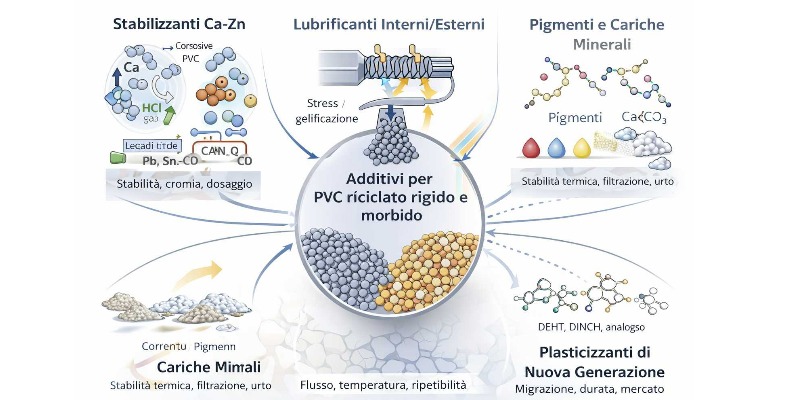
Polyvinyl chloride is unique in the landscape of industrial polymeric materials. This is not only due to its widespread use in a wide variety of sectors—construction, infrastructure, electrical engineering, packaging, medical, and automotive—but above all due to its intrinsically formulated nature. Unlike polymers like polyethylene or polypropylene, in which the resin is almost exclusively the linchpin of performance, PVC exists industrially as a complex system, in which the polymer chain is merely the starting point of a more complex equilibrium. Stabilizers, plasticizers, lubricants, fillers, impact modifiers, and pigments are not accessories, but structural elements that determine the material's behavior, transformability, and durability.
This characteristic, often considered a complication, is actually the reason why PVC lends itself particularly well to mechanical recycling. Recycled PVC is not a simple "regenerated resin," but a layered industrial material, incorporating into its chemical and physical structure the history of previous applications, the thermal cycles it has undergone, and the formulations used throughout its useful life. Each recycled PVC stream carries with it a technical memory that, if properly interpreted, can be managed and valorized.
In today's industrial context, recycled PVC can no longer be treated as a secondary material destined for residual uses. Advances in sorting, washing, compounding, and extrusion technologies have made it possible to obtain granules with levels of stability and repeatability compatible with advanced technical applications. However, this possibility is not automatic. It requires a conscious design approach that recognizes the material's complexity and transforms it into a controllable system. Where this awareness is lacking, recycled PVC becomes unpredictable; where it is present, it becomes a competitive industrial resource.
One of the most common misconceptions in the industry is the idea that recycled PVC must "behave like virgin." This assumption, besides being technically unfounded, is often the main cause of production failures. Recycled PVC is not a direct substitute for virgin PVC, but a material with its own technical identity, requiring different evaluation criteria. Expecting it to meet the same parameters without adapting the formulation and process ignores the very nature of the material.

The quality of recycled PVC is not an absolute attribute, but the result of a chain of coherent decisions.
Waste origin, degree of contamination, type of legacy additives, regeneration method, thermal stabilization, and processing window: each factor plays a decisive role in the final result. In this sense, recycled PVC cannot be judged with simplified or reductive parameters. It requires a multidimensional analysis that takes into account the intended use, processing conditions, and required performance over time.This manual begins with a clear premise: recycled PVC is a manageable industrial material, not an uncontrollable variable. But manageability isn't a given; it's a goal to be achieved. It's achieved through technical knowledge, process experience, and the ability to interpret the signals the material emits during processing. PVC, more than other polymers, clearly communicates its conditions: chromatic variations, thermal instabilities, surface defects, and dimensional anomalies are not random events, but manifestations of altered equilibrium.