- Rigid PVC: polymer structure, stability and mechanical behavior
- Industrial applications of rigid PVC in construction, infrastructure, and technical components
- Functional limits of rigid PVC: impact, temperature and durability over time
- Recycled rigid PVC: material variability and process criticalities
- Plasticized PVC: role of plasticizers and modulation of properties
- Classes of plasticizers in PVC: technical evolution and regulatory constraints
- Recycling of plasticized PVC: migration of plasticizers and residual performance
- PVC copolymers: structural modifications and application advantages
- PVC-based blend: polymer compatibility and performance management
- Compatibility between virgin and recycled PVC: technical criteria, limits and industrial strategies
From the differences between rigid and plasticized PVC to copolymers and blends: properties, application limits and compatibility between virgin and recycled PVC
Recycled PVC – Technical Manual - Chapter 3: Types of PVC. Technical characteristics, formulations, and industrial implications
Rigid PVC is one of the most emblematic industrial applications of polyvinyl chloride, not only for its vast range of applications but also for the structural role it plays in numerous key sectors. Unlike plasticized PVC, rigid PVC is designed as a material with high dimensional stability, defined mechanical behavior, and predictable long-term performance. This nature makes it particularly suitable for applications where strength, durability, and geometric precision are essential.
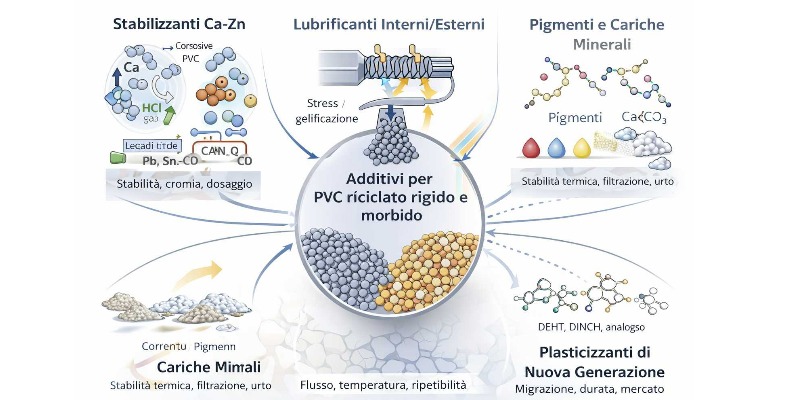
From a chemical and structural standpoint, rigid PVC is characterized by a relatively rigid polymer chain, in which the absence of plasticizers allows for a high elastic modulus and good resistance to deformation. However, this intrinsic rigidity is never the result of the resin alone, but of a carefully designed formulation balance. Thermal stabilizers, lubricants, fillers, and impact modifiers play a key role in making the material processable and suitable for the intended applications.
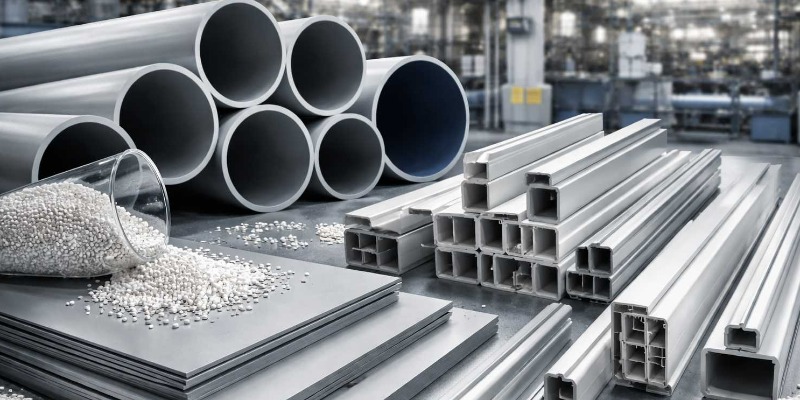
In the industrial sector, rigid PVC is used in a wide range of products: pipes for water and sewer systems, profiles for windows and doors and construction, sheets, ducts, technical containers, and components for construction and industry. In all these applications, the material must guarantee consistent performance over time, often in harsh environmental conditions. Rigid PVC's chemical resistance, combined with its resistance to corrosion and good weatherability, contributes significantly to this reliability.
One of the most important aspects of rigid PVC is its industrial processability. The material lends itself effectively to processes such as extrusion and injection molding, enabling the production of complex products with high precision. However, this processability should not be taken for granted, especially when entering the field of recycled rigid PVC. The process window for rigid PVC is relatively narrow and requires careful control of thermal and rheological parameters. Small deviations can result in noticeable defects, such as dimensional instability, burning, or fragility of the finished product.

From a mechanical standpoint, rigid PVC offers a good compromise between strength and weight, but it has well-defined limitations.
Impact resistance, for example, is intrinsically lower than that of other technical polymers, unless specific formulations are applied. This aspect is particularly important in recycling, where the material's thermal history can increase fragility if not adequately compensated. Understanding these limitations is essential to avoid improper applications that could compromise the product's safety or durability.Another structural limitation of rigid PVC concerns its behavior at low temperatures. The material tends to become more brittle as temperatures decrease, a phenomenon that must be carefully considered when designing products intended to operate in cold environments. Here too, the formulation plays a key role, but it cannot completely eliminate the polymer's intrinsic characteristics. In the context of recycling, these limitations can be amplified by the presence of already degraded material or by an uneven distribution of additives.