- Thermal stabilization in recycled PVC: why it is a design phase and not an addition
- Dehydrochlorination and residual stability: degradation mechanisms and early signals
- Legacy stabilizer residues: synergies and antagonisms with new additive packages
- Overstabilization of recycled PVC: effects on rheology, gelation and process defects
- Compatibilizers in recycled PVC: internal cohesion, microphases and mechanical resistance
- Real vs. Perceived Compatibilization: How to Avoid Short-Term “Cosmetic” Improvements
- Compatibilizers and formulation interactions: impacts on stabilizers, lubricants and plasticizers
- Granulation filtration: mesh and pressure drop between efficiency and risk of degradation
- Sandblasting and regeneration of filter surfaces: operational continuity and process stability
- Granule quality control and industrial standards: repeatability, color, viscosity and traceability
How to stabilize and granulate recycled PVC: choosing additives, controlling impurities, and quality criteria for stable, marketable granules
Recycled PVC – Technical Manual - Chapter 9: Granulation and Stabilization of Recycled PVC
Thermal stabilization additives
For recycled PVC, thermal stabilization is not an ancillary operation or a simple adaptation of the practices used for virgin material. Rather, it is a key design phase, which determines whether the material can undergo a new industrial life in a stable, repeatable, and technically reliable manner. Unlike virgin PVC, which arrives for processing with a defined and consistent stabilizing system, recycled PVC exhibits a "residual" stability, often uneven and difficult to predict, resulting from its history of use, processing, and exposure to thermal and environmental stress.
The concept of stability in recycled PVC must therefore be reformulated. It's not about restoring an original, now unattainable, condition, but rather designing a new stability compatible with the actual state of the material. This approach requires a thorough understanding of PVC degradation mechanisms and the role stabilization additives can play in an already partially compromised system. The most common mistake is to apply stabilization schemes designed for virgin PVC to a material that has already consumed a significant portion of its "chemical capital."
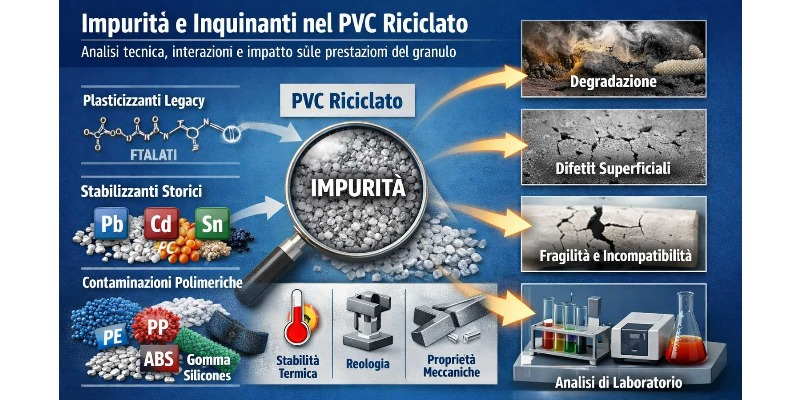
In PVC, thermal degradation is primarily associated with dehydrochlorination, an autocatalytic process that leads to the formation of polyene sequences and the progressive loss of mechanical and color properties. In recycled material, this process may already be underway, although not always clearly. The presence of residues of historical stabilizers, often in unknown quantities, further complicates the situation. These residues can interact with new additives introduced during the granulation phase, generating synergistic or antagonistic effects that are difficult to predict.
From an industrial perspective, the choice of thermal stabilization additives in recycled PVC must begin with a realistic assessment of the material's residual stability. There is no "standard level" of stabilization that applies to all streams. Materials from long-term, rigid applications present different challenges than plasticized PVCs used in dynamic environments. Even within the same application category, variability can be significant. This makes a flexible and adaptive approach to stabilization essential.

A key aspect is balancing thermal protection and process stress.
Adding stabilizers in large quantities may seem like an intuitive solution to compensate for the fragility of recycled material, but in industrial practice this strategy is often counterproductive. Excess stabilizers can alter the rheology of the melt, negatively impact gelation, and create compatibility issues with other additives or the material itself. In recycled PVC, over-stabilization is one of the most common and least immediately recognizable errors.Effective stabilization is achieved by supporting the material throughout the granulation process and subsequent processing stages, without introducing additional rigidity or instability. This requires a homogeneous distribution of additives and their consistent integration into the polymer system. In recycling, where heterogeneity is the norm, achieving this homogeneity is a technical challenge that involves not only the choice of additives, but also the process conditions and the quality of the mixing.