- PVC as an infrastructure material in contemporary industry
- Formulational versatility and adaptability of PVC in industrial processes
- Reliability, durability and long-term economic value of PVC
- Integration of PVC into global production chains
- Why recycle PVC: economic rationale and risk management
- Environmental impacts of PVC recycling throughout the life cycle
- The role of European legislation in PVC recycling
- Technological evolution of rigid PVC recycling
- Recycling of plasticized PVC: critical issues and industrial solutions
- The second life of PVC as a circular industrial strategy
Industrial role of PVC, economic and regulatory reasons for recycling, technological evolution and the concept of the material's second life
Recycled PVC – Technical Manual - Chapter 1: PVC between modern industry and recycling: from infrastructure material to circular resource
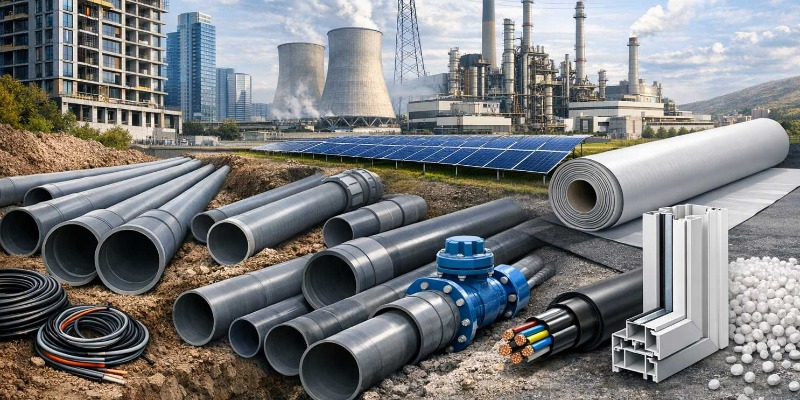
Polyvinyl chloride occupies a structural position in modern industry that goes far beyond its simple classification as a consumer polymer. PVC is, in every sense of the word, an infrastructure material: it supports networks, buildings, energy systems, industrial equipment, and technical products intended for long life cycles and often harsh operating conditions. This load-bearing function does not arise from a single distinctive property, but from the unique combination of formulation versatility, chemical stability, and adaptability to industrial processes.
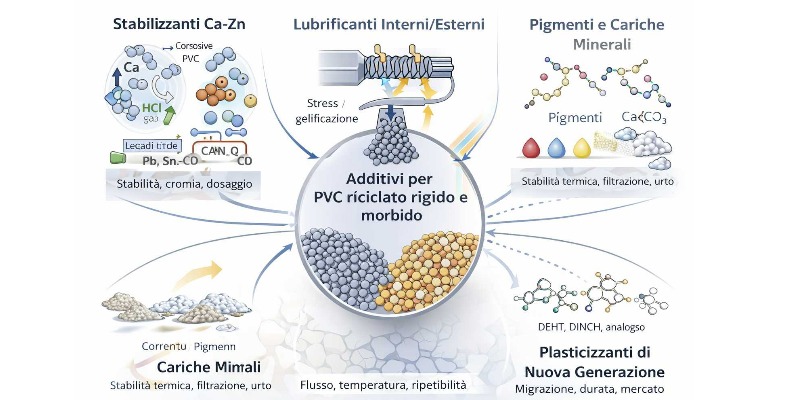
Over the past few decades, PVC has established itself as one of the few polymers capable of covering an extremely broad range of applications, moving from rigid materials with high structural performance to flexible, resistant, and durable plasticized systems. This continuity of application is not a coincidence, but the result of a profound integration between the material's chemistry and processing technology. PVC was never conceived as a "universal" material in the passive sense of the term; on the contrary, it is a material designed, adapted, and optimized to meet the specific needs of the sectors in which it is used.
From an industrial perspective, PVC has represented a particularly effective technical solution for meeting three fundamental needs: long-term reliability, overall cost-effectiveness, and compatibility with highly efficient production processes. In applications such as pipes, profiles, cables, membranes, and technical components, the ability to guarantee consistent performance over decades has made PVC a benchmark that is difficult to replace. This reliability is the result of a balanced formulation that allows for the modulation of rigidity, impact resistance, thermal behavior, and response to chemical agents.
An often overlooked aspect of PVC's role in modern industry is its ability to integrate into complex production chains without requiring radically dedicated infrastructure. PVC is compatible with established technologies such as extrusion, calendering, injection molding, and blow molding, and can be processed with systems designed for continuous and repeatable operation. This compatibility has significantly contributed to its global diffusion, making it accessible not only to large industrial groups but also to a widespread network of specialized processors.
From an economic standpoint, PVC has always struck a balance between raw material cost and finished product value. Unlike more expensive technical polymers, PVC allows for high performance with a relatively low investment, especially when the overall cost is evaluated over the product's entire life cycle. This is particularly important in sectors such as construction and infrastructure, where durability and low maintenance are crucial.

PVC's centrality in modern industry is also reflected in its ability to adapt to regulatory changes and new market demands.
Over time, the material has undergone profound transformations, both in terms of the additives used and its safety and environmental specifications. This evolution has not compromised PVC's role, but has strengthened its position as a technically mature material, capable of renewing itself without losing its industrial consistency.Another factor contributing to PVC's strategic role is its nature as an "engineerable" material. Formulation isn't just a secondary step, but a true design process that allows the material to be adapted to a wide range of application contexts. This characteristic makes PVC particularly suitable for integration into complex systems, where the material must meet multiple and sometimes conflicting requirements, such as mechanical strength, flexibility, dimensional stability, and fire behavior.....