- Stabilizing Recycled PVC: Why We Never Start from Scratch
- Ca-Zn stabilizers in recycled PVC: mechanisms, “repair” limits and process window
- Interactions with legacy additives (lead, tin, cadmium): effects on stability and chromaticity
- Ca-Zn in recycled rigid PVC: trade-off between extrusion stability and mechanical performance
- Ca-Zn in recycled plasticized PVC: compatibility with heterogeneous plasticizers, migration and odors
- Internal and external lubricants: stress control, gelation and repeatability in recycled materials
- Over- and under-lubrication in recycled PVC: symptoms, side effects, and diagnosis
- Pigments and color correctors in recycled PVC: standardizing without “masking” instability
- Mineral fillers (CaCO₃, talc, gypsum): impacts on rheology, filtration, impact and durability
- New generation plasticizers (DEHT, DINCH and similar): rebalancing of recycled content, migration and market value
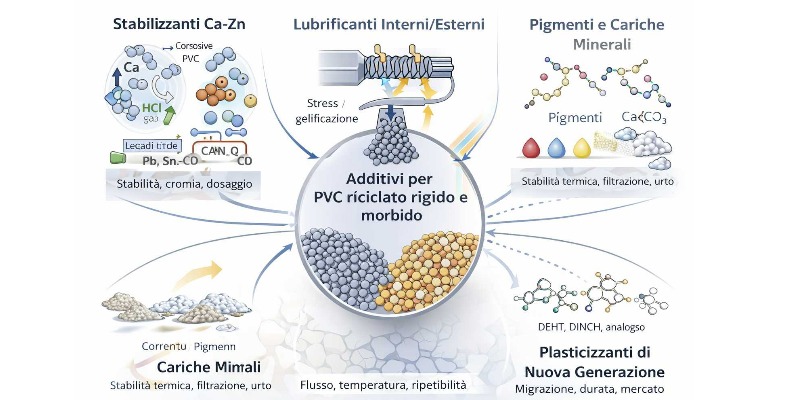
Ca-Zn stabilizers, internal/external lubricants, pigments and fillers, DEHT/DINCH plasticizers
Recycled PVC – Technical Manual - Chapter 10: Additives for rigid and soft recycled PVC: stability, processability and variability control
Ca-Zn stabilizers in recycled PVC
Among additives for recycled PVC, calcium-zinc stabilization systems are now almost mandatory from a regulatory perspective, but not necessarily a simple choice from a technical standpoint. In virgin material, Ca-Zn stabilizers have gradually replaced historical heavy metal-based systems following a relatively linear path. In recycled PVC, however, their use occurs in a much more complex context, in which the polymer matrix is not "neutral" but carries with it a chemical history that profoundly influences the effectiveness and behavior of any new stabilizing system.
The first conceptual error to avoid is considering Ca-Zn stabilizers as a simple functional equivalent of traditional systems. In recycled PVC, stabilization never starts from scratch. The material almost always contains residues of legacy stabilizers, often unidentifiable, which may still be partially active or, conversely, transformed into degradation byproducts. The introduction of a Ca-Zn system therefore disrupts an existing chemical equilibrium, which can react unpredictably if not correctly interpreted.
From a chemical standpoint, Ca-Zn systems operate according to mechanisms that prioritize the neutralization of hydrochloric acid released during PVC degradation and the protection of polymer chains from the initiation of autocatalytic processes. In recycled materials, however, some of these processes may already be underway or have been triggered in the past. This means that the Ca-Zn stabilizer not only works in a preventative manner, but also in a sort of "reparative" mode, with obvious limitations compared to its actual capabilities.
One of the most delicate aspects of using Ca-Zn in recycled PVC concerns their interaction with residual lead, tin, or cadmium-based stabilizers. Even when these additives are no longer present in their active form, their byproducts can influence the response of the Ca-Zn system, modifying its effectiveness or altering the material's color behavior. This explains many of the color and stability variations observed in apparently similar batches of recycled PVC.

From an industrial perspective, formulating a Ca-Zn system in recycled materials requires a less "dosimetric" and more "systemic" approach.
Simply increasing or decreasing the dosage is not enough to achieve the desired effect. It is necessary to evaluate how the Ca-Zn system interacts with the material's viscosity, its thermal history, and other additives in the formulation. In many cases, excessive dosage does not improve stability, but introduces rigidity into the process, worsening processability and increasing sensitivity to operational variations.A particularly critical issue is the balance between thermal stability and rheological behavior. Ca-Zn systems, especially in recycled PVC, can influence the material's melting and gelation more significantly than traditional systems. Apparently effective thermal stabilization can result in uneven melting or a narrower processing window. This effect is often underestimated in the early stages of formulation development and only becomes apparent in continuous production....