Legacy plasticizers in recycled PVC: origin, persistence, and technical issues
- Effects of historical plasticizers on the rheology and mechanical behavior of PVC
- Residual migration and inhomogeneity of plasticizers in post-consumer flows
- Historical stabilizers in PVC: lead, cadmium and tin in recycled materials
- Interactions between legacy stabilizers and modern stabilization systems
- Polymer contamination in recycled PVC: PE and PP as instability factors
- ABS, rubbers and silicones: critical contaminants and structural incompatibilities
- Physical impurities in recycled PVC: dust, paper and cellulose fibres
- Metals and organic residues: process risks and impacts on granule quality
- Cumulative effects of impurities on the final properties and industrial repeatability of recycled PVC
Plasticizers, stabilizers and polymeric contamination: how impurities affect the stability, rheology and industrial quality of recycled PVC
Technical Manual: Recycled PVC – Technical Manual – Chapter 5: Impurities and contaminants in recycled PVC: technical analysis, interactions and impact on granule performance
Plasticizers from legacy additives and historical stabilizers
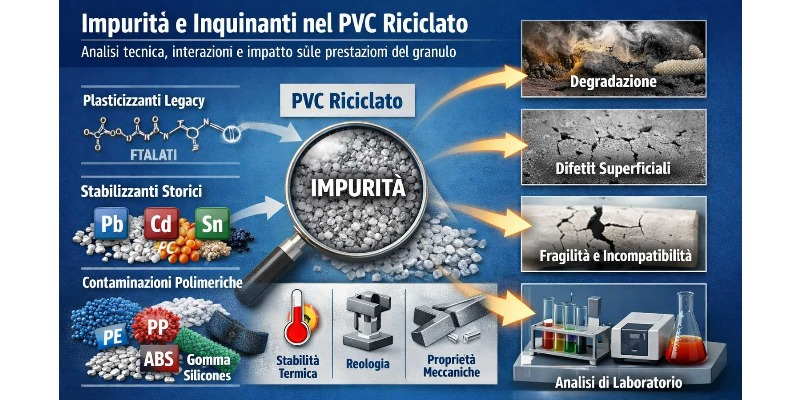
The analysis of impurities and contaminants in recycled PVC requires a shift in perspective compared to the traditional evaluation of virgin raw material. In recycling, the material is never a tabula rasa; rather, it carries with it a chemical and industrial memory that manifests itself through the presence of additives introduced during its first life. Among these, legacy plasticizers and historical stabilizers represent one of the most critical categories, not so much because of their mere presence, but because of the complex and often indirect effects they exert on the behavior of the regenerated material.
Legacy plasticizers, particularly those belonging to the family of phthalates historically used in plasticized PVC, are a frequent component in post-consumer PVC streams. These additives, introduced to provide flexibility and processability to the material, are characterized by good compatibility with the polymer matrix, a feature that favored their extensive use for decades. However, it is precisely this compatibility that makes their removal extremely difficult during recycling. Once incorporated into PVC, legacy plasticizers tend to remain present even after multiple processing cycles, influencing the behavior of the regenerated material in ways that are not always predictable.
From a technical standpoint, the presence of legacy plasticizers in recycled PVC results in modifications to the rheological and mechanical properties of the material. Even when the residual content is relatively low, the effect on the glass transition temperature and melt viscosity can be significant. This is particularly relevant when recycled PVC is intended for rigid or semi-rigid applications, where unwanted flexibility can compromise dimensional stability and the mechanical strength of the finished product.
Industrial operators must therefore consider the presence of legacy plasticizers not as a simple compositional parameter, but as a factor that alters the overall balance of the system.Another critical aspect is residual plasticizer migration. In materials that have already undergone a complete life cycle, part of the original plasticizer may have migrated or degraded, leaving a non-uniform residual content. This heterogeneity is reflected in the behavior of the recycled material, which may exhibit local variations in flexibility and mechanical response. During processing, such variations can translate into surface defects, process instability, and difficulties in controlling dimensional tolerances.
Alongside legacy plasticizers, historical stabilizers represent another category of additives of major technical relevance in PVC recycling. For many years, lead-, cadmium- and tin-based compounds were used as effective thermal stabilizers, capable of protecting PVC from degradation during processing and use. These stabilizers made a significant contribution to the durability of PVC products, but their presence in recycled streams now introduces a series of technical and industrial complexities.
From the standpoint of material behavior, historical stabilizers can significantly influence the residual thermal stability of recycled PVC. In some cases, the presence of lead- or tin-based stabilizers can confer an apparently higher resistance to degradation than expected. This effect, however, should not be interpreted as an indiscriminate advantage. The combination of legacy stabilizers with modern stabilization systems can generate non-linear interactions, reducing the overall effectiveness of the stabilizing package and making the material’s behavior less predictable....