- Gels in recycled polymer films: structural causes and process limitations
- Holes and micro-holes: film discontinuity and functional implications
- Black spots and carbonized inclusions: thermal degradation and contamination
- Odors in recycled films: chemical origin and application impact
- Process instability and burns: signs of material-system imbalance
- Bubble collapse and thickness fluctuations in recycled extrusion
- Sealing defects in bags: resistance, fragility and delamination
- Preventive approach to recycled film defects: diagnosis and industrial design
Gels, black spots, odors, process instability, and sealing defects in flexible recycled plastic packaging
Technical Manual. Recycled Plastic Film. Chapter 16: Film Defects Made of Recycled Polymers. Technical Analysis and Industrial Solutions
Gels, holes and black spots in recycled polymer films
In flexible packaging made from recycled polymers, visual and structural defects in the film represent a major source of waste, complaints, and loss of market confidence. Gels, holes, and black spots are different manifestations of a common problem: the difficulty of transforming a heterogeneous material with a long history into a continuous, thin, and reliable film. Understanding the nature of these defects means going beyond their superficial appearance and analyzing the profound interaction between raw materials, process, and operating conditions.
Unlike virgin polymers, where defects are often traced to out-of-spec process parameters, in recycled polymers they represent the visible emergence of an intrinsic complexity. The temptation to treat these defects as occasional anomalies often leads to ineffective or temporary solutions. A mature industrial approach instead requires interpreting them as diagnostic indicators of the state of the material and the process.
Gel: origin and industrial significance
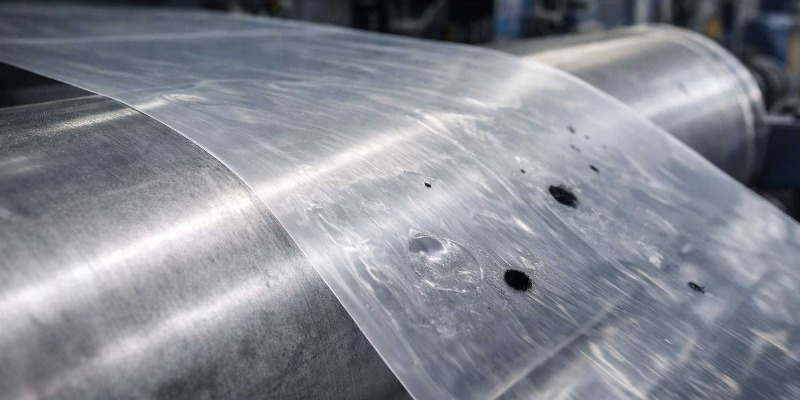
Gels in recycled films appear as more or less transparent inclusions, often perceptible to the touch as localized thickenings. Structurally, a gel is the result of incomplete melting or localized cross-linking of the polymer. In recycled materials, this condition is favored by the presence of fractions with different thermal and rheological histories.
Gel is not simply an "unmelted piece," but the expression of a molecular inhomogeneity that the process has failed to level. It may arise from residues of severely degraded polymer, materials with a higher melting point than the matrix, or incompatible polymer contaminants. In all cases, gel indicates a limitation in the extrusion system's ability to homogenize the material.

From a functional standpoint, gel represents a weak point in the film.
Even when it doesn't immediately generate a hole, it locally alters the stress distribution and can trigger fracture under stress. In thin films, even the sporadic presence of gel can compromise the overall quality of the product.Holes: manifestation of structural discontinuities
Pinholes, or micro-holes, are one of the most critical defects in recycled films, especially in applications requiring surface continuity and mechanical strength. They can arise from various causes, but they share a common origin: a local discontinuity in the melt during film formation.