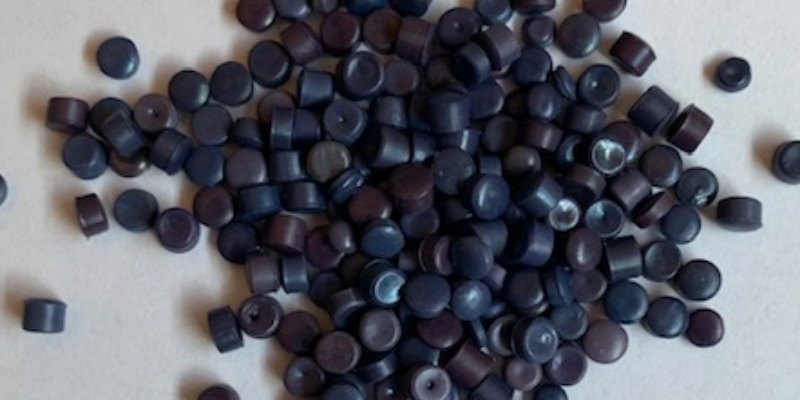
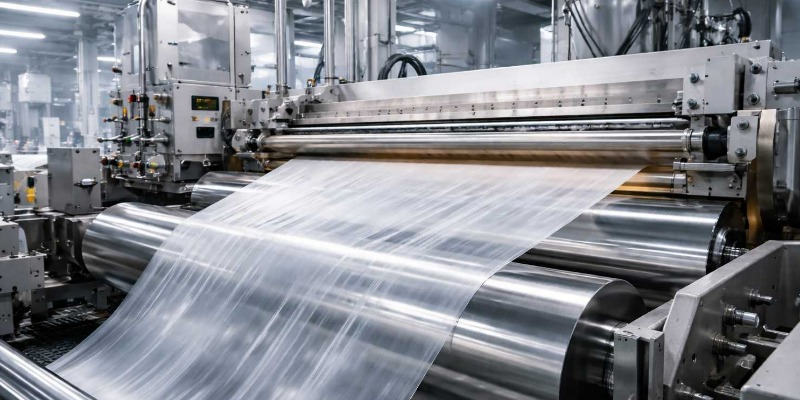
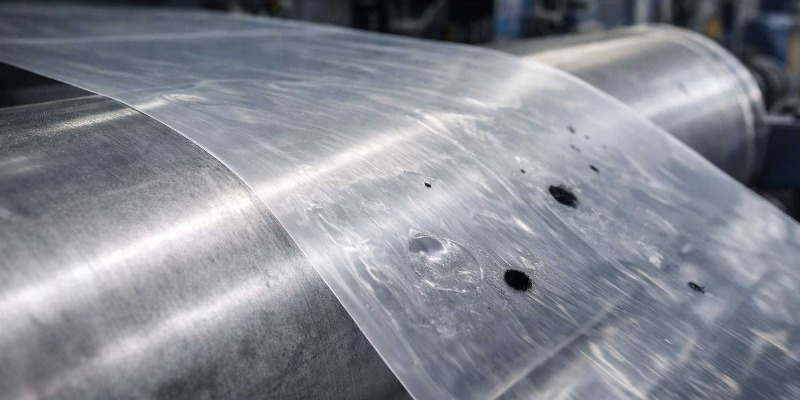
- Industrial evolution of flexible packaging made from recycled plastic
- From virgin to recycled polymer: a technical paradigm shift
- Recycled material variability and process implications
- Design of plastic film with recycled polymers
- Relationship between formulation, extrusion and film performance
- The bag as a test bed for recycled film
- Quality control and data interpretation in recycled materials
- Alignment between market, regulations and industrial feasibility
Advanced Guide to the Design, Processing and Quality Control of Films and Bags Made from Recycled Polymers, Between Regulation, Performance and Industrial Reality
This manual originates from an industrial observation even before an environmental one: the recycled plastic flexible packaging sector has entered a phase of forced maturity, in which it is no longer sufficient to declare a sustainable intention or to pursue symbolic percentages of recycled content. The technical complexity of materials, the tightening of regulations, market pressure and rising quality expectations have transformed films and bags made from recycled polymers into highly complex engineered products, requiring knowledge, method and awareness.
In recent years, the debate on plastics has often focused on a simplified opposition between “good” and “bad” materials, between virgin and recycled, between use and waste. While effective from a communication standpoint, this approach has proven inadequate from an industrial perspective. Flexible packaging is not an ideological object, but a technical system that must operate under real conditions: high line speeds, tight tolerances, stringent mechanical requirements, complex regulatory frameworks and precise cost expectations.
This manual was written to fill a clear gap in the technical landscape: the absence of a text that addresses, in a systematic, realistic and non-simplified manner, the entire value chain of recycled plastic films and bags, from pellets to finished products, integrating materials, processes, quality control and applications. It is neither a theoretical compendium nor an abstract regulatory guide, but a working tool for those who operate daily on machines, extrusion lines, quality laboratories and technical offices.
Flexible packaging made from recycled polymers requires a break from traditional logics based on virgin polymers. The material is no longer constant, the process is no longer strictly “replicable,” operating windows become narrower, and variability becomes a structural variable to be managed rather than an anomaly to be eliminated. In this context, technical knowledge can no longer be fragmented across departments or entrusted solely to empirical experience; it must be shared, codified and transferable.
This manual therefore aims to make complexity readable, not to conceal it. Each chapter is designed to guide the reader through the real logics of recycled material processing: the origins of material streams, intrinsic material limits, implications for film design, interactions between additives and polymers, and the consequences for sealing, winding and final performance. Nothing is treated as an isolated compartment, because in flexible packaging every technical choice has cascading effects across the entire production system.
Another motivation behind this manual is the growing gap between commercial narratives and industrial reality. The market demands films “with recycled content,” often without distinguishing between LDPE, LLDPE, HDPE or PP, and without considering rheological, mechanical and process-related implications. This misalignment generates unrealistic expectations, technical non-conformities and tensions along the value chain. The manual positions itself as a tool to realign what is technically feasible, economically sustainable and regulatory compliant.
The text is intended for those who must make operational and strategic decisions: production managers, process engineers, quality managers, formulation specialists, film and bag designers, as well as those operating in recycling who need to understand how their material will actually be used downstream. It is neither a popular science book nor an academic text; it is an industrial manual, written in the language of the workshop, the laboratory and the extrusion line.
Finally, this introductory chapter clarifies a fundamental point: flexible packaging made from recycled plastic is not a temporary or transitional solution. It is a structural choice, destined to become the standard in many market segments. Those who fail to develop the necessary competencies today risk being excluded from the competitive industrial landscape tomorrow. This manual was written to support this transition in a conscious, technical and non-ideological manner.
Who This Manual Is For and the Competence It Builds
This book was not conceived as a generalist text or as an introductory guide to recycled plastics. It is a document designed for an audience already operating within the flexible packaging value chain and dealing daily with the concrete challenges of industrial production. Its usefulness becomes fully apparent when the reader recognizes in its contents situations already experienced: bubble instability, batch-to-batch MFI variations, recurring defects not explainable by virgin-material logic, sealing difficulties or quality control issues.
The primary intended audience of this manual is the film and bag converter—not merely as a raw material user, but as a central technical actor tasked with transforming an intrinsically variable material into a reliable, repeatable and marketable finished product. For this professional profile, the manual provides an integrated interpretative framework linking the behavior of recycled pellets to film performance, overcoming the fragmented approach that improperly separates raw material, process and product.
Alongside converters, the manual directly addresses production and process managers, who are increasingly required to manage complex lines with narrow operating margins. In the recycled context, empirical experience alone is no longer sufficient: material variability demands a structured understanding of the root causes of defects. This text does not provide “universal recipes,” but conceptual tools to interpret phenomena, enabling faster and more informed decision-making under conditions of uncertainty.
Another key audience is quality managers, whose role changes radically when working with recycled polymers. With virgin materials, quality control often consists of conformity verification; with recycled materials, it becomes a continuous activity of data interpretation, risk assessment and technical dialogue with production and suppliers. The manual offers a coherent view of control parameters, explaining their real meaning in relation to the final use of films and bags, avoiding a purely formal reading of laboratory results.
The text is also intended for those operating upstream of transformation—namely recyclers, compounders and pellet suppliers. Understanding how the material will actually be extruded, sealed, wound and characterized is essential to producing industrially viable recycled material. The manual makes explicit the real expectations of converters, clarifying why certain variables, seemingly secondary during recycling, become critical in the production of thin films at high speeds.

Another often underestimated audience is technical sales staff and product project managers.
In recycled flexible packaging, sales can no longer be separated from technical understanding. Promising unrealistic performance or recycled content incompatible with the application creates downstream problems that affect the entire value chain. This manual provides the technical language and reference points necessary to build credible offers aligned with real industrial possibilities.From a training perspective, the manual does not merely transfer information but builds systemic competence. The goal is not to teach how to “make a single plant work,” but to develop a cross-functional reading ability that links material, process and final application. This competence is particularly valuable in a context where operating conditions change rapidly and standard solutions lose effectiveness.
A central aspect of the competence built by this manual is the conscious management of compromise. Flexible packaging made from recycled plastic is always the result of balances: between cost and performance, between recycled content percentage and process stability, between declared sustainability and actual reliability. The text does not propose ideal solutions, but helps the reader choose the compromise best suited to their industrial context, reducing the risk of technically fragile decisions.
The manual is also conceived as a tool for internal alignment within companies. In many organizations, production, quality, procurement and sales operate with different—and often conflicting—metrics and objectives. Recycled materials amplify these tensions by introducing variables that require collaboration and shared vision. A common reference text, based on rigorous technical language, becomes a useful foundation for more coherent collective decision-making.
Finally, the manual can be used as a basis for advanced training of new technical professionals. The flexible packaging sector is experiencing generational turnover during a period of strong technological transformation. Transmitting competencies related to recycled materials means preparing technicians capable of operating in a more complex industrial context than in the past. The manual provides a logical structure that enables understanding not only of “how” a film or bag is made, but “why” certain technical choices are necessary.
In summary, this text is intended for those who do not seek operational shortcuts, but tools to govern complexity. The competence it builds is not narrowly specialized, but integrated and cross-functional—and it is precisely this integration that represents the true added value in flexible packaging made from recycled polymers.
The Value of Technical Depth in Films and Bags Made from Recycled Polymers
Technical depth in films and bags made from recycled polymers is not an exercise in specialization for its own sake, but an industrial necessity arising from the structural transformation of the flexible packaging sector. Unlike the past, when film technology could be considered relatively stable and consolidated, the systematic introduction of recycled materials has reopened issues that once seemed definitively resolved, imposing a profound revision of operational knowledge.
Plastic film is one of the products most sensitive to raw material quality. Thin gauges, high line speeds, process-induced molecular orientation and seemingly simple mechanical requirements make film an extremely reactive system to material variations. In the case of recycled polymers, this sensitivity is amplified: the material’s thermal history, the presence of residues, molecular weight distribution and compositional heterogeneity translate directly into non-linear process behavior.
For this reason, technical depth in film cannot be limited to describing extrusion technologies or nominal material properties. It is necessary to understand how recycled material interacts with the very logic of film production: bubble or sheet formation, dimensional stability, cooling, orientation and response to mechanical stress. This manual dedicates specific attention to these aspects because it is precisely in these stages that recycled material reveals its true industrial nature.
The bag, often considered a “simple” product, is in reality the final proving ground of film quality. Sealing, cutting, in-use resistance and load behavior concentrate, within a few seconds, all the criticalities accumulated upstream. A film that appears acceptable on the roll may prove inadequate during packaging or final use. To deepen understanding of the bag therefore means analyzing film not as an intermediate product, but as a component of a complete functional system.
In the recycled context, the bag highlights compromises that can be masked when using virgin materials. Seal strength, weld stability, response to dynamic stresses and performance repeatability become key indicators of the true quality of both material and process. This manual addresses these aspects not in abstract terms, but as direct consequences of upstream choices in formulation, filtration and process management.
Technical depth in recycled films and bags also has strategic value for innovation. Many solutions currently adopted in the sector arise from attempts to adapt recycled materials to processes designed for virgin polymers. While understandable, this approach quickly reveals its limitations. Recycled materials often require a rethinking of structures, formulations and operating conditions. Without deep knowledge of film behavior mechanisms, this rethinking remains empirical and inefficient.
Another central element of technical depth concerns variability management. In recycled flexible packaging, variability is not an accidental defect, but an intrinsic system characteristic. The value of technical depth lies in the ability to transform this variability into a controllable variable through process and product design. Understanding how variations in MFI, density or composition affect film behavior allows problems to be anticipated rather than endured.
From an industrial standpoint, this level of understanding enables reductions in scrap, line stoppages and reprocessing, improving overall efficiency. Technical depth is therefore not a cost, but an investment that translates into production stability. In a context where operating margins are increasingly narrow, this stability represents a concrete competitive advantage.
Focused attention on films and bags is also essential to avoid excessive simplification of the sustainability concept. Recycled content is often assessed purely in percentage terms, without considering its real impact on performance and product lifespan. A technically inadequate film—even if rich in recycled content—can generate waste, breakages and customer dissatisfaction, undermining the declared environmental benefits. Technical depth is precisely what prevents this paradox.
Another value of technical depth lies in enabling more effective dialogue with end customers and distribution channels. In flexible packaging, market requests are often formulated in functional or regulatory terms, without full awareness of technical implications. A company that masters the mechanisms of recycled films and bags can propose alternative solutions, explain limitations and build relationships based on competence and transparency.
From a training perspective, technical depth contributes to building a stronger industrial culture. Flexible packaging with recycled materials cannot be managed solely through standardized procedures; it requires observation, interpretation and adaptation skills. This manual provides a coherent framework within which such skills can be developed, preventing experience from remaining isolated and non-transferable.
Finally, technical depth in recycled films and bags has a forward-looking value. The sector is set to evolve further, with the introduction of new recycling streams, new additives and new market requirements. Companies that invest in deep understanding of fundamental mechanisms will be better equipped to adapt to these changes without having to start from scratch each time.
This section of the manual therefore emphasizes that the value of technical knowledge does not lie in knowing individual solutions, but in understanding the relationships linking material, process and product. In flexible packaging made from recycled plastics, this ability represents the true enabling factor for sustainable and lasting industrial growth.
MANUAL TABLE OF CONTENTS
Introduction
SECTION I — INTRODUCTION AND INDUSTRIAL CONTEXT
Chapter 1 – Flexible Packaging in the Modern World
Chapter 2 – Circular Economy and European Regulations
SECTION II — RECYCLED POLYMERS
Chapter 3 – Recycled LDPE
Chapter 4 – Recycled LLDPE
Chapter 5 – Recycled HDPE
Chapter 6 – Recycled PP
Chapter 7 – Additives in Recycled Materials
Chapter 8 – Quality Control of Recycled Granules
SECTION III — PROCESSING TECHNOLOGIES
Chapter 9 – Blown Film Extrusion
Chapter 10 – Cast Film Extrusion
Chapter 11 – Dosing and Mixing Materials
Chapter 12 – Filtration and Deodorization
Chapter 13 – Cooling, Pulling, and Winding
SECTION IV — FILM AND BAG DESIGN
Chapter 14 – Single- and Multi-layer Structures
Chapter 15 – Production Recipes
Chapter 16 – Film Defects and Solutions
Chapter 17 – Film Characterization
SECTION V — APPLICATIONS AND MARKETS
Chapter 18 – Bag Types
Chapter 20 – Food Packaging with Recycled Materials
Chapter 21 – International Market
Conclusion
© Reproduction Prohibited