- Highly recycled content monolayer film: design principles and structural limitations
- Managing recycled polymer variability in film design
- Weldability and dimensional stability in recycled monolayers
- Multilayer structures with recycled materials: role of functional and barrier layers
- Rheological balance and interlayer adhesion in recycled multilayer films
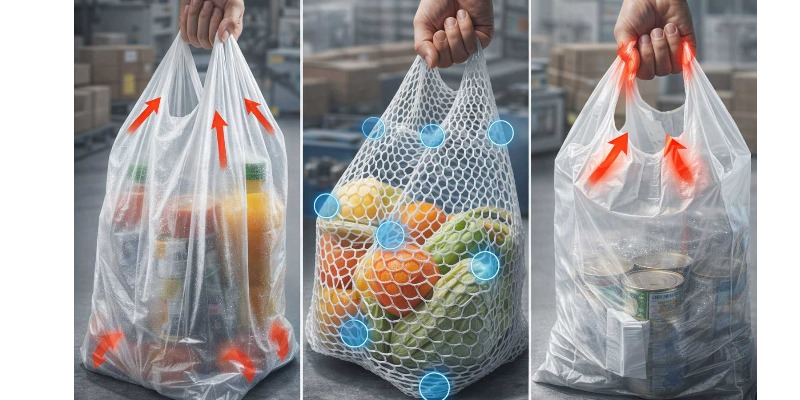
- Design layouts for recycled polymer shopping bags
- Structural layouts for industrial bags and films with high recycled content
- Integration between film structure, product layout and end-of-life in circular packaging
From managing recycled polymer variability to layouts for shopping bags, bags, and industrial films: an integrated approach combining performance, processability, and the circular economy
Technical Manual. Recycled Plastic Film. Chapter 14: Design of Single- and Multilayer Film with Recycled Polymers
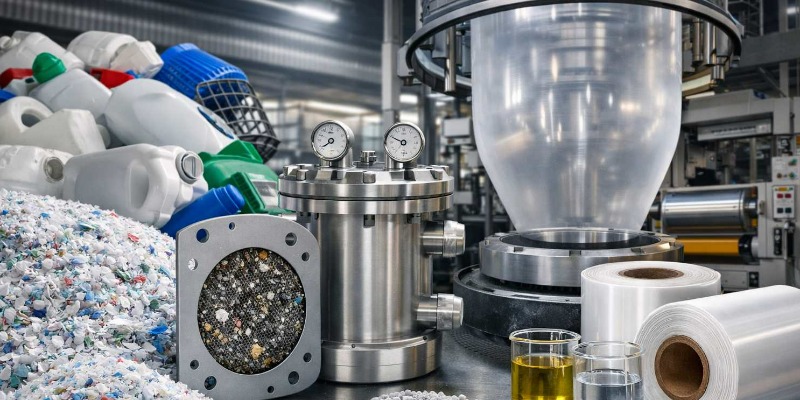
Designing monolayer films with a high recycled polymer content represents one of the most complex and, at the same time, strategic challenges in contemporary flexible packaging. By its very nature, monolayers concentrate all the film's functions in a single polymer mass: mechanical strength, sealability, dimensional stability, processability, and, in many cases, aesthetic quality. In virgin materials, this functional concentration is made possible by the consistency of the raw material. In recycled materials, however, monolayers become an advanced balancing act between the required performance and the material's structural limitations.
A monolayer film with a high recycled content cannot be designed as a simple replica of the virgin film with a percentage of replacement. This approach almost always leads to unstable results because it ignores the different nature of the recycled material. Recycled material is not a "weaker" polymer, but a material with a history, a broader molecular distribution, and intrinsic variability that must be incorporated into the design. In the monolayer, this variability cannot be "isolated" in a dedicated layer, but manifests itself directly in the final performance.
From a structural perspective, the first design criterion concerns the realistic definition of expected performance. In recycled monolayer films, the goal should not be to achieve the highest possible performance, but rather stability and repeatability of performance over time. A slightly less resistant but consistent film is more industrially viable than a nominally high-performance but unstable film. This paradigm shift is essential to understanding the role of monolayers in the context of the circular economy.
The high recycled content directly influences the mechanical response of the film. The presence of degraded polymer chains and low molecular weight fractions reduces the material's ability to absorb energy without breaking. In a monolayer, this reduced resilience translates into greater sensitivity to micro-defects and inclusions. Design must therefore take into account the statistical probability of defects, increasing the film's overall strength rather than pursuing extreme minimum thicknesses.
A crucial aspect concerns thickness distribution. In recycled single-layer films, even small variations in thickness have a significant impact on performance. Thinner areas become points of structural weakness, while thicker areas alter the overall mechanical response and processability. The design must therefore include a thickness range that is not only compatible with the process, but also offers sufficient tolerance for material variability.

Sealability is one of the most critical elements in monolayers with a high recycled content.
In recycled materials, the sealing window tends to be narrower and less predictable than in virgin materials. This phenomenon is related to the presence of contaminants, residual additives, and the uneven distribution of polymer fractions. A monolayer film designed without considering these aspects risks inconsistent sealing, with variable resistance along the line.From a design perspective, this requires favoring formulations that offer a more gradual thermal response, even at the cost of sacrificing extremely rapid welding. In recycled monolayers, weld consistency is often more important than welding speed, especially for applications like shopping bags and sacks, where functionality takes precedence over aesthetics....