- Origins of recycled HDPE and variability of post-consumer and industrial flows
- Molecular structure of HDPE and implications for recycling for flexible applications
- Typical pollutants in recycled HDPE and their impact on quality and processability
- High-fine filtration: technological role, operational limitations and industrial costs
- Modifiers for recycled HDPE: polymer compatibility and rheological control
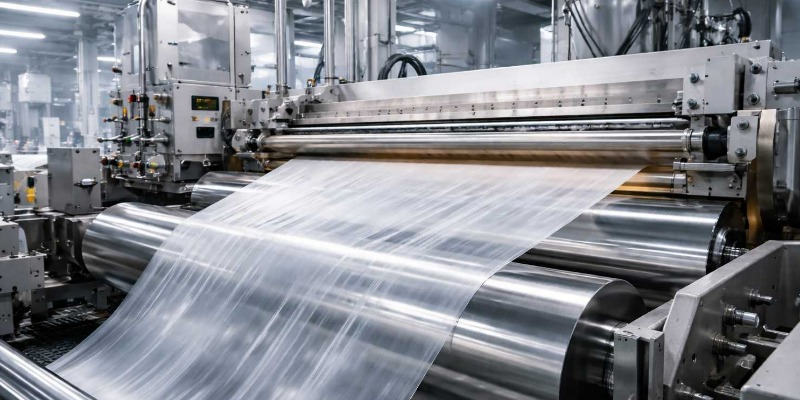
- Behavior of recycled HDPE in film extrusion: bubble stability and defects
- Typical defects of recycled HDPE film: process causes and application criticalities
From contamination to film design: filtration, modifiers, and the extrusion behavior of recycled HDPE
Manual. Recycled Plastic Film. Chapter 5: Recycled HDPE in Flexible Packaging. Origins, Process Critical Issues, and Industrial Strategies
High-density polyethylene (HDPE) occupies a distinct position within the landscape of polymers used in packaging, especially for rigid containers, bottles, canisters, and technical packaging. However, its role in the flexible packaging sector, while less evident than that of LDPE and LLDPE, is far from marginal.
In particular, recycled HDPE is used in technical films, high-strength bags, industrial liners, and structures requiring relative stiffness, chemical resistance, and dimensional stability. Understanding the material's origins and the nature of its typical pollutants is a crucial step in evaluating its suitability for processing into films and bags.
Unlike low-density polyethylenes, HDPE has a molecular structure characterized by high linearity and a high degree of crystallinity. This characteristic, which gives the material rigidity and strength, directly affects the polymer's behavior in the recycling cycle. HDPE tends to maintain a certain structural integrity even after intensive use, but it is particularly sensitive to the presence of contaminants and incompatible polymers, which can significantly compromise the performance of the recycled material.
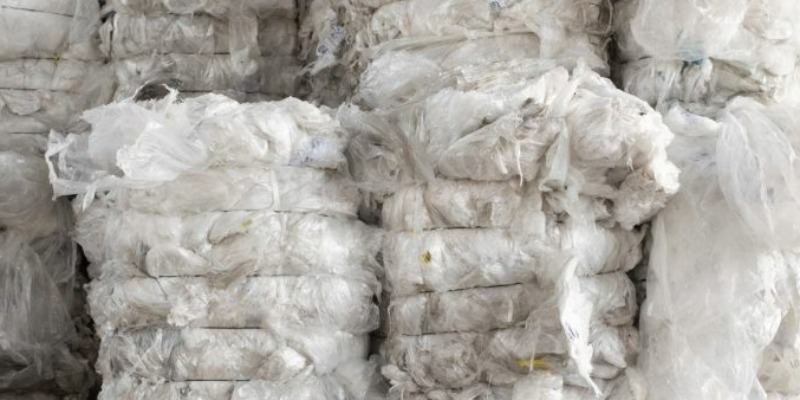
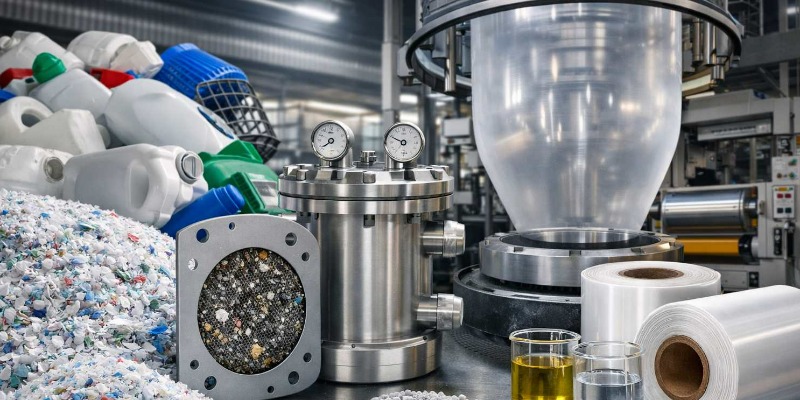
The main sources of post-consumer HDPE are rigid packaging used in household and industrial settings. Detergent bottles, chemical containers, canisters, and drums represent a significant portion of the HDPE waste stream. These materials, at the end of their useful life, enter collection and sorting systems, giving rise to recycled streams with very different characteristics depending on their original use and the contents previously housed.
From a technical standpoint, one of the main critical issues with recycled HDPE is the variety of substances with which the material has come into contact during its life cycle. Detergents, solvents, oils, chemical additives, and industrial residues can penetrate the polymer matrix, especially in materials used for containers for aggressive products. These residues are not always completely removed during washing and can subsequently manifest themselves in the form of odors, surface defects, or process instability.

Another significant source of recycled HDPE is industrial and logistics waste.
Crates, plastic pallets, reusable containers, and technical packaging generate relatively homogeneous and less contaminated HDPE streams than post-consumer household waste. However, even in these cases, the presence of specific additives, pigments, and fillers can influence the behavior of the recycled material, especially in flexible applications where good melt homogeneity is required.