- What is starlight and why does it show us the past of the universe?
- The speed of light and the concept of distance-time in space
- Distant Galaxies: Seeing Today What Happened Billions of Years Ago
- The present does not exist in the cosmos: the temporal paradox of light
- Telescopes as Time Machines: Observing the History of the Universe
- The cosmic microwave background: the fossil light of the Big Bang
- Time travel through light: physical reality or science fiction?
- Philosophical Reflections: Living in the Present While Observing the Cosmic Past
How starlight allows us to observe events that happened millions of years ago and imagine time travel through deep space
by Marco Arezio
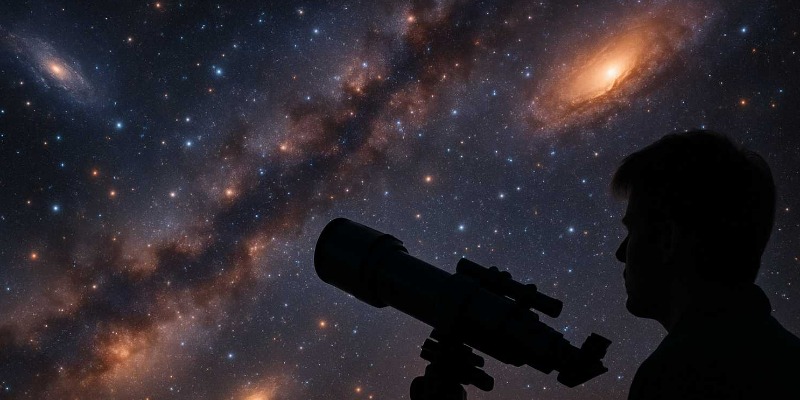
In the dead of night, under a clear sky, the human eye is confronted with a fascinating and counterintuitive reality: everything we see in the firmament belongs to the past. The stars, galaxies, and nebulae twinkling above us appear not as they are today, but as they were when their light began its journey to Earth. Gazing at the sky, in astronomical terms, is an act of cosmic archaeology: every photon that reaches us is an ancient messenger, departed millions or even billions of years ago.
But what does this phenomenon really mean? How can we reconcile the notion of "present" with a past that continually reaches us in the form of light? And, above all, could this principle pave the way for a form of "time travel" through outer space?
Light as a natural time machine
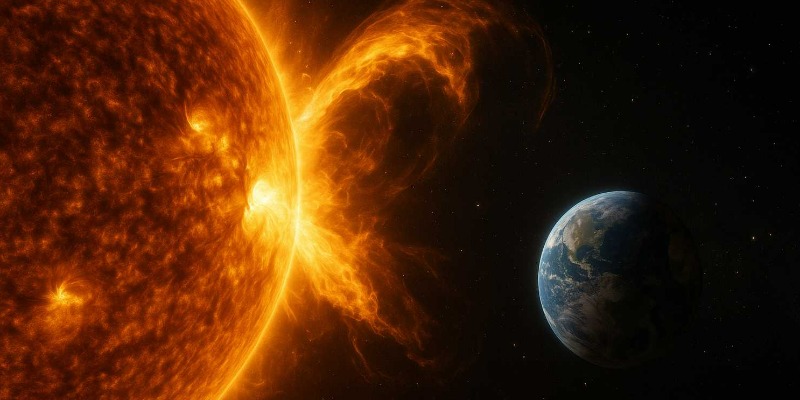
The speed of light in a vacuum is a universal constant: approximately 299,792 kilometers per second. At this speed, a ray of light takes about eight minutes to travel from the Sun to Earth. This means that every time we look at the Sun (with due caution!), we see its surface as it was eight minutes earlier. Similarly, the light from the closest star to our solar system, Proxima Centauri, took over four years to reach us.
As we look toward distant galaxies, the travel time of light increases dramatically: some of the galaxies visible to space telescopes are billions of light-years away. Their light tells us a story of the universe so remote that it predates the formation of our own solar system.
It's not a poetic metaphor, but a scientific fact: seeing a galaxy 10 billion light-years away means observing it as it was 10 billion years ago. It's as if the cosmos were an immense visual archive, where every corner of space contains authentic images of the past. In this sense, space is the visible theater of history.
Observe history in real time (from the past)
This property of light makes astronomy a science deeply connected to time. Astronomers observe not what is happening now, but what has happened. The events we record, such as supernova explosions or galaxy collisions, occurred millions or billions of years ago: only today can we observe their signs.
This is also how scientists have been able to trace the evolution of the universe. Although we cannot travel into the past, we can study increasingly distant objects to "see" what the cosmos was like in its earliest stages. The James Webb Space Telescope, for example, was designed specifically to intercept infrared light from the first galaxies formed after the Big Bang, that is, to penetrate the depths of cosmic time.
The time paradox: a present composed of the past
The phenomenon of cosmic light raises an intriguing philosophical and scientific question: when do we live in the present? If every visual information we receive from space is at least a few minutes old (in the case of the Sun), or years, or billions of years old, can we still say we're observing the present? Or is our "now" merely a collage of echoes from the past?
In a certain sense, our perception of the cosmos is always postponed. We cannot observe the "here and now" of a stellar event. The present, in astronomy, is an illusion. And this opens us to a new and fascinating way of conceiving time: as a dimension that propagates through space in the form of light, allowing us to "experience" the past.
Cosmic time travel: science fiction or future possibility?
The idea of time travel through space is often the stuff of science fiction , but it has theoretical roots in physics. According to Einstein's general relativity, spacetime is a flexible structure that can be deformed by very large masses or high velocities.
Speculative theories such as wormholes or closed timelike curves (through which one could travel back in time) are still far from proven, but they show that theoretical physics does not entirely rule out the possibility of time travel.Yet, in our present, we already travel through time every night, simply by raising our eyes to the sky. Every star we observe is a window onto a different era. Every galaxy is a fragment of cosmic history. Some stars may not have existed for millions of years, and their light continues to tell us of their existence like a belated echo. It's like watching a movie with a delay, but the only one possible, the only one that nature allows us to see.
Time in the Cosmos: A Visible Fourth Dimension
When we say that space has three dimensions, we often forget that time is the fourth. In outer space, this fourth dimension isn't hidden: it's there, visible, encapsulated in photons that travel for millions of years. Every telescope, therefore, is a kind of time machine. Every astronomical observatory is a window into forgotten eras.
The extraordinary thing about cosmic light is that it gives us a real, unreconstructed image. It's as if we could witness a historical event through a live broadcast recorded billions of years ago, with the certainty that what we see actually happened.
Fossil Light: The Cosmic Microwave Background
One of the most extraordinary examples of this "luminous memory" of the universe is the cosmic microwave background (CMB). It is the radiation leftover from the Big Bang, still present throughout the universe. This "fossil light," first detected in 1965, is the oldest photograph we possess: a snapshot of the universe as it was approximately 380,000 years after its birth.
Today, we can study the CMB thanks to extremely sensitive instruments that detect tiny variations in temperature and density. These imperceptible fluctuations are the primordial imprints of galaxies yet to form. It's like looking into the cradle of time, and it further highlights the power of light as a vehicle for universal memory.
The incredible normality of cosmic time
While all this may seem extraordinary, what makes the phenomenon even more powerful is its absolute normality. Every night, millions of people gaze at the sky without realizing they're contemplating the past. Every telescope pointed at a galaxy is a historical investigation. Every photon that strikes an observer's retina is an authentic document of what has been.
It's hard to find anything more poetic and at the same time more scientifically concrete: time moves through space, and it does so in the form of light. And every human being, with a simple glance at the stars, can live—literally—in the past.
Conclusion: A journey through the history of the universe at your fingertips
The light of the cosmos teaches us that time is not just a linear dimension that advances inexorably. It is also something we can see, measure, and in a certain sense "inhabit." Every time we look at the sky, we immerse ourselves in the history of the universe. It is not an optical illusion, but a physical reality: what we see is the past, and we are living it in our present.
This invites us to a broader reflection: if light can tell the story of what has been, perhaps the future is already underway, written in some photon that hasn't yet arrived. In this grandiose scenario, the night sky is no longer just a silent backdrop, but a cosmic diary, a visible memory, a bridge between what has been and what will be.
So, the next time you look up at the heavens, remember: you're not just gazing at stars. You're traveling through history.
© Reproduction Prohibited