- What is a solar flare: definition and physical causes
- How Coronal Mass Ejections Affect Earth
- Interaction between CMEs and the magnetosphere: the mechanism of geomagnetic storms
- Solar Flares and Satellites: Risks for Electronics and Low Orbits
- Impacts of solar storms on radio and GPS communications
- Power Grids and Geomagnetic Storms: The Case of the Quebec Blackout
- Space Weather: How to Monitor Solar Activity
- Why it is important to protect technological infrastructure from solar flares
- Do you want me to also add an SEO introduction for the web page?
Learn about the effects of solar flares on Earth's technology and why monitoring solar activity is crucial
At the heart of our solar system, the Sun is not only the primary source of light and heat, but also a dynamic and unpredictable celestial object.
Among the most energetic phenomena that concern it, solar eruptions (or solar flares) represent violent manifestations of energy release that, although they occur millions of kilometers away, can have tangible, and sometimes serious, effects on terrestrial technology.
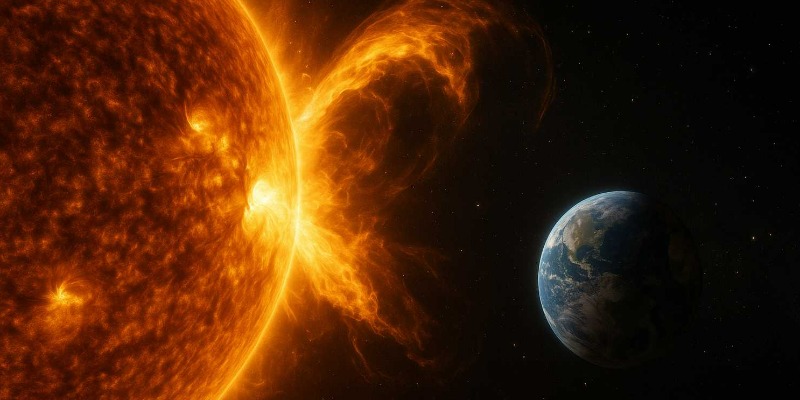
These events, triggered by sudden reconfigurations of the solar magnetic field, are often accompanied by coronal mass ejections (CMEs), which release enormous quantities of high-energy charged particles into the interplanetary medium.
When these particles reach the Earth's magnetosphere, they can trigger a variety of disturbances in complex technological systems: from communications satellites to power grids, from GPS systems to high-frequency radio communications.
In a world increasingly dependent on digital and interconnected infrastructures, understanding and mitigating the impact of these phenomena has become a crucial objective for the security of contemporary societies.
Solar flares: nature and physical dynamics
Solar flares are explosions of energy that occur in the upper atmosphere of the Sun, particularly in the chromosphere and corona. They manifest as sudden increases in brightness that release energy in the form of electromagnetic radiation (particularly X-rays and ultraviolet), plasma, and high-energy particles.
The mechanism underlying these events is attributable, as we have said, to reconfigurations of the solar magnetic field, often in correspondence with sunspots, where the lines of force intertwine and accumulate potential energy. When the magnetic tension exceeds a critical threshold, the energy is suddenly released, producing a flare and, often, a CME. The CME, propagating at speeds that can exceed 1000 km/s, can impact the Earth in 1-3 days, carrying with it a turbulent interplanetary magnetic field and a flow of high-energy plasma.
Interaction with the Earth's magnetosphere
Earth is protected from the hostile space environment by its magnetosphere, a magnetic field generated by the planet's fluid metallic core. However, in the presence of a CME, the magnetosphere can undergo significant compressions and reconfigurations. If the magnetic field carried by the CME is oriented in the opposite direction to that of the Earth (southern direction with respect to the Earth's magnetic north pole), the interaction can be particularly intense. This triggers the so-called "geomagnetic storms", phenomena that cause even severe disturbances in technological systems both in orbit and on the Earth's surface.
One of the most visible effects of such interactions is the appearance of auroras at unusually low latitudes. However, far more problematic are the less visible but potentially devastating effects: fluctuations in induced electric fields, overheating and damage to satellites, interference with GPS and radar signals, and disturbances in radio communications.
Impact on satellites and communications
Artificial satellites orbiting the Earth are among the first victims of the effects of intense solar activity. High-energy particles can penetrate the satellites' protective casings, accumulate in electronic circuits, and cause malfunctions, known as single event upsets (SEUs).
In severe cases, radiation can permanently damage onboard systems, rendering the satellite inoperable. In addition, the heating of the Earth's upper atmosphere, due to increased ultraviolet radiation, leads to an expansion of atmospheric molecules at higher altitudes, increasing aerodynamic drag for satellites in low orbit (LEO), resulting in a decrease in orbital altitude and a greater risk of uncontrolled reentry.
Radio communications, especially those that rely on ionospheric reflection of low- and medium-frequency (HF) waves, can be severely disrupted.
During a solar flare, the sudden increase in ionization in the upper atmosphere alters the reflective properties of the ionosphere, making long-distance transmission of radio signals ineffective or even impossible. This effect, known as a radio blackout, can compromise the safety of maritime, aeronautical, and military communications.GPS Systems and Navigation at Risk
The Global Positioning System (GPS), now pervasive in daily life and crucial in military, logistical, and civilian settings, is extremely sensitive to ionospheric disturbances caused by geomagnetic storms. GPS signals, transmitted by satellites in medium orbit (MEO), pass through the ionosphere before reaching ground-based receivers.
Variations in electron density along the signal path can introduce significant errors in position calculations, with deviations exceeding 50 meters in the most extreme cases. In critical situations, such as landing an airplane or automated vehicle navigation, these errors can become dangerous. GPS-based timing technologies, used to synchronize telecommunication networks and financial transactions, can also be compromised.
Power grids and ground infrastructure
One of the most feared effects of geomagnetic storms is on the Earth's electrical grids. The varying magnetic fields induced by incoming solar particles can generate geomagnetically induced currents (GICs) in the long metal conductors of high-voltage power lines. These currents, often not anticipated in the original designs of the infrastructure, can overheat transformers, causing them to melt or fail, and cause large-scale blackouts.
A historical example is the Quebec blackout in March 1989 : a geomagnetic storm, following a particularly intense CME, generated enough GICs to collapse the electrical system of the entire Canadian province in a few minutes, leaving six million people without power for over nine hours.
Oilfield infrastructure, such as metal pipelines, can also be subject to induced currents, which can affect the efficiency of cathodic protection against corrosion, increasing the risk of long-term structural damage.
Monitoring and Prevention: Space Weather
Faced with the vulnerability of modern technologies, the scientific community and space agencies have invested increasing resources in the development of so-called space weather, a discipline that studies and monitors solar phenomena to predict and mitigate their effects on Earth.
Organizations such as NASA, ESA, and the National Oceanic and Atmospheric Administration (NOAA) operate solar-observing satellites – such as the Solar Dynamics Observatory (SDO), the Solar and Heliospheric Observatory (SOHO), and the Deep Space Climate Observatory (DSCOVR) – that can continuously monitor the Sun, detect the onset of flares and CMEs, and calculate the arrival times of high-energy particles.
Although accurately predicting the direction and intensity of an event remains an open scientific challenge, current models allow warnings to be issued several hours in advance, allowing authorities and critical infrastructure operators to take precautionary measures.
Conclusions
Solar flares, while cyclical natural phenomena and an integral part of the Sun’s behavior, pose real and growing risks in a technology-dependent world. Advances in space weather and resilient infrastructure design are key tools to reduce the vulnerability of modern societies.
However, greater public awareness and coordinated international governance are essential to address a risk that, although invisible to the eyes, has the potential to seriously compromise the daily functioning of advanced economies. Preparing for these challenges does not mean fearing the Sun, but learning to live with its power, respecting its cycles and adapting our technologies to its millennial variability.
© Reproduction prohibited