- What is the precession of the equinoxes and how does it work?
- Astronomical origin of the Earth's precession
- Milankovitch cycles and the Earth's climate
- How precession affects seasons and temperatures
- Precession and Ice Ages: The Connection in Geological Data
- Impacts of precession on regional climates and tropical areas
- Precession of the equinoxes and current global warming
- The importance of precession for predicting climate change
From the Millennial Dance of the Earth’s Axis to Major Climate Changes: Understanding the Precession of the Equinoxes and Its Impact on Ice Ages and Climate Cycles
by Marco Arezio
Every era in Earth’s history has been marked by climate changes, sometimes slow and imperceptible, other times sudden and disruptive. Among the astronomical factors that guide these changes over thousands of years, one stands out: the precession of the equinoxes. This is a fascinating phenomenon, still not widely known to the general public, but it plays a fundamental role in the long history of Earth’s climate.
To understand precession, let us imagine the Earth as a slowly spinning top. The axis around which our planet rotates is not perfectly stable, but describes a slow oscillation—a conical motion—due to the gravitational pull mainly from the Sun and the Moon on the Earth’s equatorial bulge. This movement, known as axial precession, causes the direction of the rotation axis to change slowly over time, completing a full cycle roughly every 26,000 years.
The most direct consequence of precession is the drift of the equinoxes’ positions along Earth’s orbit—hence the term “precession of the equinoxes.” Yet this slow dance is not just an astronomical curiosity: it has profound implications for Earth’s climate, especially when observed on time scales of tens of thousands of years.
The Link Between Precession and Climate Cycles: Milankovitch Variations
A real leap in understanding the relationship between astronomical movements and Earth’s climate is owed to Serbian scientist Milutin Milankovitch. In the early decades of the twentieth century, Milankovitch developed the theory that the great climatic cycles of Earth—particularly the alternation of ice ages and interglacial periods—are influenced by three main astronomical cycles:
- Eccentricity of Earth’s orbit (variation in the shape of the orbit from more elliptical to more circular, with a cycle of about 100,000 years)
- Obliquity of the Earth’s axis (variation in the tilt angle, with a cycle of about 41,000 years)
- Precession of the equinoxes (wobble in the orientation of the rotation axis, with a cycle of about 23,000–26,000 years)
These three components, known as Milankovitch cycles, modulate the amount and distribution of solar radiation reaching Earth’s surface, with profound effects especially on the formation and melting of the major ice sheets.
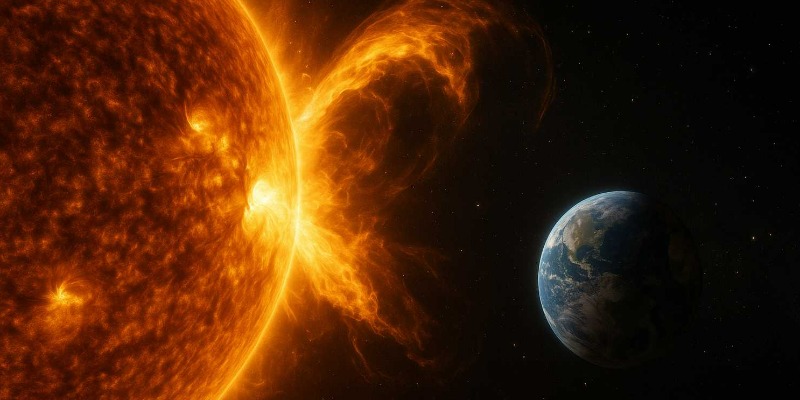
In particular, the precession of the equinoxes determines the time of year when the seasons occur in each hemisphere, in relation to Earth’s position along its orbit. Currently, for example, the perihelion (the point in the orbit closest to the Sun) coincides with the northern hemisphere’s winter, making winters in the northern hemisphere slightly milder. However, in about 11,000 years, the situation will be reversed, with the perihelion during the northern summer, and this will affect the distribution of seasonal temperatures, potentially triggering new climatic dynamics.
Impacts of Precession on Earth’s Climate: Ice Ages and Regional Oscillations
The signatures of precession are clearly imprinted in the great natural archives of climate history, such as Antarctic and Greenland ice cores and marine sediments.
By studying these “geological memories,” scientists have observed that oscillations of the Earth’s axis have contributed to triggering and modulating the cycles of ice ages during the Quaternary.Precession mainly affects seasonality—that is, the difference between summer and winter—especially at middle and high latitudes. When summer in the northern hemisphere coincides with aphelion (the farthest distance from the Sun), summers tend to be cooler, reducing the melting of winter snows and promoting the accumulation of ice, thus expanding ice sheets. Conversely, when northern summer occurs near perihelion, the surplus of solar radiation can trigger the melting of ice and favor warmer and more stable periods.
It is important to stress that precession alone is not sufficient to cause a glaciation, but acts together with the other astronomical cycles and internal feedbacks in the Earth’s climate system. In some areas, especially tropical Africa, variations in precession have influenced cycles of aridity and humidity, leading to the alternation of greener and wetter periods (such as the so-called “Green Sahara”) and more desert phases.
A Cosmic Clock That Regulates Climate—But Not Current Global Warming
While the precession of the equinoxes has driven major natural climate oscillations for millennia, today we are witnessing a different phenomenon: current global warming is linked to the increase in greenhouse gases produced by human activities, and it is occurring on time scales far more rapid than the slow oscillations of the Earth’s axis. Whereas precession operates on cycles of 23,000–26,000 years, recent changes are unfolding over mere decades.
This does not mean that precession is no longer important: it continues to dictate the slow pace of climate eras and can still provide valuable context for understanding climate evolution over the long term. However, anthropogenic effects are now overlapping with—and, in some cases, masking—natural ones, driving Earth’s climate in a new and unprecedented direction in recent geological history.
Conclusion: Knowing Precession to Read the Future of Climate
Studying the precession of the equinoxes means seeing Earth as part of a great cosmic clock, where every gear—orbit, tilt, axial wobble—helps define the long trajectory of climate. As we face the challenges of current climate change, understanding these deep dynamics helps us distinguish between natural causes and anthropogenic factors, anticipate future trends, and keep alive a sense of history in which Earth has always known how to adapt and reinvent itself.
© All rights reserved
Sources
Berger, A. L. (1988). "Milankovitch theory and climate." Reviews of Geophysics, 26(4), 624-657.
Hays, J. D., Imbrie, J., & Shackleton, N. J. (1976). "Variations in the Earth's orbit: Pacemaker of the ice ages." Science, 194(4270), 1121-1132.
Lisiecki, L. E., & Raymo, M. E. (2005). "A Pliocene-Pleistocene stack of 57 globally distributed benthic δ18O records." Paleoceanography, 20(1).
Zachos, J. C., et al. (2001). "Trends, rhythms, and aberrations in global climate 65 Ma to present." Science, 292(5517), 686-693.