- Space Espionage in the Cold War: The Historical Context of the Race to the Moon
- The Rise of the CIA and the KGB in the Technological Challenge between the USA and the USSR
- Interceptions and decryption: the secret listening networks between America and the Soviet Union
- Infiltrators in space laboratories: technicians, scientists and undercover agents
- Major cases of data and technology theft in space programs
- Reverse engineering and recovery of space wrecks between the United States and the USSR
- Covert Operations and Declassified Dossiers: The Truth Beyond Official Missions
- The Legacy of Espionage in the Conquest of the Moon and Lessons for the Future
The Challenge of the 1960s Lunar Conquest: Secret Dossiers, Undercover Agents, and Stolen Technologies Between the CIA and KGB in the Decade That Changed the History of Space
by Marco Arezio
In the collective imagination, the space race of the 1960s was the stage for two giants clashing with science, courage, and audacity: the United States and the Soviet Union.
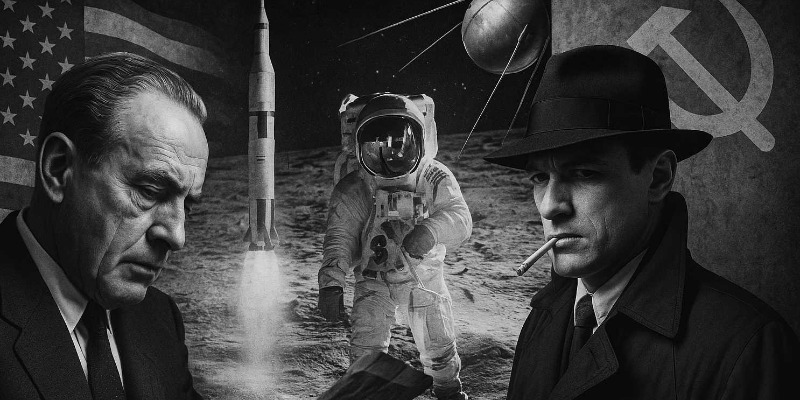
The conquest of the Moon—a symbol of progress and technological power—has often been told as a story of rockets, astronauts, and visionary engineers. Yet behind the polished images of heroes in white suits, there lies a much darker backdrop, made up of industrial espionage, undercover agents, stolen technologies, and a dense network of deception orchestrated by the CIA and KGB. This is the never fully revealed story of space espionage during the hottest decade of the Cold War.
The Space Race: An All-Out Challenge
After the launch of Sputnik in 1957, the USSR had gained a psychological and technical advantage that deeply unsettled the American establishment. The Soviet overtake seemed unstoppable: after the first satellite came the first probe on the Moon (Luna 2, 1959), the first man in space (Yuri Gagarin, 1961), and the first spacewalk (Alexei Leonov, 1965). The United States, forced to play catch-up, invested unprecedented resources and created NASA, but quickly realized that scientific supremacy alone was not enough. They needed information, industrial secrets, and detailed plans of Soviet missions. That’s when the “shadow war” took shape.
Spies and Codes: The Invisible Battle
American intelligence soon began intercepting radio communications and telemetry signals transmitted from Soviet bases. Through the NSA (National Security Agency) and the CIA, the US set up listening networks across the Mediterranean, Northern Europe, and even Antarctica to capture every transmission. Agents worked day and night to decipher encrypted messages, interpret radar readings, and analyze Soviet rocket trajectories.
On the other side of the Iron Curtain, the KGB infiltrated its “moles” into Western research centers, targeting universities, NASA contractors, and civilian laboratories involved in the Apollo program. The goal was not just to steal technical data, but also to anticipate strategic moves and influence the public narrative. The KGB employed undercover agents as technicians, translators, and cleaning staff at embassies and delegations, collecting confidential documents and microfilming every useful note.
Incidents and Dossiers: True Stories Beyond Fantasy
A particularly emblematic episode was the “Walker affair”: in the 1960s, US Navy officer John Anthony Walker began selling the KGB thousands of secret documents, many of which concerned communication codes used for space launches and Apollo rocket telemetry. The damage was incalculable, to the point that Moscow was reportedly able to foresee and track many NASA activities with precision.
No less daring were operations to recover hardware: in 1969, a Soviet spy satellite, Kosmos, fell into the Atlantic Ocean. Thanks to information gathered by Norwegian and British intelligence, the Americans managed to intercept the wreck before the Soviets, studying the navigation systems that would later prove useful for their own missile defense systems.
On the opposing side, the CIA launched “Operation Corona,” one of the first satellite photography campaigns in history, which managed to obtain detailed images of Soviet launch bases and missile facilities, circumventing the strict secrecy imposed by Moscow.
Stolen Technologies and “Reverse Engineering”
The technological race was further fueled by so-called “reverse engineering”: pieces of probes, rocket remains, and fragments of capsules recovered at sea were dissected and analyzed by engineers from both sides to discover materials, design, and propulsion systems. Paranoia was such that during certain missions, both astronauts and cosmonauts were trained to destroy their vehicles in case of landing in enemy territory.
The “theft” of technology was not limited to hardware. Calculation algorithms, communication protocols, and navigation techniques were systematically stolen or imitated, sometimes even through the forced exchange of scientists during diplomatic missions or seemingly harmless official meetings.
The Legacy of Space Espionage
When Neil Armstrong and Buzz Aldrin set foot on the Moon on July 20, 1969, the world celebrated the triumph of science and the human spirit. But behind that one small step for man lay a long trail of invisible battles, double-crosses, and betrayals that had marked every stage of the space race.
Many dossiers remain classified, both in the United States and in Russia, but declassified archives are increasingly shedding light on the past: the conquest of the Moon was also a victory for intelligence—of those who could read between the lines, decipher signals, and anticipate enemy strategies.
Today, as a new space race involves powers like China and India, the lesson of the 1960s is more relevant than ever: innovation never advances alone. Behind every technological leap move, silently and pervasively, the long shadows of espionage and the war for information.
© All Rights Reserved
Sources
James E. Oberg, Red Star in Orbit (1981)
John Logsdon, Apollo: The Race to the Moon (2015)
National Security Archive, “The Secret History of the U.S. Space Program”
CIA, “Corona: America’s First Satellite Program” (declassified documents)
Anatoly Zak, Russia in Space: The Past Explained, The Future Explored (2021)