- The Alabama Expedition: The Beginning of the Arctic Odyssey
- Iver Iversen and Mikkelsen: Friendship at the Edge of the World
- Surviving the Freeze: Greenland's Extreme Tests
- Polar silence as inner mastery
- Arctic Isolation: Two Men and a Continent of Ice
- Geographical discovery and the truth about Peary's canal
- The return to civilization after two years of silence and cold
- The Spiritual Legacy of Iver Iversen: The Voice of the Arctic
The Intimate Story of the Man Who Challenged the Arctic and Found Himself in Extreme Solitude
by Marco Arezio
He was not born for glory, nor did he seek the kind of adventures that fill newspapers. Iver P. Iversen was a Danish mechanic — a man of few words and hands accustomed to iron and oil. His life was made of gears and regularity, of workshop silences and precision. But one day, destiny offered him something greater and purer: an expedition to Greenland, alongside explorer Ejnar Mikkelsen, in search of the traces of another mission lost among the ice.
It was not merely a matter of embarking on an adventure, but of accepting an inner challenge. When he agreed, Iversen could not have imagined that he was about to begin a pilgrimage toward the deepest solitude a man can know — the kind that leads to the very heart of nature and of oneself.
The Ship Alabama and the Edge of the Ice
It was 1909 when the Alabama left port, bound for the eastern coast of Greenland. The North Sea received the vessel like a tiny creature in an immense breath of wind and mist. On board, Iversen moved with focused calm, as if the noise of engines and waves had always belonged to him.
But the farther north the ship sailed, the more the human world disappeared. The expanses of ice rose into impassable walls, and one day the ocean itself closed around the hull, locking it in place. The Alabama became trapped in the ice off Shannon Island, a prisoner of white. There, Iversen’s true story began: the slow surrender to the immensity of nature.
Everything familiar — the sound of the harbor, human voices, the certainty of return — dissolved. Only the cold remained, and the pale light, and the silence. And within that silence, the man began to change.
Beyond the White: A Dialogue with Nature

Greenland was not a land; it was a dimension.
The whiteness stretched endlessly, erasing every boundary, and the sky was a faint breath that seemed to blend with the snow. Iversen soon learned that the landscape was not hostile, but beyond human scale: a different language, made of space and silence.Each day, the wind carried new lessons. The ice sheets shifting beneath his feet, the glow of infinite dawns, the long shadows of the low sun at the horizon — everything spoke, yet in a wordless tongue. To hear it, one had to fall silent.
It was then that Iversen began to understand that nature is not an enemy to be defeated, but a being to be understood. And the more he shed the habits of the civilized man, the more he became part of the landscape — a fragment of ice in motion, a presence among presences.
Silence and Breath in Isolation
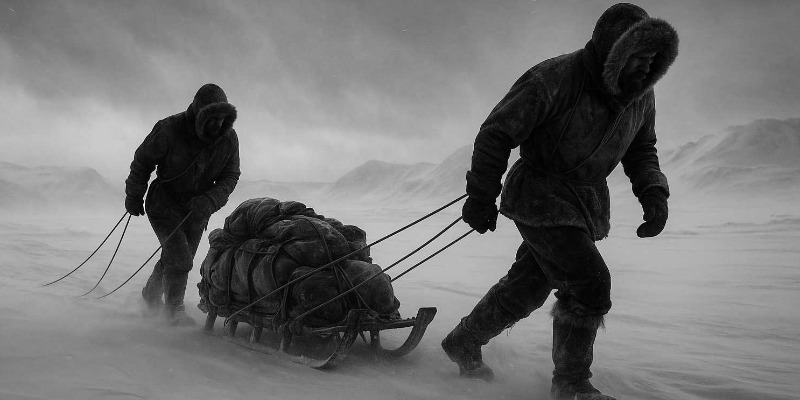
As months passed, the original group dispersed. Only Mikkelsen and Iversen remained, determined to reach the heart of the continent to recover the lost journals of their predecessors. The sleds loaded with supplies, the weary dogs, the ceaseless wind — that was all they had.
Silence became their companion. In the polar nights, when darkness lasted for days, Iversen could feel the universe breathing in a slow, steady rhythm. No human voices, no artificial sounds — only the whisper of the wind and the creak of ice underfoot.
In that absolute void, the man began to sense himself with a new clarity. Every act — lighting a fire, setting up a tent, checking the compass — was both survival and meditation. The cold forced him to be present in every moment. Nature shaped him quietly, like a wordless teacher.
Walking Beside Mikkelsen

Between Iversen and Mikkelsen, a bond formed — made of few words and total trust. They shared the cold, the hunger, the exhaustion, but also a deep mutual respect that can only arise in extremity. When one faltered, the other became his strength.
Time no longer flowed as it does in the world of men: it was a slow circle of waiting, of identical days and small discoveries. The sleds slid over the frozen crust, the dogs’ shadows stretched across the white. Each step northward was also a step deeper into solitude.
Sometimes Mikkelsen would remain silent for hours, staring at the horizon. Iversen let him be, knowing that each man had his own way of facing that motionless desert. In the vastness of the Arctic, companionship was not meant to fill the void — only to remind them that even in solitude, one human being can still understand another without a single word.
Pain, Hunger, and the Ultimate Test
The expedition became a hell of endurance. Supplies ran low, dogs died, and the frost bit into flesh and mind. Mikkelsen was struck by scurvy, and Iversen — now a shadow of himself — lifted him onto the sled and dragged him for miles.
Every step was a dialogue between life and death. Hunger had a smell, the cold had a sound. Yet, at his lowest point, Iversen found a form of peace. The world was no longer divided between man and nature: everything was part of the same breath. The body, the snow, the wind — all flowed together.
When the storms covered the sky, he would stare into nothingness with the calm of one who has accepted his fate. In that ice, he found the highest form of freedom: the kind that is born when one fears nothing anymore.
The Return Between Light and Shadow
After two and a half years of survival, Iversen and Mikkelsen were finally rescued by a Norwegian whaling ship. They returned home unrecognizable — thin, aged, but alive. Denmark welcomed them as heroes, but Iversen did not seek honors.
When asked to recount the expedition, he spoke little. He said that some silences cannot be translated into words. Indeed, his eyes told far more than his sentences: they carried the light of the polar dawn, the vastness of the ice, and the humility of one who has looked at nature and understood he is part of it.
Listening: The Secret of the Inner Legacy
Iversen lived the rest of his days simply, quietly, far from celebrations. Yet within him, the echo of the Arctic remained. Not a day passed when he did not return there in thought — to that boundless white where he had met true solitude, the kind that does not destroy, but purifies.
His story is not that of a conqueror, but of a man who learned to listen. The Arctic had taught him that nature is not to be challenged — it is to be respected, contemplated, and embraced as a mystery.
And perhaps, if Iversen could still speak, he would say that nothing is ever truly lost among the ice. Instead, one rediscovers what truly matters: breath, silence, and the certainty that the world — even in its harshest cold — holds a voice within it.
The voice of the soul.
© Reproduction Prohibited