- The North Face of the Eiger: The “unsolved problem” of the Alps
- The 1930s and the golden age of extreme mountaineering
- Failed attempts before the 1938 conquest
- The protagonists of the first ascent of the Eiger North Face
- The departure and the union of the two teams
- The Hinterstoisser crossing and the technical difficulties
- The White Spider and the last bivouac on the wall
- The arrival at the summit and the historical legacy of the feat
From the "unsolved problem of the Alps" to the conquest of Anderl Heckmair, Ludwig Vörg, Heinrich Harrer and Fritz Kasparek: the story, the protagonists and the legacy of the legendary first ascent
by Marco Arezio
In the 1930s, the North Face of the Eiger was considered the greatest unsolved problem in European mountaineering.
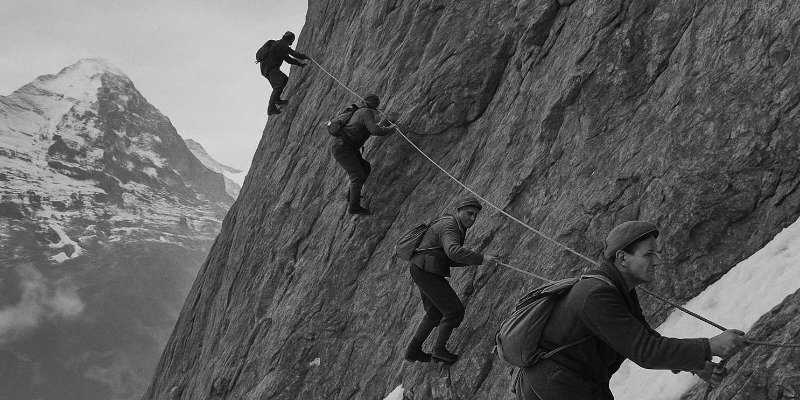
A limestone wall nearly two thousand meters high, exposed to the icy winds of the Bernese Oberland and perpetually battered by rockfall and icefall, stood as a silent warning to anyone who dared approach. The Eiger, with its dark shadow that stretched across the valleys of Grindelwald at sunset, was already known for claiming victims among the most experienced climbers. Previous attempts had ended in tragedy: roped parties trapped by snow, men swept away by avalanches, bivouacs forced into the heart of the face in freezing temperatures. The press spoke of it as a "cursed face," and each new expedition was followed with a mixture of admiration and fear.
The historical-alpinistic context of the 1930s
Europe was experiencing a time of political tension and national pride, and great Alpine ascents were also becoming symbols of prestige. Conquering the three great North Faces—the Matterhorn, the Grandes Jorasses, and the Eiger —was the supreme goal for elite climbers. The Matterhorn and the Jorasses had already fallen to the assault of visionary mountaineers, but the Eiger held firm. Its North Face was not just a technical challenge: it was a test of human endurance, of survival, of the ability to navigate an environment where the margin for error was measured in seconds.
In 1935, two German climbers, Karl Mehringer and Max Sedlmayr, died trapped in a blizzard; the following year, another team had to retreat in desperate conditions. Each failure added to the mountain's allure and legend.
The protagonists of the conquest
July 1938 marked a turning point. Two teams, one formed by Austrians Heinrich Harrer and Fritz Kasparek, the other by Germans Anderl Heckmair and Ludwig Vörg, found themselves on the face almost by chance. Harrer, young and ambitious, and Kasparek, solitary and methodical, had begun the ascent with a light and fast approach. Heckmair, an experienced guide with a decisive character, was accompanied by Vörg, a powerful and tireless athlete. Fate would have it that, after a day of climbing, the two pairs would join together, combining Heckmair's prudence and strategic vision with the boldness of the two Austrians.
Their collaboration, born on the face, would become legendary.The chronicle of the enterprise
The ascent began on July 21st. Already in the first hours, the four had to negotiate extremely delicate passages, including smooth slabs and icy sections. The traverse of the infamous "Hinterstoisser" —a diagonal section on smooth slabs where loss of traction meant falling into the void—was overcome with a fixed rope, which would then allow Heckmair and Vörg to pass. Progress was slow and arduous: long pitches on vertical ice, powdery snow falling from above, and the constant need to secure themselves in an environment devoid of natural anchors.
On the second day, they completed the ascent of the "First Snowfield" and tackled the "White Spider," a patch of ice suspended beneath the summit, which resembled an enormous web of snow and seemed to protect the approach to the summit. The temperature plummeted, the wind increased, and the night bivouac was an extreme experience: hanging from ropes, their shoes frozen, they breathed in icy vapor.
On July 24, exhausted but determined, they surmounted the last rocky bastion and reached the summit ridge. The panorama of the Oberland opened up suddenly and dazzlingly. The first ascent of the Eiger North Face was accomplished.
The historical importance
The news spread within hours. In Switzerland, Germany, and Austria, newspapers heralded the feat as a momentous victory, not only sporting but also symbolic. The conquest of the "last problem of the Alps" marked a turning point: mountaineering definitively entered the extreme realm, where technique, strategy, and the ability to physically and mentally endure became essential factors.
The 1938 feat didn't end the Eiger tragedy—other teams would lose their lives in the years to come—but it ushered in a new era of challenges. The Heckmair Route, as it was named, became the benchmark for generations of climbers. Harrer would later immortalize the story in his famous book The White Spider, turning the climb into a legend that has endured for decades.
Even today, anyone who looks at the North Face of the Eiger can imagine the four men suspended between rock and sky, defying the wind and fear, and understand why that conquest remains one of the most extraordinary feats in the history of mountaineering.
© Reproduction Prohibited