






- The rubber rush: when the Amazon became the center of the world
- Slavery and debt: the condition of the Indians in the Seringales
- Putumayo: The Forgotten Genocide in the Peruvian Jungle
- Manaus and Belém: the ephemeral capitals of the rubber empire
- Indigenous uprisings against exploitation in the forest
- Henry Wickham and the smuggling of Hevea brasiliensis seeds
- The decline of the Amazon and the rise of Asian rubber
- Roger Casement and the Birth of International Awareness on Human Rights
The history of the rubber rush in South America between the nineteenth and twentieth centuries, of the exploitation of the Indians, of the revolts, of international profits and of the collapse of an economic empire
by Marco Arezio
Between the late 19th century and the early 20th century, the Amazon basin was the scene of one of the most intense and dramatic rushes for natural resources in modern history: the Rubber Rush . What began as an industrial innovation in Europe and North America—the use of rubber for tires, electrical insulation, pipes, and consumer products—quickly transformed into a brutal machine of human and environmental exploitation in the heart of the South American rainforest.
Within a few decades, natural rubber became an essential commodity for industrial economies, and the Amazon, rich in Hevea brasiliensis, the tree from which latex is extracted , became the center of feverish mining activity. The cities of Iquitos, Manaus, and Belém exploded in population, suddenly becoming cosmopolitan urban centers, with theaters, luxury hotels, and automobiles. But behind this veneer of progress lay a horrific reality: the systematic exploitation of the Indians, the native peoples of the forest, transformed into slaves or semi-slaves by the so-called rubber barons.
Exploitation and slavery: the reality for the Indians
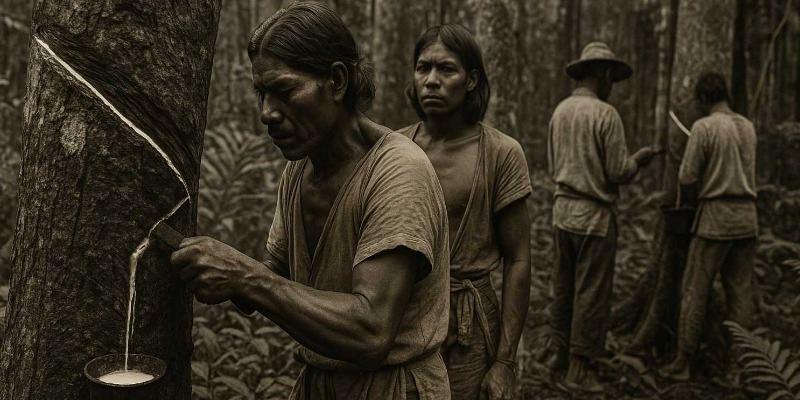
To meet growing global demand, latex collectors—often indigenous—were forced to endure a harsh life. They labored in hellish conditions, traveling miles through the jungle to hack trees and collect the milky fluid, often with few tools and without any health protection. Patrons (the leaders of plantations or concessions) imposed violent work regimes, corporal punishment, and actual systems of debt peonage —a mechanism whereby workers were forced into debt to obtain tools and supplies, unable to repay their debts, effectively becoming prisoners.
The most emblematic—and tragic—case was that of the Peruvian Amazon Company, an Anglo-Peruvian company operating in Putumayo, on the border between Peru, Colombia, and Brazil. Here, under the direction of Julio César Arana, systematic atrocities occurred: torture, mutilations, executions, the enslavement of entire indigenous communities, and the enslavement of women and children. According to estimates by Roger Casement, a British consul and later human rights activist, tens of thousands of indigenous people died in Putumayo between 1890 and 1910, in what is now remembered as one of the first economic genocides of the industrial age.
The Rubber Barons and the Rise of Manaus
Manaus, the capital of the Brazilian Amazon, became a symbol of the wealth derived from rubber in those years. The opera house, modeled on that of Paris, imported European marble, Venetian chandeliers, and fine furnishings. The rubber barons lived in sumptuous palaces, often sending their children to study in England or France. The semblance of civilization, however, rested on the backs of the latex collectors.
In Brazil, as in Peru, the condition of the indigenous people was desperate. In many cases, they were captured and forced into labor, while the state's presence was weak or in collusion with large commercial interests. Any form of resistance was violently repressed. Yet, on several occasions, indigenous populations attempted revolt, often taking refuge in more remote areas of the forest, forming autonomous communities, or attacking mining centers. These rebellions, though rarely successful, marked a significant resistance, today reevaluated by historians and activists.
Asian competition and the collapse of the Amazon monopoly
The Amazonian monopoly lasted less than fifty years.
In 1876, the Englishman Henry Wickham managed to steal approximately 70,000 Hevea brasiliensis seeds from the Amazon, taking them first to Kew Gardens (London) and then to the British territories of Ceylon (Sri Lanka), Malaysia, and Singapore. It was a turning point.Asian plantations, organized according to more rational methods and less dependent on indigenous labor, began to produce rubber on an industrial scale. Beginning in 1912, international markets began to prefer Asian rubber, which was cheaper and of consistent quality. Amazonian cities entered a rapid and irreversible economic decline. Manaus and Belém became ghost towns of a vanished commercial empire.
The disaster was economic, but also social: the indigenous populations did not benefit from the collapse, but continued to live in marginal conditions, often without land or rights. The forest, already devastated in many areas by the rubber rush, was abandoned without any regeneration plan.
International complaints and the birth of a global conscience
The first to systematically denounce abuses in rubber harvesting was Roger Casement , already known for his report on the Belgian Congo, another scene of violence related to rubber extraction. His Putumayo Report, published in 1912, caused a huge scandal in the United Kingdom, leading to the dissolution of the Peruvian Amazon Company and the beginning of a public debate on the responsibilities of Western companies in colonies and territories under their influence.
His work, along with that of journalist Walter Hardenburg and other activists, was crucial in laying the foundations of the modern concept of human rights, even though the concrete repercussions at the time were minimal. Nevertheless, the horrors of the Amazon remained etched in the imagination of the time and were echoed by writers and travelers, including Joseph Conrad and Mario Vargas Llosa.
The erased memory (and to be rediscovered)
Today, the Amazon rubber boom is often forgotten, buried under narratives of industrial progress and colonization. Yet, it was one of the most powerful examples of how global economic expansion can be based on the cultural, social, and environmental destruction of entire regions.
The memory of indigenous peoples survives in oral histories, material culture, and some ongoing land reclamation initiatives. Recent studies, thanks also to access to archives and the digitization of documents, are rewriting history from the victims' perspective, restoring dignity to communities that for too long have been treated as "obstacles" to development.
Conclusion: a lesson still valid
The history of Amazonian rubber exploitation is a painful yet essential chapter in understanding the power mechanisms that link natural resources, global economic interests, and human rights. Now that the Amazon is once again at the center of attention for its environmental destruction, remembering the past becomes an ethical and political duty.
Only by acknowledging historical injustices can we build a future in which development and respect for indigenous peoples are not in opposition, but rather part of the same, essential equation.
© Reproduction Prohibited