- What are tides and how do they arise
- The gravitational force of the Moon and the Sun on the tides
- Tidal friction: the mechanism that slows down the Earth's rotation
- How the length of the Earth's day changes over time
- The Moon's moving away and its future consequences
- The role of tides in Earth's dynamics and ecosystems
- Tidal interactions in the solar system: examples beyond Earth
- Why study the influence of tides on the Earth's rotation
A Journey Through Science, History, and Curiosities to Understand How the Action of the Tides Shapes the Rotation of the Earth and Its Effects Over Time
by Marco Arezio
When we think of tides, our minds immediately go to the alternation of sea levels, to the rhythm of the waves rising and falling on beaches, and perhaps to memories of holidays or fishing trips. Rarely, however, do we pause to reflect on an extraordinary fact: tides, with their constant ebb and flow, are the visible result of powerful gravitational forces binding the Earth to the Moon, and to a lesser extent, the Sun. These same forces not only regulate the daily cycle of the tides but also influence deeper, more hidden aspects of Earth's dynamics, including the very rotation of our planet on its axis
In this article, we will dive into the world of tides, analyzing how and why they manage to “fatigue” the rotation of our planet, altering it imperceptibly but constantly.
Tides: An Effect of the Gravitational Dance Between Earth, Moon, and Sun
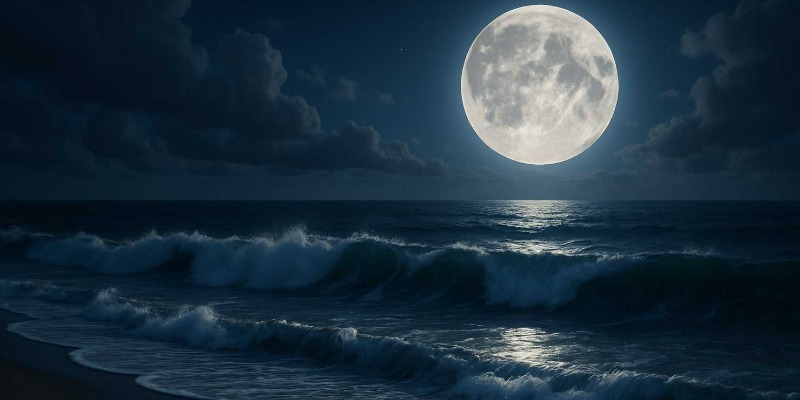
To understand how tides influence Earth's rotation, it's essential to know what tides are and which forces generate them. Tides are periodic variations in sea level caused by the gravitational pull that the Moon, and to a lesser extent the Sun, exert on the Earth. The Moon, being relatively close to our planet, is primarily responsible for this phenomenon: its gravitational force “pulls” the water of the oceans, causing the sea level to bulge on the side closest to the Moon and, due to a balancing effect, also on the side farthest from the Moon.
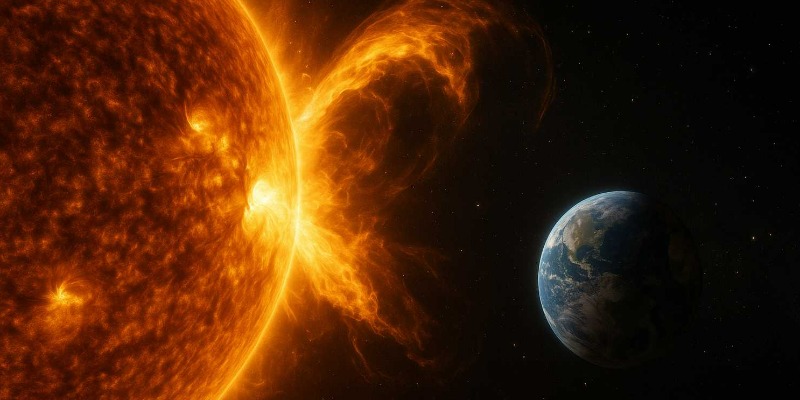
The Sun, though much more massive than the Moon, is so distant that its effect on tides is about half that of the Moon’s. However, it can amplify or reduce the phenomenon depending on its alignment with the Earth and Moon (as seen in spring and neap tides).
Tidal Friction: When the Tides “Brake” the Earth
But how do we go from the phenomenon of tides to the influence on Earth’s rotation? Here comes into play a fascinating and little-known concept: tidal friction.
Every time the Moon “lifts” Earth’s waters, Earth’s rotation tends to move these bulges slightly ahead of the Moon’s position. This shift creates a kind of gravitational “brake”: the bulged mass of water pulls on the Moon, but at the same time, the Moon exerts a reactive force on Earth, which gradually slows its rotation.
This friction, known in physics as “tidal dissipation,” transforms part of Earth's rotational energy into heat and transfers a tiny fraction of that energy to the Earth-Moon orbital system, causing the Moon to drift away from Earth by about 3.8 centimeters each year.
Historical Data: Evidence of Earth’s Slowing Rotation
Concrete proof of this phenomenon comes from the historical analysis of astronomical data. For example, ancient solar eclipses, recorded in Babylonian and Chinese chronicles, show that the length of Earth's day has slowly increased over millennia.
Today, thanks to atomic clocks and extremely precise measurement technologies, we know that the length of Earth's day increases by about 1.7 milliseconds per century. This may seem negligible, but on geological timescales, the accumulated effect becomes significant: hundreds of millions of years ago, a day on Earth lasted only 22 hours.
Long-Term Implications: Ever Longer Days and a More Distant Moon
This slow deceleration has major consequences for the Earth-Moon system. If we project this phenomenon into the distant future, Earth will eventually show the same face to the Moon, just as the Moon already always shows the same hemisphere to Earth (a synchronous rotation).
The final result, known as “tidal locking,” would lead to a state of equilibrium in which an Earth day would last as long as a lunar month—about 47 days, according to projections. However, this would take tens of billions of years, well beyond the estimated lifespan of the Sun as an active star.
In the meantime, the Moon will continue to drift slowly away from Earth, altering the climatic, tidal, and astronomical balances that we currently take for granted.
Tides as a Driver of Earth’s Dynamics
The influence of tides does not stop at merely slowing Earth's rotation. The dissipation of tidal energy also contributes to geological phenomena such as internal heating of the Earth's crust, the shifting of tectonic plates, and even the evolution of life. Some scientists hypothesize that tidal cycles helped create favorable environments for primitive life in tidal pools, where nutrients could concentrate and conditions changed rapidly.
Tides also influence the climate by regulating the movement of ocean masses that transport heat and nutrients around the globe. The rhythm of the tides also governs the biosphere cycle and the habits of many animal species.
Beyond Earth: A Universal Phenomenon
Tidal friction is not exclusive to Earth. In the solar system, tidal interactions have also shaped other planets and satellites. Consider Jupiter and its moons, like Io, where powerful tidal forces generate intense volcanic activity. Or the Pluto-Charon system, where both celestial bodies are tidally locked to each other.
These examples highlight how gravitational and tidal forces are universal and shape the dynamic evolution of celestial bodies in often surprising ways.
Scientific Research on the Future of Earth’s Rotation
Today, science is studying with increasing precision the influence of tides on Earth's rotation, using satellites, GPS sensors, and lunar observatories to monitor movements and changes in the Earth-Moon distance.
The applications are not only theoretical: accurately knowing Earth’s slowing rotation is fundamental for calibrating satellite navigation systems, atomic clocks, and even for managing Coordinated Universal Time (UTC), which occasionally needs “leap seconds” to stay aligned with astronomical reality.
Research on tides is also providing new insights to better understand Earth’s geological history and the formation of the solar system.
Curiosities and Cultural Impacts: From Ancient Civilizations to the Future
The influence of tides on Earth’s rotation did not go unnoticed by the great ancient civilizations, which observed the rhythms of the waters and the rising of celestial bodies to regulate calendars and daily activities.
In modern thought, awareness of the link between tides and Earth’s rotation offers a new perspective on the nature of time, making it clear that the “day” as we know it is not a static unit but the result of a dynamic and delicate equilibrium.
Future generations may find themselves living on a planet with longer days, a more distant Moon, and different tides—small changes that, on a human scale, seem imperceptible, but which mark profound transformations in the geological history of Earth.
Conclusion: The Invisible Force That Shapes Time
The influence of tides on Earth's rotation is one of the many wonders that physics allows us to discover—a hidden force that sets the rhythm of time, links Earth to the Moon, and, indirectly, accompanies the history of life and climate on our planet.
Becoming aware of this connection invites us to observe nature with new eyes, seeing in the waves breaking on the shore a reflection of the grand cosmic dance in which we are all involved.
Tides are not only a daily phenomenon but also a symbol of the delicate balance on which life on Earth is founded, and of the constant evolution of which we are both witnesses and protagonists.
© All rights reserved