- The Strategic Role of LDPE in the Plastic Film Industry
- Molecular Structure of LDPE and Implications for Mechanical Performance
- Industrial Applications of LDPE in Packaging, Agriculture, and Construction
- From the Linear Model to the Circular Economy in the Polyolefin Sector
- Post-Consumer LDPE: From Waste to Secondary Raw Material
- Evolution of European Regulations on the Recycling of Plastic Packaging
- Economic Dynamics of the Recycled LDPE Market
- Technical Differences between Virgin, Post-Industrial, and Post-Consumer LDPE
- Critical Issues and Opportunities in LDPE Film Recycling
- Methodological Approach and Operational Objectives of the LDPE Recycling Manual
The role of LDPE in modern industry, the value of post-consumer plastics, the differences between virgin and recycled plastics, and the regulatory framework for plastic film recycling
Technical Manual. General Introduction to LDPE Recycling: Industrial, Regulatory, and Technical Context. Chapter 1
The role of LDPE in modern industry
Low-density polyethylene, commonly referred to by its acronym LDPE (Low Density Polyethylene), was one of the cornerstones of the industrial development of plastics during the twentieth century and continues to play a key role in the modern polymeric materials industry. Its popularity is not due to a single distinctive property, but rather to a particularly favorable balance between mechanical performance, ease of processing, application adaptability, and the economic sustainability of production processes.
From a chemical-structural standpoint, LDPE is characterized by a highly branched macromolecular chain, with an irregular distribution of long and short branches that hinder the orderly packing of the polymer chains. This molecular configuration results in a low degree of crystallinity, a density typically between 0.915 and 0.935 g/cm³, and markedly ductile mechanical behavior.
The industrial implications of this structure are manifold . LDPE exhibits high flexibility, good resistance to tear propagation, pronounced elastoplastic behavior, and considerable tolerance to cyclic deformation. These characteristics make it particularly suitable for the production of thin, flexible products, where the ability to absorb mechanical stress without brittle fracture is an essential requirement.
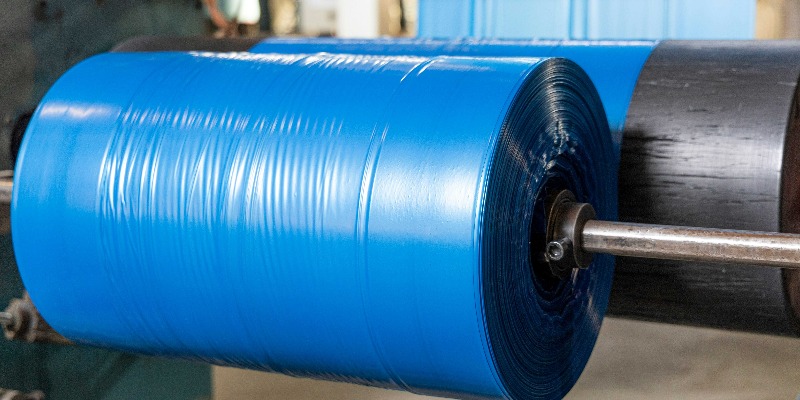
It is no coincidence that LDPE's main application area has historically been linked to film production: films for food and industrial packaging, bags and pouches, stretch and shrink films, agricultural films for mulching and crop covering, protective coatings and waterproofing membranes.
From a technological standpoint, LDPE has contributed significantly to the standardization and diffusion of blown and flat extrusion processes . Its relatively wide processing window, combined with good thermal stability at typical processing temperatures, allows for continuous and reliable production even on older systems.
This has had a significant impact on the material's global penetration, allowing a large number of converters, even small and medium-sized ones, to access plastic film production with limited investment. In many industrial contexts, LDPE has been and still is the reference polymer for high-volume, low-margin applications, where process reliability is often more important than maximizing mechanical performance.

Another factor that has consolidated LDPE's role in modern industry is its compatibility with a wide range of formulations and blends. The ability to blend it with LLDPE, MDPE, or, in some applications, with recycled polyethylene fractions, allows for the tuning of properties such as stiffness, puncture resistance, transparency, and welding behavior. Added to this is the widespread use of functional additives—antioxidants, slip agents, antiblocking agents, UV stabilizers—which further expand the material's range of applications. This formulation flexibility has made LDPE a technological platform rather than a simple polymer, capable of adapting to a wide range of markets, from consumer packaging to low-complexity technical applications.
From an economic and systemic perspective, LDPE has for decades served as a "bridge" material between the need for sufficient performance and cost containment throughout the entire supply chain. The relatively low cost of the virgin raw material, combined with the high productivity of processing plants, has favored the growth of markets based on large volumes and very short product life cycles. This industrial model, while ensuring efficiency and accessibility, has also generated a growing flow of end-of-life plastic waste, largely consisting of LDPE products in the form of post-consumer film.
Promote your company on rMIX manuals and give copies to your customers.