- What is meant by contamination in post-consumer LDPE film?
- Physical contaminants in LDPE film recycling: origin, diffusion and critical issues
- Paper, sand, organic material and metals: the most frequent pollutants in post-consumer flows
- Inks, glues, and labels in plastic film: why they compromise recycling
- Incompatible polymers in recycled LDPE: PVC, EVA, PP, PET and multilayer structures
- Used agricultural films: soil residues, fertilizers and organic substances in recycling
- Environmental residues and polymer degradation: how the quality of recovered film changes
- Effects of contamination on the densifier: wear, instability and reduction in yield
- How contaminants affect the extrusion and quality of recycled LDPE pellets
- Film defects, weldability and final properties of contaminated recycled film
Technical analysis of physical, chemical, and polymeric contamination in post-consumer LDPE film: paper, sand, organic residues, inks, glues, labels, PVC, EVA, PP, PET, and multilayer
Post-Consumer LDPE Handbook. Chapter 4: Contamination in Post-Consumer LDPE Film. Types of Impurities, Incompatible Polymers, Effects on Extrusion and Recycled Film Quality
Author: Marco Arezio . Expert in the circular economy, polymer recycling, and industrial plastics supply chains. Founder of the rMIX platform, dedicated to the valorization of recycled materials and services for the circular economy.
In the mechanical recycling of post-consumer LDPE film, contamination is not an anomaly, but a structural condition of the input material. Understanding the nature, origin, and industrial impact of impurities is essential for those involved in sorting, washing, densifying, extruding, and final processing of the recycled polymer.
This chapter analyzes the main forms of contamination affecting post-consumer film and evaluates their concrete effects on process stability, granule quality, and the material's convertibility into new technical or commercial films. The goal is not merely descriptive, but operational: to offer an industrial interpretation of the problem, useful to technicians, recyclers, compounders, converters, and quality managers.
Types of physical and chemical contaminants
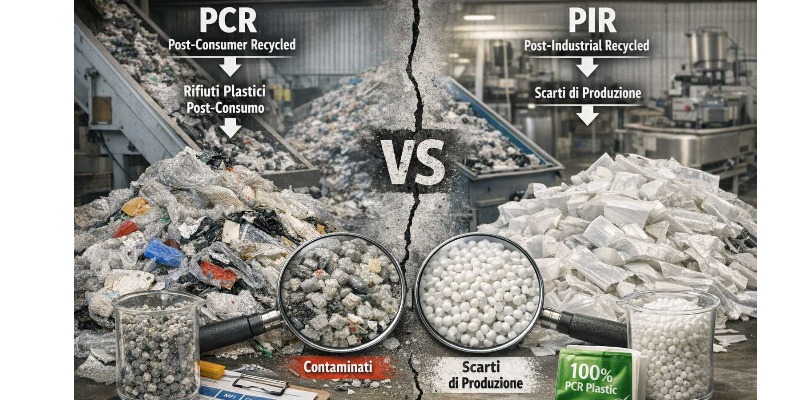
In the recycling of post-consumer LDPE film, contamination is one of the most critical and determining factors for the final quality of the recycled material. Unlike virgin or post-industrial material, post-consumer film is the result of a real, often uncontrolled, use cycle that exposes the polymer to a variety of external agents. Contamination is not a marginal or accidental phenomenon, but a structural element of the post-consumer flow, which must be understood, classified, and managed systematically. Analyzing the types of physical and chemical contaminants therefore lays the foundation for a realistic assessment of the possibilities and limitations of LDPE film recycling.
Physical contaminants are generally the most immediately perceptible and visible. They include solid foreign materials that mix with the film during use, collection, and handling. Paper, cardboard, sand, dust, mineral residues, glass or metal fragments are typical examples of physical contamination. In the context of post-consumer film, these contaminants are particularly insidious because they tend to adhere to the surface of the material or remain trapped between the layers of compressed film. The flexibility and lightness of LDPE favor the accumulation of impurities, making complete separation difficult in subsequent phases.
Among physical contaminants, organic matter occupies a prominent position. Food residues, grease, moisture, plant residues, and microorganisms are common, especially in domestic and agricultural waste streams. These contaminants not only degrade the material's appearance and odor, but also trigger chemical and biological degradation processes that can compromise the polymer's stability. The presence of organic matter also increases the demand for washing and drying, directly impacting operating costs and recycling yields.
Alongside physical contaminants, chemical contaminants represent a more complex and less readily identifiable category. They include substances that interact with the polymer at the molecular level or are carried over into the recycling process as difficult-to-separate residues. Printing inks, glues, adhesives, and labels are among the main sources of chemical contamination in post-consumer film. These elements are an integral part of the original product and cannot strictly be considered extraneous, but they become problematic when the material is remelted and reprocessed.
The inks used to print films may contain pigments, solvents, and additives that, during the recycling process, migrate into the polymer or degrade, altering its color and properties. Glues and adhesives, often formulated to ensure permanent adhesion, can melt at different temperatures than LDPE, creating inclusions or charred residues that compromise the quality of the recycled pellet. Labels, especially if made from materials other than the base polymer, represent a further source of incompatibility and material variability.
A particularly critical category of contamination is represented by incompatible polymers. Post-consumer LDPE film may contain varying amounts of other polymers, either intentionally introduced during the product's design phase or accidentally during collection. PVC, EVA, PP, PET, and multilayer materials are the main sources of polymer contamination. Even in small percentages, these materials can significantly affect the behavior of the recycled polymer.

PVC, for example, is extremely problematic for LDPE recycling, as it releases corrosive compounds and degrades at lower temperatures than polyethylene processing temperatures.
EVA, despite being chemically more similar, alters the rheological and mechanical properties of the material, making the melt behavior less predictable. PP and PET, if present in the form of fragments or residues, can cause surface defects and structural discontinuities in the final product. Finally, multilayer materials represent structural contamination, as they combine different layers designed not to be separated.Another type of contamination involves agricultural and environmental residues. Films from agriculture are frequently contaminated with soil, sand, fertilizers, pesticides, and plant residues. These contaminants not only increase the content of solid impurities, but can also introduce chemicals that accelerate polymer degradation or interfere with processing. Films dispersed in the environment and subsequently recovered also often exhibit a high degree of surface degradation and complex contamination that is difficult to completely eliminate.
From an industrial perspective, it is essential to understand that the different types of contaminants do not act in isolation, but interact with each other and with the polymer during the recycling process. The simultaneous presence of physical and chemical contaminants amplifies the negative effects, reducing process stability and the quality of the final material. Contamination management therefore cannot be entrusted to a single technological step, but must be integrated throughout the entire supply chain, from collection to processing....
FAQ
What are the most common contaminants in post-consumer LDPE film?
The most common are paper, sand, soil, organic residues, metals, inks, glues, labels and incompatible polymers such as PVC, PP, PET, EVA and multilayer structures.
Why is PVC so dangerous when recycled from LDPE?
Because it degrades at lower temperatures than polyethylene is processed, releasing corrosive compounds and generating serious defects in the recycled material.
Can printing inks compromise recycled film?
Yes. They can alter the color, promote degradation, and generate aesthetic and structural defects in the film obtained from recycled material.
Is agricultural film more difficult to recycle than domestic film?
In many cases, yes, because they contain soil, moisture, plant residues, fertilizers, and degradation from environmental exposure, often resulting in lower yields and higher treatment costs.
Do contaminations only affect the aesthetics of the recycled film?
No. In addition to the visual appearance, they affect viscosity, bubble stability, sealability, mechanical strength, process continuity, and maintenance costs.