- The Technical Gap in LDPE Recycling: Why a Structured Vision of the Supply Chain is Needed
Post-Consumer LDPE: Environmental Expectations and Industrial Reality
- From Harvest to Processing: Understanding the Technical Constraints of LDPE PCR
- Quality, Performance and Variability of Recycled Polyethylene Granules
- Real Sustainability in LDPE Recycling: Efficiency, Yield, and Application Consistency
- Economics of LDPE PCR: Costs, Margins, and Industrial Risks
- Shared Technical Lexicon in the Plastics Recycling Sector
- LDPE Recycling as an Applied Materials Engineering Discipline
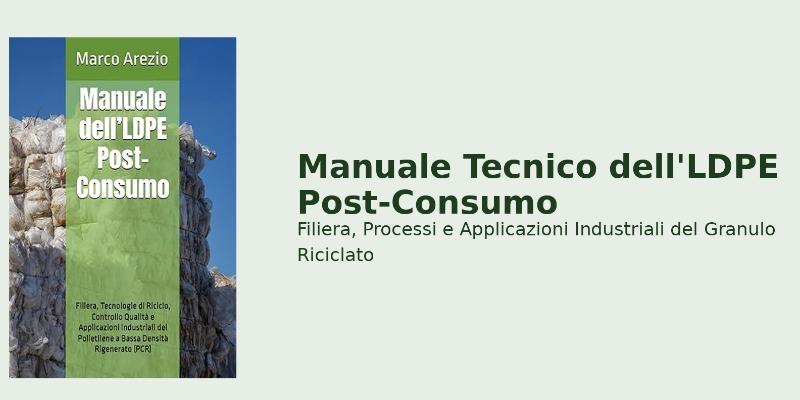
Why was this manual on LDPE recycling written, who is it aimed at and what technical-industrial approach does it propose?
Origin, recipients and purpose of this technical manual on LDPE recycling
This manual was written because, in the plastics industry, and particularly in the world of LDPE recycling , there exists a cultural and technical void that has become increasingly evident in recent years. Not a complete information void, but a lack of structured understanding, of connections between the various levels of the supply chain, and of a technical narrative consistent with industrial reality.
LDPE recycling is mentioned everywhere: in regulatory documents, sustainability plans, corporate presentations, and marketing claims. But it's rarely explained for what it truly is: a complex, imperfect industrial process that can only be managed through skill, method, and experience.
This text was born from the need to bring LDPE recycling back to its proper place: industry. Not environmental rhetoric, simplified communication, or unconstrained technological optimism. But an industry characterized by irregular flows, process parameters, variable yields, and trade-offs between quality, cost, and production continuity. The manual was written because recycling is too often presented as a concept, while those who work with the material every day know that recycling is, above all, a practice.
In recent years, post-consumer LDPE has become one of the most discussed and, at the same time, most misunderstood materials in the entire plastics supply chain. On the one hand, it is burdened with high expectations: CO₂ reduction, replacement of virgin materials, closing the loop, demonstrable sustainability. On the other hand, it is used without a true understanding of its limitations, generating production problems, process instability, and disappointment in final applications. This manual was created precisely to bridge this gap between expectations and reality, offering a technical, honest, and systemic analysis of the material and the processes that transform it.
It was written because LDPE recycling is no longer an ancillary, residual, or experimental activity. It has become a structural function of many industrial supply chains. Today, producers of film, bags, or flexible packaging cannot ignore the issue of recycled materials, just as recyclers can no longer simply "make granules" without considering the applications, performance, and economic sustainability of their product. In this new context, continuing to treat recycling as an appendage of the production system means exposing oneself to increasingly greater technical and strategic risks.
This manual was also written because the sector suffers from a fragmented language. The same words—quality, PCR, sustainability, suitability, performance—take on different meanings depending on whether they are used by a recycler, a processor, a marketing manager, or a regulatory decision maker. This ambiguity generates misunderstandings, conflicts, and misaligned expectations. One of the implicit objectives of this text is to reconstruct a shared technical lexicon that allows the various players in the supply chain to engage in concrete dialogue.
The manual was written for those who work with post-consumer LDPE, but also for those who make decisions regarding it without necessarily touching it firsthand. It is aimed at plant managers who must choose which flows to accept and how to treat them; at process technicians who must operate washing, extrusion, and filtration lines under non-ideal conditions; at quality managers who must transform a variable material into a defensible specification; and at processors who incorporate PCR into their recipes and must ensure production continuity. It is also aimed at managers, consultants, salespeople, designers, and strategic figures who must evaluate investments, define procurement policies, or build credible sustainability strategies.
This manual is not intended for those seeking simple answers to complex problems. It is intended for those who accept the idea that LDPE recycling is a system with physical, chemical, and economic constraints, and that only by understanding these constraints can lasting results be achieved. It does not promise universal solutions, because they do not exist. It does not propose recipes that apply to every context, because every flow, every plant, and every application has its own characteristics. Instead, it offers interpretation criteria, interpretative keys, and process logics that allow one to navigate the complexity.
Reading this manual means understanding why post-consumer LDPE isn't "just LDPE." It means understanding why two seemingly similar pellets can behave completely differently during extrusion. It means recognizing that the quality of recycled material doesn't start in the lab, but much earlier: in collection, sorting, and in the choices made upstream in the supply chain. It means accepting that sustainability isn't an automatic attribute of recycled material, but the result of efficient processes, high yields, and consistent applications.

This text was also written to counter a distorted narrative that recycling is an intrinsically virtuous activity, regardless of how it is implemented.
In reality, poorly designed, inefficient, or technically inadequate recycling can generate more waste, consumption, and frustration than the conscious use of virgin material. The manual addresses this issue fearlessly, demonstrating that true sustainability stems from industrial expertise, not mere intention.The manual is also aimed at those who need to evaluate recycling from an economic perspective. One of the most widespread misconceptions is that recycled material is, by definition, more cost-effective. In reality, the cost of PCR depends on multiple factors: flow quality, plant efficiency, yield, energy costs, waste, and process stability. This text provides a clear overview of the economics of LDPE recycling, showing when and why it can be profitable, and when it becomes a source of structural losses.
Another reason to read this manual is that it restores technical dignity to the recycler's work . For too long, recycling has been perceived as a second-rate activity compared to the production of virgin polymers. In reality, managing post-consumer flows often requires superior skills, because it means working with imperfect, variable, and historically charged materials. This text addresses recycling for what it has become: an applied materials engineering discipline, where operational experience is as important as theory.
The manual was also written for those involved in regulations, certifications, and sustainability communications. Reading it, it becomes clear that no certification can replace a technical understanding of the process. Rules only make sense when applied to the reality of plants and applications. This text helps us understand regulations not as a set of abstract obligations, but as a system of constraints that interact directly with industrial decisions.
Why read this manual , then? Because it helps you avoid costly mistakes. Because it allows you to distinguish between structural and contingent problems. Because it helps you understand when a limitation is technical and when it is organizational. Because it offers a comprehensive view rarely found in fragmented specialist texts. But above all, because it restores LDPE recycling to its true dimension: not as a life-saving solution, but as a powerful industrial tool, if used wisely.
This manual doesn't ask the reader to believe in recycling. It asks them to understand it. It doesn't ask for ideological adherence, but rather technical attention. It doesn't promise simplicity, but clarity. And in an industry where complexity is often disguised as slogans, clarity is already a competitive advantage.
Those who read this text will not have an idealized vision of LDPE recycling, but a solid, concrete, and usable one. They will understand why certain materials work and others don't. They will understand why some supply chains are sustainable while others are only apparently so. Above all, they will know that the future of recycling belongs not to those who best describe it, but to those who design, manage, and improve it every day, methodically and responsibly.
That's why this manual was written. And that's why it's worth reading.