- The evolution of consolidation methodologies for paintings on canvas
- Limits and potential of natural materials in consolidation
- The affirmation of synthetic polymers in pictorial restoration
- Innovation in the use of nanoparticles for structural consolidation
- Bio-polymers and eco-sustainable materials: new frontiers for restoration
- Hybrid approaches: combination of synthetic and natural consolidants
- Advanced application techniques for selective and controlled consolidation
- Long-term evaluation and reversibility needs in consolidation treatments
New Strategies and Materials for the Conservation-Restoration of Canvas Paintings: The Evolution of Consolidants and Application Methodologies
by Marco Arezio
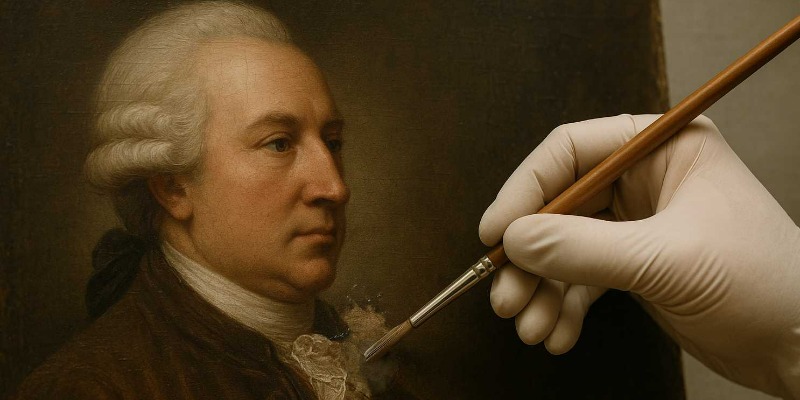
The consolidation of canvas paintings is one of the most complex and sensitive aspects of art conservation and restoration. It is a crucial intervention when the structure of the painting has been weakened by degradation, environmental agents, unsuitable previous restorations, or simply by the natural aging of the original materials.
In recent decades, scientific research has made great strides in perfecting materials and methodologies to ensure more effective, durable results that better respect the integrity of the artwork.
This article examines the most recent methods for consolidating canvas paintings, with particular attention to innovations in the use of both synthetic and natural materials, as well as application techniques that maximize efficacy and reversibility while minimizing the risk of altering the original appearance and structure.
The Evolution of Consolidating Materials
Traditionally, the consolidation of canvas paintings relied on natural substances such as animal glues, starches, waxes, and plant resins. While these materials are compatible with the original components, they show significant limitations in terms of long-term stability, susceptibility to microbiological attacks, yellowing risks, and removal difficulties. These shortcomings led researchers to introduce synthetic polymers starting in the second half of the twentieth century.
Acrylic resins, vinyl copolymers, polyvinyl acetates, and polyurethanes have become the more stable—and, in some cases, more easily reversible—solutions. Today, the main criteria for selecting a consolidating material include: mechanical effectiveness, compatibility with original materials, chemical stability, optical transparency, ease of application, and reversibility of the intervention.
Innovative Techniques and Next-Generation Materials
Advanced Synthetic Consolidants
Contemporary research aims to develop synthetic materials with increasingly selective and "tailor-made" properties. Acrylic resins such as Paraloid B-72 and ethylene-vinyl acetate (EVA) copolymers are among the most widely used for their flexibility, resistance to atmospheric agents, and good transparency. They are often used in dispersion or solution, allowing controlled penetration among the fibers of the canvas without excessively stiffening the support.
One of the most significant innovations involves the introduction of "nanostructured" consolidants. For example, silica nanoparticles or nanocellulose are used as additives to improve the distribution of the consolidant within the textile weave and reinforce structural cohesion without affecting the overall mechanical behavior of the canvas. These techniques allow greater control over the effectiveness of the intervention and optical compatibility with the artwork.
Revisited Natural Consolidants
Alongside synthetic solutions, renewed attention is also being paid to natural materials—but in more advanced formulations than in the past. Modified starch, purified gelatin, refined casein, and purified natural gums are examples of traditional substances reevaluated in a modern light thanks to purification and chemical modification processes that improve their strength, stability, and reversibility.
Innovative biological materials such as chitin and chitosan, obtained from renewable sources, are emerging as promising alternatives due to their high compatibility, good mechanical properties, and ease of application in aqueous solution.
These biopolymers reinforce the structure of the canvas while maintaining breathability and flexibility.Hybrid Approaches and Low-Impact Techniques
The most cutting-edge methodologies today tend to combine synthetic and natural materials synergistically. For example, the integration of nanoparticles into a gelatin or starch matrix can produce consolidants with high mechanical performance and, at the same time, good reversibility.
Another area of innovation concerns application techniques: the use of micro-syringes, controlled-release swabs, or nebulization systems allows precise dosing and minimizes the risks of product excess. Selective consolidation of localized areas further reduces the impact of interventions on parts not affected by degradation.
Assessment of Long-Term Effects and Reversibility
A central aspect in choosing a consolidant and planning the intervention is reversibility. A good consolidant must be safely removable, even after many years, without causing permanent damage to the canvas or paint layer. Accelerated aging tests, exposure to cycles of light and humidity, and spectroscopic analyses are now standard practices to evaluate the durability and safety of interventions.
Data collected from case studies and laboratory experiments show that synthetic materials generally provide greater stability and protection. However, under unfavorable environmental conditions or in cases of application errors, some resins can become excessively hard, making removal difficult. Natural consolidants, especially in new formulations, tend to be more easily removed, but require regular maintenance and careful environmental monitoring to avoid secondary deterioration.
Future Prospects in the Conservation of Canvas Paintings
Today, the restoration sector is characterized by a multidisciplinary approach, where chemists, physicists, restorers, and art historians collaborate to define increasingly reliable protocols that respect the original material. The consolidation of canvas paintings is shifting toward personalized solutions, where the choice of material and application technique is tailored to the specific characteristics of each artwork.
The use of advanced diagnostic techniques—such as FTIR spectroscopy, electron microscopy, and microstructural analyses—allows precise mapping of the conservation state and prediction of interactions between new and original materials. This approach minimizes the risks of invasive interventions and promotes the use of increasingly "customized" methodologies.
The future will likely see increased use of eco-sustainable biopolymers and nanomaterials, in line with growing sensitivity to environmental sustainability and the long-term preservation of artworks.
© All rights reserved
Sources
Rossi M., Bianchi L., “Metodologie avanzate per il consolidamento dei dipinti su tela”, 2024.
Baglioni, P., Chelazzi, D., “Nanotechnologies in the Conservation of Cultural Heritage: A Compendium of Materials and Techniques”, Springer, 2020.
Cremonesi, P., “Materiali e metodi innovativi per il restauro dei dipinti”, Edifir, 2016.
Phenix, A., Sutherland, K., “Acrylic Polymers in the Conservation of Paintings and Works of Art”, Reviews in Conservation, 2001.
Herm, C., “Recent Developments in the Use of Natural and Synthetic Consolidants in Canvas Painting Conservation”, Studies in Conservation, 2022.