- Acidity of paper: causes and consequences of degradation
- Scientific principles of deacidification
- Aqueous techniques and their conservative efficacy
- Non-aqueous treatments and application advantages
- Mass deacidification for archives and libraries
- Long-term stability of the processed documents
- New frontiers of interdisciplinary research
- Future prospects in paper conservation
Scientific strategies to extend the life of historical paper documents
by Marco Arezio
Paper is one of the most fragile and, at the same time, most precious materials in the world's cultural heritage. Libraries, archives, and private collections preserve millions of documents whose survival is threatened by an invisible enemy: acidity. The acidic degradation of cellulose fibers, a phenomenon particularly widespread in paper media produced since the mid-nineteenth century, represents one of the main causes of loss of mechanical stability and legibility.
To address this problem, deacidification has emerged as a key preventative conservation practice. It is not an aesthetic intervention, but rather a chemical action aimed at neutralizing the acids present in paper and introducing an alkaline reserve capable of slowing deterioration over time. The study and experimentation of various techniques have led to the development of diverse methodologies, each with advantages and limitations, depending on the characteristics of the document and the context in which they are applied.
Acidity of paper: causes and consequences
The fragility of modern paper documents is linked to past technological choices. With the advent of industrial paper production, cellulose extracted from wood gradually replaced traditionally more stable cotton or linen fibers. The presence of lignin and the use of alum-based glues made paper particularly vulnerable to acid attack.
Over time, exposure to humidity and air pollutants has exacerbated the problem, leading to obvious degradation: yellowing, mechanical fragility, and loss of elasticity. If left unchecked, this process leads to the document's complete unusability.
Objectives and principles of deacidification
Deacidification is not simply a stabilization treatment, but a scientific approach to conservation. It aims to:
- neutralize the acids already present, reducing the rate of cellulose hydrolysis
- introduce an alkaline reserve, that is, a deposit of substances capable of reacting with any acids that may form over time
- ensure physical and visual stability, preventing the treatments themselves from causing chromatic alterations, deformations or solubilization of the inks
The desired result is a more resilient document, capable of facing the coming decades without risk of structural loss.
Aqueous methods: direct neutralization
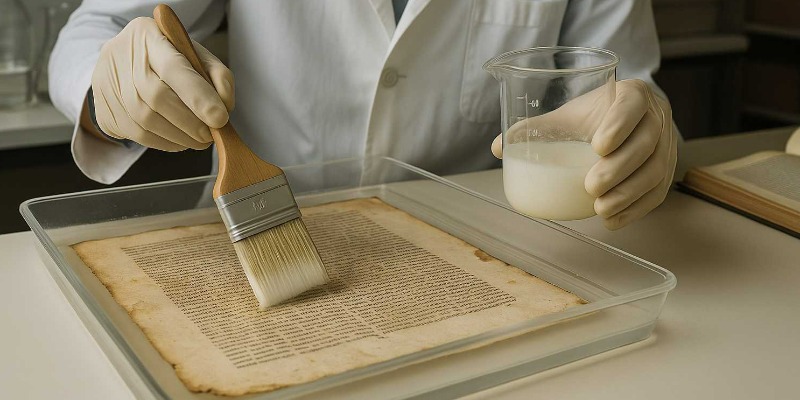
Aqueous treatments represent the traditional method of deacidification. Documents are immersed in carbonate or hydroxide solutions, which can diffuse into the fibers and react with acids. This results in rapid neutralization and the formation of insoluble carbonates that act as an alkaline reserve.
The chemical effectiveness of these methods is undeniable: the treated paper shows a marked improvement in mechanical properties and a longer expected lifespan. However, water is not a neutral medium: sensitive inks, unstable pigments, or decorated documents may suffer alterations or color losses. For this reason, aqueous treatments are recommended only for papers free of delicate pictorial elements.
Non-aqueous treatments: selective approaches
To overcome the risks associated with water, systems based on organic solvents have been developed. In this case, the deacidifier—often a magnesium or calcium oxide or alcoholate—is dissolved in nonpolar solvents that can penetrate the fibers without solubilizing the inks.
These methods allow for selective application, minimizing side effects.
The main advantages are the absence of paper swelling and compatibility with a wide range of materials. Limitations include the cost of solvents and the less uniform alkaline reserve compared to aqueous systems.Mass deacidification: collective treatments
Large libraries and national archives have posed the problem of scale: how to process thousands of volumes in a reasonable time and at a sustainable cost? The answer has been the development of mass deacidification systems.
These involve the simultaneous exposure of numerous volumes to alkaline vapors or suspensions of micronized particles in pressurized chambers. The process allows for uniform and rapid treatment, reducing unit costs. However, undesirable effects have occurred: discoloration, lingering odors, or differences in effectiveness between areas of the document. Nevertheless, they represent a viable solution for large, homogeneous collections.
Long-term efficacy assessments
The real challenge of deacidification is verifying the stability of the results over time. Analyses conducted on treated documents have demonstrated a significant slowdown in cellulose depolymerization, with a significant increase in the expected useful life.
The main advantage is the reduction in mechanical fragility, allowing documents to be consulted without risk of breakage. Some critical issues remain, such as interaction with iron gall inks, which can undergo accelerated corrosion processes without further protective treatments.
The contribution of interdisciplinary research
No conservation intervention can ignore an integrated approach. Deacidification is a field in which chemistry, materials physics, restoration, and archival science converge. The most recent research focuses on the use of nanomaterials and controlled dispersions, capable of depositing the alkaline reserve homogeneously and stably. At the same time, the use of non-invasive diagnostic techniques—spectroscopy, fluorescence, multispectral imaging—allows us to monitor the effects of treatments without compromising the artifacts.
Future prospects
The future of deacidification depends on the balance between effectiveness and sustainability. The most modern systems must ensure the long-term protection of documents, avoiding negative environmental impacts and reducing operating costs. Research is oriented toward less invasive solutions that respect the historical and material complexity of cultural heritage while ensuring its enjoyment by future generations.
© Reproduction Prohibited
Sources
- Silvia Fontana, Deacidification of paper documents: methods and applications.
- Baty, J. W., Maitland, C. L., Minter, W., Hubbe, M. A. (2010). “Deacidification for the conservation and preservation of paper-based works: a review.” BioResources.
- Porck, H. (1996). Mass Deacidification: An Update on Possibilities and Limitations.
- Daniels, V., & Kosek, J. (2004). “Studies on the deacidification of paper containing iron-gall ink.” Restorer.
- Middleton, B. (1996). The Deacidification of Paper and Related Materials.