- History and technical characteristics of ancient tapestries
- Causes of deterioration in tapestries: light, dust and biological agents
- Preliminary analysis and documentation before restoration
- Cleaning tapestries: dry and wet techniques
- Structural consolidation and reintegration of fibres
- Mending and support techniques in textile restoration
- Major restoration interventions on famous tapestries
- Innovation and research in the restoration of ancient tapestries
Textile restoration techniques applied to ancient tapestries: approaches, methodologies, materials and some of the most famous international conservation and recovery interventions
by Marco Arezio
Ancient tapestries represent one of the pinnacles of European textile art, combining artisanal skill, historical value, iconography and decorative and celebratory function. Works produced between the Middle Ages and the nineteenth century, often commissioned by ruling dynasties, churches or great patrons, have undergone numerous degradation processes over the centuries, which have put their survival at risk. Dust, light, thermo-hygrometric variations, biological infestations and even wear from exposure have required the use of increasingly refined conservation and restoration methodologies.
In the following article we analyse in detail the main techniques adopted in specialized laboratories, the operational stages of a textile restoration , the recurring critical issues and some famous cases of intervention on historical European tapestries, to understand the complexity of this branch of conservation and the value it restores to the artistic heritage.
The historical and technical value of tapestries
Tapestries were traditionally woven on large vertical (haut-lisse) or horizontal (basse-lisse) looms with silk, wool, linen and sometimes gold or silver metal threads. Their production required the collaboration of painters (for the preparatory cartoon), highly specialized weavers and highly complex laboratory logistics.
The composition of the materials, the quality of the yarns and natural dyes, and the conditions of historical exposure determine the type of degradation and the relative difficulty of recovery. The main production centers were Brussels, Arras, Aubusson, Beauvais, Florence and Mantua, each with its own techniques and iconographic preferences.
Causes of Deterioration in Ancient Tapestries
Before tackling restoration techniques, it is necessary to understand the degradation factors, which are multiple:
- Light: Ultraviolet and visible radiation alters natural dyes and weakens fibers.
- Dust and particulate matter: accumulations of dust and fumes clog the textile structure, promoting humidity and infestations.
- Humidity and thermo-hygrometric variations: create mechanical stress and encourage the development of mold and fungi.
- Biological attacks: moths, mites and bacteria deteriorate fibres, especially in protein yarns such as wool and silk.
- Mechanical manipulation and tension: Moving, hanging and bending cause failure and tears, especially along seam lines or at points of greatest stress.
The stages of restoration of an ancient tapestry
Documentation and preliminary analysis
Every restoration intervention begins with a study phase:
- Historical and iconographic analysis: identification of the dating, materials and execution techniques, reconstruction of previous conservation events.
- Photographic documentation: visible, grazing, ultraviolet and infrared light shots to identify previous restorations, chromatic alterations and gaps.
- Scientific analyses: sampling of yarns and dyes (FTIR, Raman, HPLC analysis), fibre investigations by optical microscopy and SEM.
Dust removal and pre-treatment
The first practical operation is dry cleaning, carried out with low-power vacuum cleaners equipped with HEPA filters and soft silicone nozzles, often interposing a layer of tulle to avoid accidental suction of loose fibres.
In more serious cases, you can intervene with soft brushes, vacuuming at the same time so as not to redistribute the dust. In some laboratories, controlled pressure chambers are used for more delicate cleaning.
Wet cleaning
Wet cleaning is the most critical intervention and is performed only after specific tests on the solubility of the dyes. Usually a tank is prepared at a controlled temperature (around 20-22°C) with demineralized water and neutral surfactants (free of phosphates and with a slightly acidic or neutral pH), partially immersing the tapestry and acting locally with sponges and brushes.
Sometimes washing is done in suspension on a frame, so that the tapestry is never subjected to excessive weight, thus limiting the distortion of the weave. After washing, it is rinsed repeatedly and dried in a humidity-controlled environment.
Consolidation of fibres and structures
Consolidation is the central phase of restoration and is carried out in different ways:
- Reinforcement of gaps: through the insertion of new fibers, often with needle and thread, choosing materials and colors that are compatible but distinguishable with close examination, according to the ethics of reversibility.
- Lining: The application of a backing fabric to the back of the tapestry, secured with stitching in specific places, to distribute the weight and prevent further tearing.
- Integration of the textures: where large parts of the weaving are missing, a hand-made “re-weaving” technique is used, with knotting or mending stitches that imitate the original, while avoiding any invasive intervention or intervention that alters the historical reading.
- Mounting on a suspended frame: many workshops prefer to mount the restored tapestry on a new suspended frame or on a soft frame, using Velcro systems, so that the fabric is never under tension and can “breathe”.
Protection and display conditions
Finally, protective barriers such as tulle veils or dust nets are applied and exposure conditions are defined: constant temperature (18-21°C), relative humidity between 50 and 55%, reduced light (<50 lux), monitoring systems and periodic rotations in the exposure to reduce cumulative stress.
Specific textile restoration techniques
Mending and integrated support
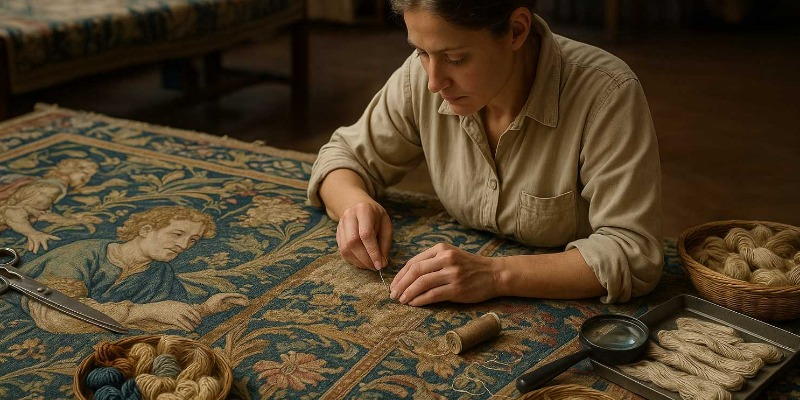
The invisible mending technique involves the use of appropriately dyed silk or wool threads, which are manually woven into the gaps, respecting the direction of the original warp and weft. It is a meticulous procedure, requiring hours of work for just a few square centimeters, and is essential to ensure the structural continuity of the tapestry.
When the gaps are too large, a support weave is applied: a base fabric is sewn onto the back (usually linen or cotton) and the missing part is integrated with embroidery that recalls the original colours and patterns, without ever imitating them perfectly, to distinguish the new from the old according to the ethics of conservation.
Chemical consolidation and protection
In recent decades, consolidating treatments based on natural and synthetic resins have been tested, but the current trend is to limit their use, favoring exclusively mechanical or reversible interventions. In some cases, methylcellulose or hydroxypropylcellulose solutions are applied to stabilize degraded fibers, but only after rigorous compatibility tests.
Non-invasive restoration techniques
Preventive conservation is the most modern strategy: climate control, pest monitoring, reduced exposure and horizontal storage or rolled on low-pressure rollers, so that the tapestries do not suffer structural deformations.
Famous cases of international restoration
The Restoration of the Sistine Chapel Tapestries (Vatican City)
One of the most well-known interventions is that on the tapestries made from Raphael's cartoons for the Sistine Chapel, commissioned by Pope Leo X and woven in Brussels between 1515 and 1519. Preserved in the Vatican Museums, they have undergone various cycles of restoration since the 19th century. The latest works, carried out between 2008 and 2012, saw the collaboration between the Vatican Museums laboratory and Belgian specialists, with cleaning, consolidation of the fibers and integration of missing parts according to non-invasive and widely documented criteria.
The restoration of the Bayeux tapestry series (France)
The Bayeux Tapestry, actually a linen embroidery almost 70 meters long and dating back to the 11th century, is one of the most famous textile artefacts in Europe. Subject to restorations since the 18th century, including a historic intervention in 1842 by Eugène Viollet-le-Duc, it was recently restored (2016-2021) with consolidation techniques using linen supports, localized cleaning, microclimatic control and complete digitization for public consultation without continuous exhibition.
The restoration of the Quirinale tapestries (Italy)
The Quirinale restoration laboratory is famous for its work on numerous Flemish and French tapestries from the 16th to the 18th century. Here, controlled wet cleaning, mending and textile integration techniques are used according to maximum reversibility and digital documentation criteria, often collaborating with the Opificio delle Pietre Dure in Florence for exchanges of skills and methodological updates.
The National Laboratory of Aubusson (France)
In Aubusson, the historic center of tapestry manufacturing, the National Carpet and Tapestry Center has developed cutting-edge restoration methodologies, including partial replica weaving for visible but historically compatible integrations, microclimatic monitoring systems, and ultra-high-definition digitization processes for mapping interventions.
The Future of Tapestry Restoration: Research, Innovation and Sustainability
The conservation of ancient tapestries is today the subject of interdisciplinary research involving chemists, physicists, biologists, art historians and textile technicians. The use of non-invasive spectroscopic analyses, multispectral imaging and artificial intelligence software for the recognition of degradation patterns allows for more precise planning of interventions.
Innovative materials for lining and support are being tested, including recycled fabrics or nanomaterials for protection from external agents. The current trend aims to minimize the impact on the original artifact, intervening only where strictly necessary and preferring reversible restoration.
Conclusions
The restoration of ancient tapestries represents one of the most complex and fascinating challenges of textile conservation, where the manual skill of the craftsman is intertwined with scientific research and ethical responsibility towards historical heritage. Through increasingly refined techniques, supported by interdisciplinary studies and rigorous protocols, it is possible to restore legibility and dignity to works that have spanned the centuries, returning them to public enjoyment and research. The famous cases tell not only of fabrics and yarns, but also of our ability to dialogue with history, respecting the material and the profound meaning of these masterpieces.
© Reproduction prohibited