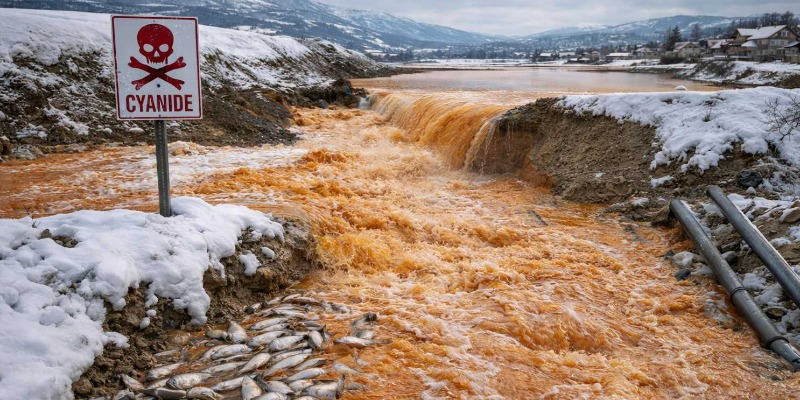
On the night of January 30-31, 2000, a dike in Romania burst, spilling millions of cubic meters of cyanide-contaminated water into the rivers of Northern Europe. It wasn't a sudden accident: it was the predictable result of a chain of fragilities—economic, institutional, and technical—that had been quietly building for years.
The Baia Mare disaster affected Romania, Hungary, and Serbia, destroying river ecosystems for hundreds of kilometers and leaving entire communities without water, without fishing, without their river. It was dubbed "the Chernobyl of water" and sparked a still unresolved debate in Europe on the industrial use of cyanide, environmental justice, and the shared management of transboundary risk. A case that, twenty-five years later, continues to question how societies assess the price of development.
Baia Mare, January 2000: The Night a Cyanide Reservoir Contaminated Three Countries and Changed Europe’s Environmental Policy
Environmental Essay. When the Earth Presents the Bill. Chapter 6: The Baia Mare Disaster — When Cyanide Poisoned Europe’s Rivers
by Marco Arezio
Before the Rupture: Mines, Economic Transition and Hidden Chemical Risk
At the end of the 1990s, Romania was a country trying to reinvent itself at great speed. The collapse of the socialist system had left behind an economic and administrative vacuum: entire industries in decline, rising unemployment, and towns built around a single factory suddenly deprived of a future. In that climate of transition, the word development took on an almost salvific meaning. Any project capable of generating jobs, investment and foreign currency was perceived as an anchor of stability. Yet this urgency often reduced the space for caution, for controls, and for a full assessment of risks.
Baia Mare, in the north of the country, carried with it a long mining memory. The extraction of precious metals had shaped both the landscape and the social identity of the region: tunnels, tailings, waste rock piles and sedimentation ponds. For centuries the mines had been both a promise of income and a source of tolerated pollution. That tolerance was partly cultural: when a territory lives from extraction, contamination becomes background noise, a “normal” price rarely discussed, because discussing it too openly means questioning the only available economy.
During the 1990s, technological innovation made possible a new gold rush, but according to a different logic. It was no longer simply a matter of digging rich veins, but of recovering metal from low-grade ore or from residues of previous processing. The most widespread method was cyanide leaching: crushed rock is treated with solutions containing sodium cyanide, which binds with gold and allows it to be separated. It is an effective and industrially proven technique, yet it carries an intrinsic risk: it requires the movement and storage of large volumes of water contaminated with extremely toxic compounds, often together with heavy metals and other substances present in the ore.
Cyanide here is not a minor technical detail: it is the ethical core of the problem. It is a substance that kills by interfering with cellular respiration; in aquatic ecosystems it can cause rapid and massive die-offs. Its management, if it is to coexist with inhabited territories, requires reliable physical barriers, continuous monitoring and truly operational emergency systems. Above all it requires a basic assumption: that error must not be considered merely “unlikely”, but “possible”, and therefore governed through redundancy and precaution. When this mindset is absent, toxicity is no longer a risk — it becomes a certainty waiting for the right moment.
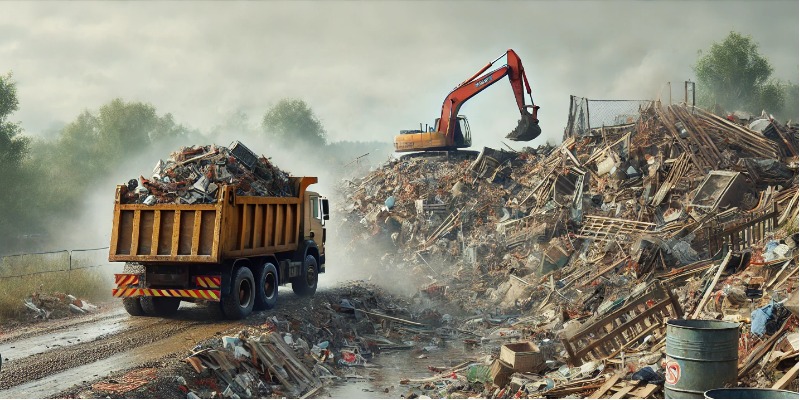
The Baia Mare facility included a large tailings pond, a structure that appears simple and precisely for that reason can be deceptive. A pond of this type is essentially an artificial lake contained by a dam or embankment. Inside there is not ordinary water, but a mixture: process solutions, fine residues and chemical compounds. The basin’s role is to allow solids to settle and to retain contaminated water, preventing it from entering natural waterways. It is the point where technology promises complete control: build a strong dam and everything remains inside. Yet the history of industrial disasters shows the opposite. A tailings pond is a living structure that responds to rain, frost, ground settlement, maintenance practices, human error and economic pressure. It is not a passive container. It is a system capable of failure.

In Romania at that time the problem was not only technical but institutional.
Local authorities had an obvious interest in economic recovery: jobs, tax revenues and the promise of “normality” after years of crisis. Environmental oversight, by definition, becomes costly and unpopular when it slows down investment. It requires trained personnel, instrumentation, unannounced inspections and the ability to impose operational shutdowns. In transitional contexts, regulation often does not disappear — it weakens. It remains formally present but loses effectiveness. This kind of fragility makes little noise, yet it creates fertile ground for accidents.Communication with the population was also problematic. Many residents had no tools to understand what it meant to live downstream from a cyanide reservoir. The gap between technical language and everyday perception was enormous. People knew the plant “used chemicals”, but that knowledge was never translated into preventive behavior, evacuation plans or warning protocols. Communities were essentially living beside a threat that had never been clearly named in understandable terms. And when a threat is not named, it cannot be prepared for.
There is also another often overlooked factor: meteorology. Tailings ponds do not fail only because of poor design; they frequently fail when a series of “normal” conditions accumulate until they become extraordinary. Persistent rain, heavy snowfall, rapid thaws, progressive saturation of the basin. Each rise in water level increases pressure on the embankment. If maintenance is insufficient, if drainage systems do not function as they should, if the dam is not reinforced or carefully monitored, safety erodes day by day. This process can remain invisible until the moment when it is already too late....
Sources
Institutional / International
UNEP / OCHA — Cyanide Spill at Baia Mare, Romania (2000): official United Nations joint report on the incident, including technical data on the composition of the toxic discharge and the international response chain.
European Commission — Report on the Baia Mare Accident (2000), DG Environment: institutional assessment of the accident and the first regulatory indications. Available in the DG ENV documentary archive.
UNECE — Helsinki Convention on the Protection and Use of Transboundary Watercourses: regulatory framework for transboundary environmental governance relevant to the case.
Scientific and Academic
Wouters, P. & Rieu-Clarke, A. (2001) — The Role of International Water Law in Promoting Sustainable Development, published in international environmental law journals; includes references to Baia Mare as a case study.
Macklin, M.G. et al. (2003) — The downstream impact of the Baia Mare tailings dam failure, in Earth Science Reviews — geomorphological and chemical analysis of the impact on river sediments. DOI available on ScienceDirect.
Kocsis, E. et al. — studies published in Environmental Pollution and Hydrobiologia concerning the biological response of the Tisza ecosystems after the accident.
Regulatory / Policy
Directive 2006/21/EC of the European Parliament — on the management of waste from extractive industries, adopted partly in response to the Baia Mare case. Official text available on EUR-Lex.
European Parliament resolution on the Baia Mare cyanide spill (2000): parliamentary resolution addressing the responsibilities of the operator and national control systems.
Journalistic / Archival
BBC News — Romania cyanide spill “affects millions”, February 2000, for contemporary media context.
The Guardian — 2000 archive coverage of the Tisza contamination and the reactions in Hungary.