- Millenary history of the Via Francisca del Lucomagno
- The slow trekking experience on the Via Francisca
- The landscapes and villages of authentic Lombardy
- The stages and points of interest along the way
- How to prepare and what to bring on the Via Francisca
- How to reach and travel the Via Francisca del Lucomagno
- Trail conditions, surfaces and atmosphere
- Useful tips and suggestions for the slow traveler
A journey of discovery, slowness and wonder among the woods, villages and waters of the most authentic Lombardy
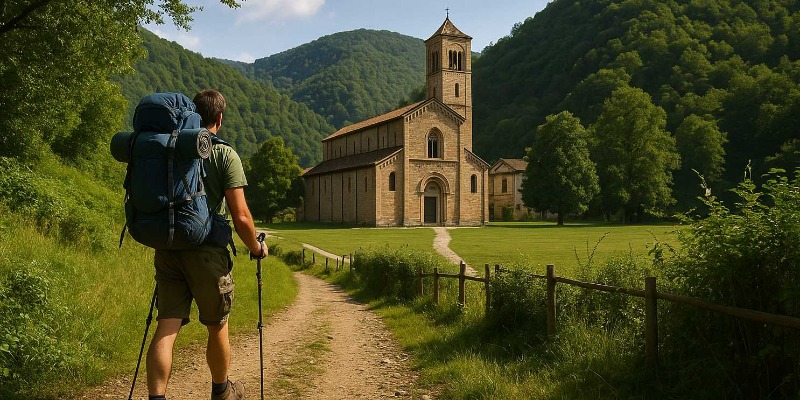
Imagine a morning suspended between two worlds: Switzerland just behind you, the Italian border that opens between quiet waters and green hills. Here, in Lavena Ponte Tresa, the Via Francisca del Lucomagno invites the traveler to leave behind the haste and the noise, to enter the silent rhythm of his own step . It is not just an ancient road: it is a school of slowness, a gym of wonder where every day you gain meter after meter, observing the constant transformation of the landscape.
For centuries, the Via Francisca has been the backbone of travelers seeking Rome by crossing the Alps from the Lucomagno Pass. It was a road of faith, of exchanges and encounters between different worlds, between abbeys where monks welcomed, merchants with saddlebags full of stories and pilgrims seeking redemption. Today, every step on these roads mends the thread of a past that resurfaces in the silence of the monasteries, in the stones of the abbeys, in the villages overlooking the streams and between the rows of poplars.
Tips and suggestions for those leaving
For those who want to undertake this slow trekking adventure, you don't need the athletic skills of a marathon runner, but rather curiosity, a spirit of adaptation and respect for yourself and the places. The stages are designed to be traveled without stress and offer a thousand opportunities for rest, both for those who love the simple hospitality of country B&Bs and for those who prefer the spiritual welcome of monasteries and abbeys. Getting hold of the credential of the path is not only a symbolic ritual, but it allows you to access a small network of services and collect stamps along the way.
How to reach the Via Francisca and how to experience it
Getting to the starting point is simple: Lavena Ponte Tresa can be easily reached by train from Milan (direction Varese, then bus to Lavena) or directly from Lugano, in Switzerland, with a cross-border train service. Those arriving by car will find parking and support points, but the train is the slowest and most sustainable choice, in perfect harmony with the spirit of the walk.
Along the route, the main stages are easily reachable even by those who want to travel only some stretches: Varese, Castiglione Olona, Morimondo and Pavia are well connected by the Lombardy railway lines. Even those travelling by bike will find suitable alternatives, especially in the flat stretches between the Ticino Park and the Pavia countryside.
The technical sheet of the Via Francisca del Lucomagno
- Total length: approximately 135 km (Italian section)
- Recommended stages: 8 (from Lavena Ponte Tresa to Pavia)
Average duration
6-8 days for the entire route, depending on pace and stops.
It is possible to divide the walk into sections of 15-22 km per day.
Main stages (indicative)
- Lavena Ponte Tresa – Ganna
- Ganna – Varese (Sacred Mount)
- Varese – Castiglione Olona
- Castiglione Olona – Castellanza
- Castellanza – Morimondo
- Morimondo – Pavia
Points of interest
- Ganna Abbey
- Sacred Mount of Varese (UNESCO)
- Castiglione Olona (“little Tuscany in Lombardy”)
- Morimondo Abbey
- Pavia, with its historic center and the Certosa
Difficulty: easy-medium. Well marked trails, few challenging elevation changes.
Credential of the Way: available online and at some reception points. It allows you to stay at affiliated facilities and obtain the final “testimonium” in Pavia.
Signage: excellent, with dedicated signs and trail markers.
Recommended period: spring and autumn (mild temperatures and nature at its best). The route is accessible all year round.
How to get to the starting point
By train: Milan–Varese, then bus N11 to Lavena Ponte Tresa.
From Lugano: train to Ponte Tresa (Switzerland) and pedestrian border crossing.
Return from Pavia:
Direct trains to Milan, easily reachable from all over Italy.
Hospitality
B&Bs, farmhouses, religious structures, small hotels.
Pilgrim hospitality along the way, often with discounted rates.
Bikes
Most of the route is suitable for cycling or has variants for two-wheelers.
What to put in your backpack
Comfortable hiking shoes, light backpack, water bottle, layered clothing, hat, paper guide or GPS tracks, small medicines, credentials.
The condition of the trail: surfaces, traffic and atmosphere along the Via Francisca del Lucomagno
Walking the Via Francisca del Lucomagno means immersing yourself in a mosaic of landscapes and surfaces that change kilometer after kilometer, offering variety but also an experience that is always safe and accessible. The entire route is designed to enhance the nature and history of the territories crossed, choosing in most cases secondary routes, historic paths and dirt roads that preserve the charm of slow walking.
Surfaces and bottom of the path
Much of the Via Francisca runs on dirt paths, country roads and secondary roads, often used only by residents or farmers. In particular, the first stretches, from Valganna to the outskirts of Varese, are characterized by paths immersed in the woods, beaten but unpaved routes, surrounded by rich and varied vegetation that provides shade and freshness in the hot months.
As you head south, the route alternates gravel country roads, dirt roads through the fields of the Ticino Park, and riverside paths, especially in the stretch toward Morimondo and Pavia. These sections are generally well maintained, easy to travel even with light trekking shoes or, in many stages, even by bicycle.
Asphalt sections
However, there are some short stretches on asphalt, especially when crossing residential areas or connecting sections of the trail with municipal roads. The asphalt is mostly present in correspondence with the larger towns (for example, crossing Varese, Castellanza or some streets of Castiglione Olona), but they are almost always secondary or residential streets, with limited traffic. Passages on busier roads are rare and short, and in those cases the signage along the way invites maximum attention, often indicating sidewalks, cycle/pedestrian paths or safe alternatives.
Traffic and noise
One of the strengths of the Via Francisca del Lucomagno is its ability to keep the walker away from the noise of the city and heavy traffic. For long stretches, especially through woods, parks and countryside, the silence is almost absolute: you can hear the rustling of the trees, the singing of the birds, the sound of the water in the canals and small streams. Near the cities, the noise of traffic can be perceived only in some short sections, but almost always you quickly return to the muffled atmosphere typical of the rural walks of Lombardy.
Accessibility and security
The surfaces are mostly suitable for beginners: there are rarely any steep gradients or technical sections, and only in the event of heavy rains can some forest paths become muddy and slippery. For this reason, technical clothing in layers and shoes with good soles are recommended, but no special equipment is necessary.
General atmosphere
The atmosphere is typical of Italian walks: the most beautiful stretches are perhaps those far from inhabited centers, between rows of poplars and irrigation ditches, where silence reigns supreme and the slow pace becomes a pure pleasure. Even when crossing villages and historic centers, the environment remains intimate, authentic and almost never disturbed by modern traffic, especially because the Via Francisca always favors historic routes and ancient roads.
In summary
- Mixed trail: mainly dirt road and trail, with limited and secondary sections of asphalt.
- Traffic: minimal; few main road crossings, almost always avoidable or well signposted.
- Noise: almost absent in most of the route, except for short urban passages.
- Difficulty: accessible to all, with caution only in case of rain on dirt roads.
The Via Francisca is therefore ideal for those seeking contact with nature, quiet and the authentic dimension of walking, without having to face dangers or the noise and visual pollution of large modern arteries. A perfect choice for practicing slow trekking in total serenity.
Helpful Tips
- Don't rush: slow trekking is the rule here, not the exception.
- Let yourself be guided by the atmosphere of the places, leave room for encounters and unexpected events.
- Enjoy the local gastronomy and typical products you will encounter along the way.
A conclusion that is a new beginning
Those who arrive in Pavia feel the good tiredness of the real journey, but also the lightness of those who have let go of the superfluous. Crossing the Via Francisca del Lucomagno means taking home a new way of looking at things, more attentive, more present, more grateful for every little wonder encountered. It is a journey that does not end with the last stop, but that awakens every time we choose slowness, even in the small gestures of everyday life.
Symbolic image