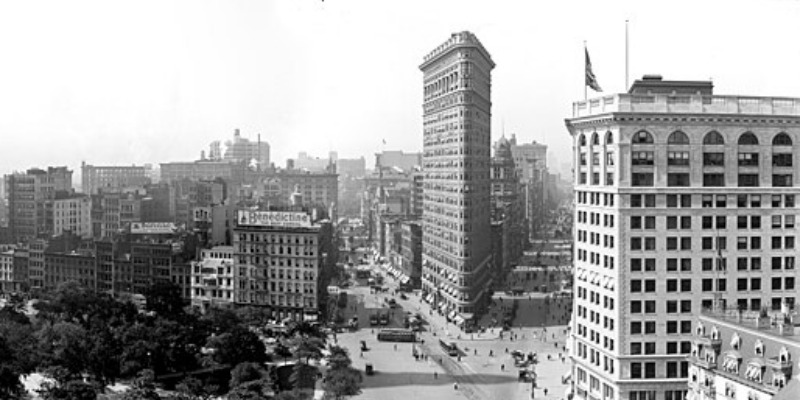





- Flatiron Building: History and Identity of a Legendary Skyscraper
- Where is the Flatiron Building and why is it so famous?
- How the Flatiron Was Born: Daniel Burnham's Bold Construction
- The Reactions of 1902: Scandal, Fascination and Urban Myth
- Flatiron as an architectural symbol of modern New York
- Why visit the Flatiron Building today: a practical guide
- Historical and cultural curiosities about the skyscraper shaped like an iron
- How to get to the Flatiron and what to see in the surrounding area
Guide to discovering the historic Fuller skyscraper, better known as the Flatiron Building: curiosities, history and tips for visiting it during a trip to New York
by Marco Arezio
Among the most iconic views of New York, the Flatiron Building occupies a special place. With its elegant and unmistakable silhouette, overlooking the most dynamic intersection in Manhattan, it represents a symbol of the metropolis that looks to the future without forgetting its roots.
It is not just another skyscraper, but a true architectural legend, one of the first examples of how modern construction techniques have redefined the very concept of the city. The Flatiron tells the story of the birth of vertical New York, that of the early twentieth century, full of ambition, progress and experimentation.
If you're planning a trip to the Big Apple, including a stop at the Flatiron Building will allow you to immerse yourself in a fascinating fragment of urban history: you'll walk where pioneering photographers immortalized the first icons of modernity, where air currents made the news, and where even today you can still breathe the timeless energy of a city that never ceases to amaze.
Where is the Flatiron Building located?
The skyscraper stands in the heart of Manhattan, precisely at the intersection of Fifth Avenue, Broadway and 23rd Street. A strategic position that, since its construction, has given this building extraordinary visibility. Its wedge shape, reminiscent of an iron, is what gave it the nickname by which it is universally known: Flatiron, precisely.
The Birth of the Flatiron Building: An Act of Architectural Boldness
When Daniel Burnham was commissioned by the Fuller Company to design a new commercial building in the heart of Manhattan, the city was in the midst of an epochal transformation. It was the early 20th century, and New York was moving upward. The term “skyscraper” was still relatively young, yet it was already becoming the symbol of urban modernity.
The Fuller Company wanted a building that would not only exploit every inch of the triangular lot, but that would be a statement of industrial, technological, and aesthetic power. Daniel Burnham, an architect already famous for the 1893 World's Columbian Exposition in Chicago, proposed something no one had ever dared: a 22-story building, narrow and sharp, tall and tapered, that seemed to defy logic and gravity.
The real revolution of the Flatiron Building, completed in 1902, was in its structure. The heart of the building was not made of brick but of steel, a still new construction technique that allowed for taller construction without excessively weighing down the base. This allowed the tip of the building — just 2 meters wide — to be built in a space that would otherwise have been unusable.
Reactions to the inauguration: scandal, fascination and fear
When the skyscraper opened, the press was divided. Some newspapers praised the work as a "marvel of human ingenuity", but there was no shortage of criticism and mockery. The New York Times questioned the aesthetic impact of the building, while others described it as "an urban horror". Some engineers, unaware of the strength of the steel structure, feared that it could collapse in the first hurricane.
Meanwhile, the citizens were intrigued, almost magnetically drawn. Men gathered on the corners of 23rd Street to admire the women who passed by, taking advantage of the famous vortices of air that formed at the base of the skyscraper and that maliciously lifted their skirts. This behavior became so common that the police had to patrol the area to discourage "gawkers" (voyeurs).
The building quickly became a cultural phenomenon . Photographers, such as Alfred Stieglitz and Edward Steichen, began to immortalize it in all weather conditions.
For many, it was a cathedral of modernity.A model for the future and a symbol of the city
The Flatiron Building was not just an architectural exception: it was a model. Its shape inspired similar projects around the world. More than a building, it became a visual mantra of the changing city, a symbol of an era that believed in speed, efficiency, and height.
Inside, the Flatiron housed state-of-the-art offices for the time, with fast elevators, natural light, and panoramic views. Many advertising agencies, architectural firms, and publishing companies settled there in the following years.
In 1966, the building was declared a national monument. In the 2000s, long conservative restoration works began, aimed at protecting the terracotta decorations, friezes and original fixtures. Today, there is discussion about its future destination for cultural or residential use, while maintaining its original appearance.
Why visit it today
The Flatiron Building cannot be visited inside, but it remains one of the most iconic photographic stops in the city. Arrive in the morning hours, when the light draws the terracotta details with extraordinary clarity. Opposite is Madison Square Park, perfect for a relaxing stop with a view of the skyscraper.
Nearby, Eataly Flatiron is an ideal stop for an all-Italian gastronomic break.
Curiosities that make the visit even more fascinating
- The Flatiron Building has inspired artists, photographers and filmmakers: from Alfred Stieglitz to Woody Allen
- It was one of the tallest skyscrapers in Manhattan at the beginning of the twentieth century.
- It was declared a National Historic Landmark in 1966
- Its shape influenced urban planning and architecture in the following century
How to get there and what to see in the surrounding area
The Flatiron Building is easily accessible by subway, 23rd Street stop (N, R, W or 6 lines). Nearby:
- Gramercy Park and its literary atmosphere
- Union Square and the Farmers Market
- Chelsea and the High Line
- Empire State Building, a little further north
A tip for those who love photography
If you are passionate about urban photography, the Flatiron is an ideal subject. Its slender shape and privileged position make it perfect for any type of framing, both vertically and diagonally. At dawn , the warm light of the sun rising between the buildings creates golden reflections on the terracotta facade, enhancing every decorative detail.
At sunset , however, the skyscraper stands out in silhouette against the orange sky, offering a perfect geometric contrast for lovers of chiaroscuro. Don't miss the night shots, with the city lights reflecting on the windows and creating dynamic plays of light around the structure.
Conclusion: a dive into the heart of New York
Visiting the Flatiron Building is much more than admiring a skyscraper: it is coming into contact with the history of a city that has been able to reinvent itself. A place that combines aesthetics, engineering and legend, and that offers, in a few minutes, a small journey through time.
© Reproduction prohibited
Photo Wikimedia