- America in the 1970s and the rise of nuclear power
- Three Mile Island: An Island in the Heart of Pennsylvania
- The morning of March 28, 1979: the beginning of the crisis
- Human errors and technical failures in the power plant
- Emergency management and institutional confusion
- Fear of the population and partial evacuation
- The political and industrial consequences of nuclear energy
- The cultural heritage and collective memory of the disaster
An investigation into the 1979 nuclear accident in the United States and its consequences for confidence in atomic energy
by Marco Arezio
In the late 1970s, the United States was experiencing a period of severe energy tension. The 1973 oil crisis had exposed the limits of dependence on imported fossil fuels, and nuclear power appeared to be the technological answer to a growing demand for energy. Dozens of power plants were planned or built in those years, with the support of institutions and the backing of a segment of the scientific community. Nuclear power promised a future of abundant and relatively clean electricity, capable of sustaining America's industrial power.
But the climate was far from calm. Environmental groups and civic associations were beginning to raise concerns about the risks of nuclear power plants, the true costs of waste management, and the vulnerability of complex facilities to human error. It was a heated debate, which found expression in the press, at universities, and in public squares. It was against this backdrop that the Three Mile Island disaster took place, destined to forever change the perception of nuclear energy in the United States and around the world.
Three Mile Island: An Island in the Heart of Pennsylvania
The Three Mile Island nuclear power plant, located on the Susquehanna River near Harrisburg, Pennsylvania, consisted of two pressurized water reactors. The plant, operational since the mid-1970s, was a symbol of technological modernity and America's energy ambition. Designed for safety and reliability, it was considered a paragon of advanced engineering.
The local population saw the plant as a source of jobs and economic growth, but also as an imposing and mysterious colossus. Few imagined that, on a March morning in 1979, the facility would become the epicenter of the most serious civilian nuclear crisis ever experienced in the United States.
The morning of March 28, 1979: the beginning of the crisis
At 4 a.m. on March 28, 1979, a series of technical events triggered the accident . A failure in a secondary circuit pump prevented the proper cooling of reactor number 2. The emergency system activated, but a fault in the relief valve caused a loss of coolant, increasing the core temperature.
The complexity of the instruments and the unclear control lights led operators to misinterpret the situation. Instead of maintaining cooling, they reduced the water flow, exacerbating the problem. Human error thus compounded the technical failure, turning a manageable situation into a potential catastrophe.
Human errors and technical failures in the power plant
The subsequent investigation revealed a complex set of causes: monitoring instruments that failed to correctly report valve status, outdated emergency protocols, and inadequate operator training. The plant was designed to withstand complex scenarios, but the accumulation of small flaws proved devastating.
The reactor core suffered a partial meltdown: a devastating event, the stuff of nightmares for any nuclear power plant. Fortunately, the containment vessel held firm, preventing large amounts of radiation from escaping. However, small radioactive leaks were detected, sparking panic among the population and raising doubts about the true extent of the disaster.
Emergency management and institutional confusion
In the days following the accident, communication was chaotic. Plant authorities, federal agencies, and the state government provided conflicting information. Initially, the severity of the incident was downplayed, then dramatic scenarios were hypothesized, even including the possibility—raised by some—of a reactor explosion.
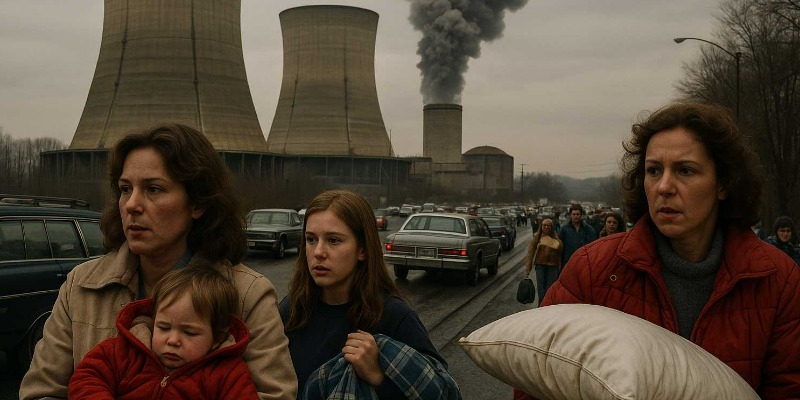
The governor of Pennsylvania ordered a precautionary evacuation of pregnant women and children within a five-mile radius of the plant. Tens of thousands of people fled their homes, generating images that played on televisions around the world. The public perception was one of impending disaster, with lines of cars fleeing and communities suspended in uncertainty.
Fear among the population and partial evacuation
The panic was not only a product of the real risks, but also of the lack of transparent communication. Pennsylvanians felt exposed to an invisible and uncontrollable danger. The radioactive leaks, though contained, fueled fears of long-term health consequences.
The press spoke of "nuclear panic," and confidence in nuclear energy was eroded day by day. Even after the situation stabilized and the immediate threat averted, many residents continued to live with the fear of having suffered irreversible damage. Subsequent epidemiological studies found no significant effects on the population's health, but the collective trauma was already etched in the memory of a generation.
The political and industrial consequences of nuclear energy
Three Mile Island had a devastating impact on the US nuclear industry. Construction of new power plants slowed dramatically, and ongoing projects were delayed or canceled. Public trust collapsed, and the political debate shifted toward analyzing the risks and costs of nuclear power.
In the years that followed, authorities introduced stricter regulations and more complex safety procedures. The accident became a case study for engineers and politicians, marking a turning point in American energy history. While nuclear power continued to expand in Europe and Asia, it remained frozen in the United States for a long time.
Cultural heritage and collective memory of the disaster
The Three Mile Island disaster was not just a technical event, but a social and cultural phenomenon. It fueled environmental movements, strengthened anti-nuclear campaigns, and influenced popular culture, inspiring films and books. It became a symbol of the fragility of supposedly safe technology and a warning against human arrogance in the face of nature's complexity.
Today, more than forty years later, the accident remains an open wound in the American memory. Although nuclear power has returned to the forefront of the debate as an alternative to fossil fuels, the shadow of Three Mile Island continues to remind us that atomic energy brings not only promise, but also profound fears.
© Reproduction Prohibited