- Who were the Macchiaioli: revolutionaries of Italian painting?
- Giovanni Fattori: biography of a lyrical realist
- The Tuscan landscape as visual and spiritual inspiration
- The “stain” as an instrument of natural truth
- Factors and nature as a mirror of the peasant soul
- The iconic places of Fattori's paintings: Maremma, Livorno, Florence
- From the countryside to war: the environment between peace and tragedy
- The ecological and pictorial legacy of the Macchiaioli
The profound connection between Giovanni Fattori, the Macchiaioli, and the Tuscan environment: a journey through plein air painting
by Marco Arezio
In the heart of nineteenth-century Italy, while Europe was experiencing the fever of revolution and the reawakening of national identities, a small but decisive aesthetic revolution was taking shape in the quiet of the Tuscan countryside. It was not noisy, it did not express itself in high-class salons or in incendiary manifestos. But it changed the face of Italian painting. The silent yet central protagonist of this revolution was Giovanni Fattori, a Livorno-born painter and a reserved soul, whose work inextricably intertwines painting and nature, man and landscape, historical memory and visual truth.
Who were the Macchiaioli: revolutionaries of Italian painting?
The term "Macchiaioli," initially coined in a derogatory tone, referred to a group of artists active in Florence in the mid-19th century, united by the desire to transcend the prevailing academicism and paint reality, light, and life. Painters such as Telemaco Signorini, Silvestro Lega, Giuseppe Abbati, and, among the most authoritative, Giovanni Fattori, gathered around the Caffè Michelangiolo.
The name derived from their innovative technique: painting in "blots" of color and light, seeking visual immediacy and abandoning precise drawing and traditional chiaroscuro. In reality, behind this stylistic innovation lay an ideological revolution: the belief that only by directly observing reality, en plein air, could one capture the essence of a landscape, a face, or a moment in history.
Giovanni Fattori: Biography of a Lyrical Realist
Born in Livorno in 1825, Giovanni Fattori trained at the Academy of Fine Arts in Florence, influenced by classical principles. However, his restlessness soon led him to frequent more experimental circles and join the Caffè Michelangiolo group. His breakthrough came with his participation in the Ricasoli competition in 1859, where he presented The Italian Camp after the Battle of Magenta: a work that combined the rigor of historical drawing with a moving landscape rendering.
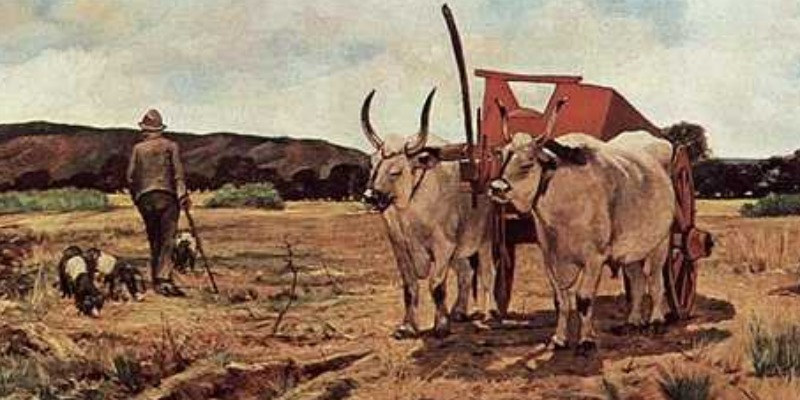
Fattori was not just a painter of battle scenes. Indeed, much of his greatness lies in his ability to capture the lyricism of everyday life, of the Tuscan countryside, of farmers at work, of horses grazing, of Maremma women—solitary women who keep watch over the silent horizon. In his paintings, nature is never a mere backdrop: it is the protagonist, it is a witness, it is the deep breath of real Italy.
The Tuscan landscape as visual and spiritual inspiration
Fattori's Tuscany is an ancestral land, marked by golden fields, maritime pines, dusty paths, and hills that disappear into the horizon. But it is also a tangible land, cultivated and inhabited by farmers, soldiers, and shepherds. The artist does not paint an Arcadian ideal, but rather the encounter between the toil of man and the sober majesty of nature.
The Maremma, in particular, became a place of the soul for Fattori. There he found the purity of the landscape, the absence of artifice, the almost epic dimension of agricultural labor. In his paintings, such as La Rotonda di Palmieri or Rest on the Flight into Egypt, one perceives a silence that speaks, a light that is not only physical but internal. Nature is a mother, but also a judge. It is comfort and harshness.
The “stain” as an instrument of natural truth
The "macchia" technique, developed by Fattori and his fellow adventurers, was not an aesthetic affectation but a means of capturing reality in its dynamic essence. The light, broken into vibrant fields, recounts the hours of the day, the heat that undulates across the plains, the toil of labor, the changing seasons.
Unlike the French Impressionists, the Macchiaioli sought not the ephemeral but the enduring.
Fattori, in particular, used stain not to dissolve forms, but to construct them with greater authenticity. His horses, soldiers, trees—everything lives on a synthesis of color and texture, immediacy and form.Factors and nature as a mirror of the peasant soul
What is striking about Fattori's paintings is the empathy he shows his subjects. The women waiting for their husbands to return from work, the old soldiers, the farmers bent under the sun—they are all immersed in a natural setting that seems to reflect their dignity and solitude. There is no rhetoric, no sentimentality: there is humanity.
The relationship between man and the earth is not one of domination, but of coexistence. The natural environment is a living presence, sometimes indifferent, sometimes involved. In his most intense paintings, such as Hay Harvest or Pasture in Maremma, the horizon line lowers, allowing sky and earth to embrace the figures as in an ancient fresco. It is in this vision that one discerns a precocious ecological awareness, a profound respect for the landscape as a value to be preserved, not exploited.
Fattori's iconic paintings: Maremma, Livorno, Florence
If the Maremma was his natural altar, Livorno represented his emotional roots. Here he returned, often in solitude, to paint the sea and the piers, with a palette that became more sober, more reflective. Florence, on the other hand, was his intellectual laboratory, the place of encounters and cultural battles.
His painting, however, rejected the emphasis on urban centers. He preferred the margins: the farmhouse, the stable, the dirt road. In these minimal spaces he found infinity. His nature is never a postcard, but a living body that breathes along with the people who inhabit it.
From the countryside to war: the environment between peace and tragedy
Fattori cannot be understood without considering his historical production. His war paintings—often based on personal experiences—do not exclude nature, but rather place it in dialogue with the human event. In The Italian Camp After the Battle of Magenta, for example, the soldiers' corpses are laid out on a meadow whose still greenery seems to welcome and silently mourn.
Here too, the landscape is not neutral. It is witness and accomplice to pain, but also to the inexorable continuity of life. The earth absorbs everything: sweat, blood, tears. Yet it remains. And in this silent permanence, Fattori read a moral lesson.
The ecological and pictorial legacy of the Macchiaioli
Today, as we return to the conversation about landscape, nature, and sustainability, the work of the Macchiaioli—and Fattori in particular—reemerges forcefully. Their painting reminds us that we cannot represent reality without understanding it, that we cannot love nature without listening to it.
Fattori was a reserved man, unwilling to compromise, and thus often marginalized by the art market. Yet his work transcends time with the power of a silent truth. His gaze on nature—humble, devout, attentive—is perhaps one of the most precious legacies of 19th-century Italian painting.
In an age when the environment risks becoming merely a backdrop to be exploited or sold, Fattori's lesson seems more relevant than ever: nature is part of us, and only if we look at it with honest eyes can we still tell its story. With a splash of color, with a slanted light, with a silence that speaks louder than a thousand words.
Photo Wikimedia
© Reproduction Prohibited