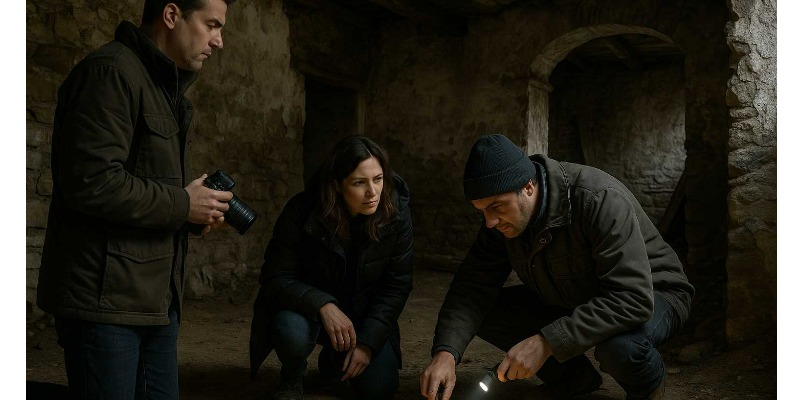
The chapter opens with a silent journey to Lake Como, where the investigation seems to advance more by subtraction than by certainty. In the Colico barracks, a tense meeting redefines the case: not an impulsive crime, but a strategy based on fear and information control. As underlying connections between victims and religious documents emerge, attention shifts from the "how" to the "who knows what." At the same time, the abbey reveals deep cracks: absences, silent complicities, balances of power overturned in silence. Prior Edward realizes he is a prisoner of a secret he no longer controls. Between apparent authority and invisible blackmail, the line between guilt and survival becomes blurred. The investigation thus enters a dangerous zone, where the truth does not save, but condemns.
Monastic Secrets and Blackmail on Lake Como: When Silence Becomes Guilt
Mystery Novel. The Secrets of Piona Abbey. Chapter 14: Monastic Secrets and Blackmail on Lake Como: When Silence Becomes Guilt
The police speedboat left the Como dock at precisely 10:15 a.m. There were no shouted orders or theatrical gestures: the pilot started the engine with a sharp, familiar action, and the lake responded immediately, opening up in a clear, silent wake.
The vessel was a Riva Ariston, one of the most reliable and fastest motorboats then in service with the lake police. With a mirror-polished mahogany hull, a low profile, a sharp bow, and a powerful yet stable engine, this vessel had a decisive advantage on Lake Como. It easily withstood the sudden gusts that descend from the canals between the mountains, remained glued to the surface even at high speeds, and allowed for quick maneuvers in narrow stretches, close to the coast or near ports. It was fast without being nervous, precise without becoming stiff: essential qualities on a lake as long, deep, and capricious as this one.
On board were Judge Carchivi, sitting in the right-hand seat with his coat zipped up to his neck, two police officers escorted in the back, and the pilot, holding the wheel with both hands, his gaze fixed straight ahead. No one spoke. The engine, full and smooth, was the only continuous sound.
The morning was crisp but clear. The cold was biting, but visibility was perfect: the lake appeared flat as a table, a pale steel surface that reflected the shores and reproduced every vibration of the motorboat with precision. The mountains, still snow-capped above, seemed closer than usual. The wake stretched behind like a white wound that quickly closed.
Carchivi watched the banks pass by without truly seeing them. A picture in his head refused to come into focus: three bodies, different modalities, a symbolism that didn't explain the motive, negative autopsies, scraps of paper that recurred like a silent refrain. In his pocket, he carried sparse, handwritten notes, and the uneasy feeling that the investigation had entered a phase where omissions mattered more than evidence.
The destination was Colico, the barracks where he had summoned Lucia and Marshal Scandurra of Dervio. Not a formal meeting, but a necessary point of reference. The autopsy results had removed certainties rather than added them; the results on the paper samples, which Scandurra kept in his briefcase, promised to clarify something or complicate everything permanently. In either case, they had to look each other in the eye and decide which direction to take.

The motorboat raced ahead, cutting through the water with controlled force.
Every now and then, the pilot adjusted the trim with a tiny, almost imperceptible gesture. The bow remained stable; the Riva didn't bounce or slam: it just glided, as if the lake were giving it free rein.As Colico's profile began to emerge, Carchivi moved for the first time. He adjusted his hat, checked his watch. Everything was on time. It wasn't a detail: that punctuality, in the midst of an investigation that seemed to be breaking the rules, had the feel of a final check.