In a small town surrounded by hills and flowers, children discover that a mysterious abandoned house hides a surprising secret. Behind its neglected appearance, the old house is alive and has a unique ability: it loves to "eat" plastic and transform it into something wonderful! But not everyone is ready to believe it, and the house risks disappearing forever. Only thanks to the courage, imagination and friendship of a group of children will a magical adventure begin among flowers, scents and colors, which will teach the whole town the value of nature and mutual help. A story full of surprises, ideal for those who dream of making a difference and saving the world, even with just a small gesture.
How Sofia and her friends saved a magical house and discovered the secret of recycling, changing the fate of their country
In the small village of Vallechiara, nestled between rolling hills and fields of flowers, many stories were told. But the most mysterious was the one about the house at the end of Via dei Gelsi.
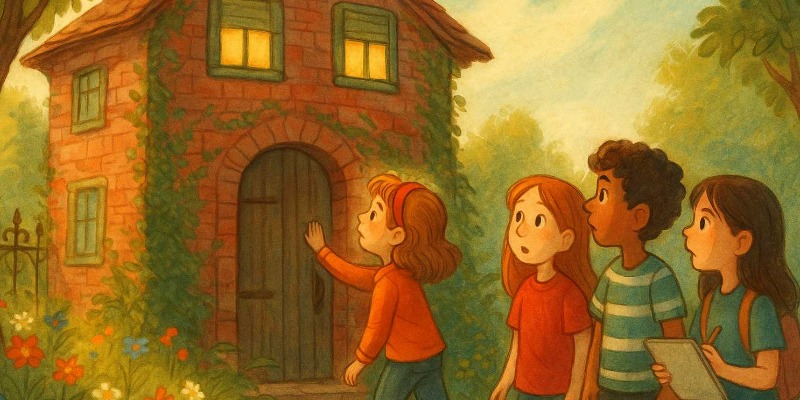
The house was old, with a pointed roof covered with moss and large windows that looked like eyes that were always sleepy. No one had lived there for many years, and the great people of the village said that it was now ready to be torn down.
“It’s unsafe,” the mayor muttered.
“Only spiders live there!” laughed Mrs. Gina, the florist.
But the children of Vallechiara, especially Sofia, Leo, Anna, Amir and Gaia, looked at it differently. That house intrigued them: every now and then, if they passed by the rusty gate, they smelled a sweet and sparkling odor, different from everything else.
One April morning, while the wind was making the daisy petals dance, Sofia suggested to her friends that they discover the secret of the old house.
“Are you there?” he asked, his eyes shining with curiosity.
“Are you crazy?” Anna replied, “They say it’s haunted!”
“Exactly!” laughed Leo, “So we can see if it’s true!”
Only Amir was a little behind, but he finally took courage. Gaia, on the other hand, held her notebook tightly: she wanted to draw every strange thing they would see.
They walked slowly down the path, passing through tall grass and nettles. When they reached the door, Sofia stopped.
“Shall we knock together?” he whispered.

Knock-knock. A deep, strange sound, like a distant echo.
Suddenly the door opened by itself, creaking loudly, and a hoarse but gentle voice rang out in the air.
“Come on, little guests. Don’t be afraid…”
The children entered, holding their breath. Inside, the house was neither dark nor scary. It was full of colors: there were piles of plastic objects – clear bottles, red and blue caps, old forgotten toys, crumpled bags.
Green creepers sprouted from the walls, and yellow and pink flowers bloomed on the floor.
“What a scent!” said Gaia, who was already looking for the right color in her pencil case.
Suddenly, a puff of colored steam came out of the old iron stove.
“Don’t be afraid,” the voice said, clearer this time. “It’s me, the house. I’ve waited a long time for someone to really listen to me.”
The children looked at each other in amazement.
“A house… that speaks?” Amir stammered.
“Not only do I talk,” said the house, “but I have a special secret. I learned, many years ago, to eat plastic!”
The children burst out laughing, thinking it was a joke.
“Don’t you believe it? Look!”
The house opened a sort of mouth in the wall. Anna threw in a bottle cap that she found on the floor. Immediately, the house jolted and, between its tiles, scented violets sprouted.
“See? Plastic, if it enters me, disappears. I transform it into flowers, grass, clean air. It’s my gift. But no adult has ever believed me… in fact, they want to kill me!”
The children were speechless.
“We have to help you!” said Sofia.
“But how?” asked Leo.
“People think you’re just old and useless… and that plastic is just garbage.”
The house sighed, making the windows rattle.
That night, at their home, the children couldn't sleep. They only thought about how to save the magical house.
“If we tell the adults, they’ll never believe us…” Anna sighed the next morning at school.
“Then we need to gather evidence!” Gaia suggested, “Let’s do experiments, document everything. Then show the results!”
Thus began the greatest adventure of their lives.
Every afternoon, with the excuse of playing, the five friends met near the house.
They collected plastic everywhere: on the banks of the river, in the parks, even in the market baskets. They brought each object to the house, which thanked them with a happy little voice and with a thousand colorful flowers.
Gaia drew everything, Anna took pictures with her brother's old cell phone, Leo took notes on how much plastic the house managed to eat every day. Amir, who loved science, studied what happened to the lawn and the air around the house.
In a few weeks, the garden in front of the old house was full of poppies, daisies, tulips, and even butterflies that had not been seen for years. The voice of the house was more and more cheerful:
“Thank you, kids! I can finally help nature and not feel useless anymore!”
But danger was near.
One day, while carrying a large bag of bottle caps to the house, the children saw a new sign in front of the gate:
“AREA UNDER DEMOLITION – WORK STARTS MONDAY”

Sofia felt a lump in her throat.
“They can't do this!” Leo shouted, “The house helps the environment!”
“We have to stop them!” Anna said, her face red with anger.
The house was sad, almost darker than usual.
“There is no more time…” he whispered. “Without your help, I will disappear forever.”
But the children did not give up.
They gathered the other friends, talked to the teacher, who – luckily – loved nature and believed at least in part the story of the flowers and the missing plastic.
“If you are right, you have to prove it in front of everyone!” he said.
So, they prepared an experiment: they invited the mayor, workers, parents and many inhabitants of the village to the garden of the house. Gaia brought her drawings, Anna the photos, Amir explained the change in the air and the plants around. But the adults still laughed.
“A house that eats plastic… Please!” said the construction site manager.
“Try and prove it!” challenged the mayor.
Sofia took courage.
“Home, are you there? Can you help us in front of everyone?”
The windows lit up.
“Give me something special,” the voice whispered.
Leo ran to get an old plastic chair from the municipal warehouse, dragged it in front of everyone and left it by the door.
The house opened its big mouth and, in a few moments, the chair disappeared as if swallowed by a vortex.
Suddenly, the lawn in front of the house filled with colorful flowers, butterflies danced among the petals and the air smelled good.
“It's not possible!” the mayor muttered, incredulous.
People applauded, some cried with joy.
Even Mrs. Gina was moved:
“I have never seen so many flowers, not even in my own shop!”
From that day on, the old house was no longer considered a problem.
The mayor canceled the demolition work and the teacher proposed turning the house into a “Magic Recycling Center,” where all the children could bring their plastic and learn to take care of the environment.
Months passed and the country changed.
The children also brought the news to the neighboring villages: the story of the house that ate plastic became famous, and everyone wanted to see the miracle with their own eyes.
Visitors, scientists, even a television crew arrived to tell the story on the children's news.
Many adults, who had previously laughed, began to reflect.
“If an old house can make a difference, we too can make a small difference,” the mayor said at a public meeting.
The house didn't just eat plastic: it taught children and adults respect for nature, the magic of collaboration and the power of hope.
Sofia and her friends organized collection days, creative workshops, and even a small “Plastic Flower Festival” every spring.
The house was always happy, her voice vibrating with gratitude every time the children knocked on the door.
“Thanks to you, I am no longer alone. Every piece of plastic you give me becomes a gift for everyone: clean air, flowers, beauty. You have saved not only me, but your country and, a little, the world.”
Over time, other old houses were also checked, and some scientists, inspired by the miracle of Vallechiara, began to study ways to transform plastic into useful materials or clean energy.
The children understood that the magic of the house was also in their ability to see beyond, to believe and to act together.
Sofia looked at the old house every day from her balcony, happy and proud.
Sometimes, if you listen carefully, you can still hear the voice of the house singing among the flowers, a sweet melody that speaks of courage, friendship and love for the Earth.
And if one day you see an old house, with smiling windows and the scent of flowers in the air, perhaps you will remember that even the strangest things can hide a magical power…
All you need is the courage to listen and the desire to change the world, one piece of plastic at a time.
© Reproduction prohibited