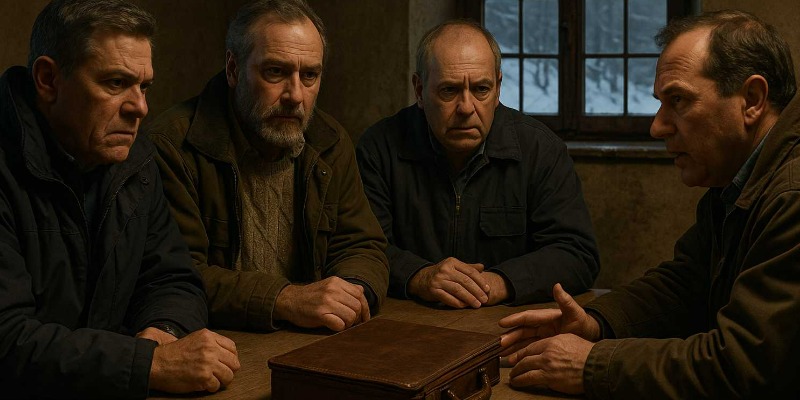
The second chapter delves into the figure of Prior Edward, reconstructing his past far from the abbey and its stone walls. From his aristocratic and military education in imperial England to his colonial missions, the portrait emerges of a man tempered by order and responsibility. The traumatic experience of the Indian Partition marked an irreversible fracture in his vision of power and justice.
The monastic choice thus appears not as an escape, but as a lucid and conscious surrender. To Piona, Edward brings with him a silent discipline and a gaze that has already seen horror. When violence erupts again in his life, the prior immediately recognizes the signs of something deeper and more calculated. The chapter leads the reader to the decisive moment where prayer gives way to responsibility, and silence becomes a prelude to inquiry.
Edward Hawthorne: from the British Empire to the silence of Piona, when evil returns to demand its reckoning
Detective novel. The Secrets of the Abbey of Piona. Chapter 2: The Prior Who Came from the War
The prior of the Abbey of Piona was a man who carried within him a history far greater than those walls of stone and silence. He came from Canterbury, a city of ancient learning, a foremost ecclesiastical and academic center, where faith had always engaged in dialogue with scholarship, and power with doctrine. There he was born, in 1905, under the name Sir Edward Hawthorne, into a family that regarded service to the Crown not as an option, but as a natural destiny.
Edward grew up among books, discipline, and precise expectations. At eighteen he entered the British military academy as a cadet, immediately distinguishing himself through cold intelligence, moral rigor, and an innate capacity for command. He was not an impulsive man; he observed, assessed, decided. These qualities made him ideal for a career that would take him far from England, into the colonies of the British Empire, where the Crown’s economic interests were to be defended firmly and, often, by force.
He traveled the world as an officer and later as a garrison commander: East Africa, the Middle East, Southeast Asia. Everywhere he left behind an appearance of order and a trail of difficult decisions, taken in the name of a balance that rarely coincided with justice. Edward Hawthorne served the Empire with conviction, yet even then he began to grasp the human cost of that loyalty.
The breaking point came in India, in 1947.
He was assigned to a strategic area during the year of Partition, when the British Empire withdrew, leaving behind a torn subcontinent. Hindus, Muslims, and Sikhs clashed in a spiral of violence that no military command could truly contain. Hawthorne found himself managing refugee convoys, protecting economic interests, while around him massacres, rapes, and the burning of entire villages unfolded.

He witnessed unspeakable atrocities.
On both sides. Children slaughtered in acts of revenge, trains arriving filled only with corpses, families exterminated for a faith or a name. He tried to maintain operational neutrality, but soon understood that no neutrality was possible in that hell. Every order he gave saved someone and condemned someone else.That year was the most painful of his life. Not because of a wound sustained, but because something within him broke forever. The belief that order imposed from above could be a good. The illusion that power, even when exercised with discipline, could redeem violence.....
© Reproduction Prohibited