- The industrial context of PP raffia fabrics
- Properties and behavior of calcium carbonate
- Improved processability and dimensional stability
- Increase in mechanical and surface properties
- Types of calcium carbonate: GCC and PCC
- Thermal, rheological and optical aspects
- Economic benefits and environmental impact
- Research and innovation prospects in PP-CaCO₃ composites
A Technical Insight into the Use of CaCO₃ as a Functional and Sustainable Additive for the Polypropylene Textile Industry
by Marco Arezio
The use of calcium carbonate (CaCO₃) in plastics—and particularly in the production of raffia and PP raffia fabrics—is among the most established and strategic practices in the modern polymer industry. Although it was initially introduced merely as a filler to reduce production costs, CaCO₃ has evolved into a multifunctional additive capable of deeply modifying the physical-mechanical, optical, and thermal properties of polypropylene, while also enhancing the overall sustainability of industrial processes.
In raffia fabrics—used in applications ranging from packaging sacks to geotextiles—calcium carbonate is no longer considered a simple additive, but rather a key component for structural and production optimization.
The Industrial Context of PP Raffia Fabrics
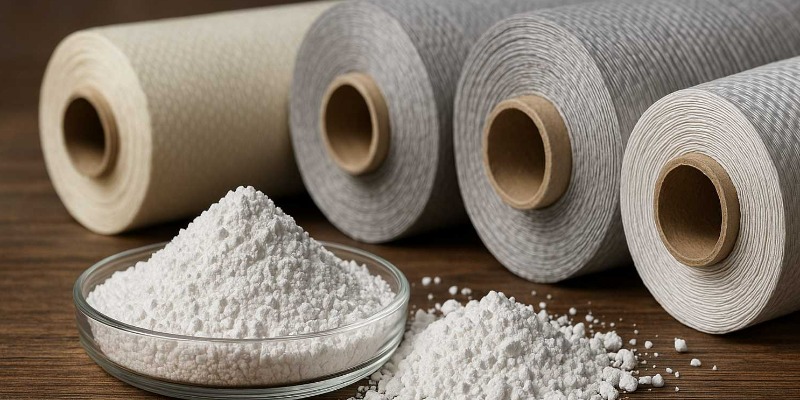
In technical terminology, the word raffia refers to extruded polypropylene tapes (tape yarns) which, after being stretched, acquire a strong and lightweight structure similar to natural fibers. These filaments are then woven or knitted to obtain versatile materials: from classic industrial bags for cereals, seeds, polymers, and cement, to agricultural sheets, drainage geotextiles, and technical furnishing components.
However, polypropylene exhibits several limitations familiar to materials technologists: it is a semicrystalline polymer, prone to shrinkage, somewhat brittle at low temperatures, and often difficult to stabilize dimensionally during extrusion. Within this context, calcium carbonate plays an essential technical role.
Properties and Behavior of Calcium Carbonate
CaCO₃ is an abundant, stable, thermally inert mineral that is compatible with many polymeric matrices. From a morphological standpoint, its particles—either natural or precipitated—offer a contact surface that interacts with the polymer during compounding and extrusion. This interaction is not chemical but physical-mechanical: the particles act as nucleating agents for PP crystallization, promoting faster cooling and a more controlled crystalline orientation.
The result is a more homogeneous structure, improved shrinkage control, and greater process stability—factors that are crucial when operating continuous, high-speed extrusion lines.
Improving Processability and Dimensional Stability
During the extrusion of polypropylene film destined for raffia, CaCO₃ acts as a nucleating agent that accelerates crystallite formation, improving solidification and the subsequent slitting of the film into tapes.
The presence of the mineral reduces thermal deformation, ensures more uniform thicknesses, and stabilizes draw ratios during stretching. In modern industrial processes, where quality consistency is critical, even slight variations in melt flow can compromise weaving performance; the inclusion of CaCO₃ mitigates these risks by stabilizing the rheological behavior of the polymer melt.
Enhancement of Mechanical and Surface Properties
Mechanically, the effect of CaCO₃ on PP raffia is twofold: it increases rigidity and improves abrasion resistance. This is particularly important for products subjected to repeated friction, such as industrial or construction sacks, big-bags, and technical sheets.
Moreover, mineral particles provide higher opacity and improve surface finish, enhancing printability while reducing the excessive gloss typical of pure PP. The resulting aesthetic effect is more textile-like—matte and natural—an appreciated feature in high-quality packaging applications.
Types of Calcium Carbonate: GCC and PCC
The distinction between GCC (Ground Calcium Carbonate) and PCC (Precipitated Calcium Carbonate) is crucial from an industrial standpoint.
GCC, produced through mechanical grinding of limestone, offers a lower cost and a broader particle size distribution suitable for standard applications.
PCC, on the other hand, is obtained by controlled precipitation, resulting in finer, more spherical, and uniform particles. This morphology enhances dispersion within the polymer, yielding smoother surfaces, greater opacity, and improved tensile performance.
The choice between the two depends on economic factors, target applications, and compatibility with other additives or color masterbatches.
Thermal, Rheological, and Optical Aspects
One of the most relevant effects of CaCO₃ addition is the increased thermal conductivity of the compound, which enables faster cooling of the extruded tapes, shortening cycle times and boosting productivity.
From a rheological perspective, the viscosity of the filled polymer becomes more stable and predictable, facilitating control over extrusion temperatures and pressures.
Optically, calcium carbonate enhances opacity and ensures more uniform coloration, improving print quality in flexographic and screen-printing processes—essential features for product branding and traceability in industrial packaging.
Economic Benefits and Environmental Impact
The inclusion of CaCO₃ reduces the amount of virgin polypropylene required per unit of product, offering substantial cost savings. Yet the benefit is not purely economic: since calcium carbonate is a naturally occurring mineral not derived from petroleum, its incorporation contributes to lowering the overall carbon footprint of the final product.
Furthermore, modern compounding systems allow for CaCO₃ derived from mining by-products or recycled marble residues, embedding raffia production within a broader circular economy framework.
The resulting fabric remains compatible with conventional mechanical recycling processes for PP, as the filler does not significantly alter thermal behavior nor release harmful substances during reprocessing.
Research and Innovation Perspectives in PP–CaCO₃ Composites
Recent studies in polymer composite materials have focused on surface functionalization of calcium carbonate through fatty acid or silane treatments to enhance adhesion with the polymer matrix.
These surface modifications improve load transfer efficiency between mineral and polymer phases, reducing brittleness and expanding the range of possible applications.
There is also a growing interest in advanced masterbatches containing ultra-fine CaCO₃ (<1 μm), which ensures superior dispersion and tangible improvements in mechanical and optical properties even at lower loadings.
The technological evolution of PP raffia with mineral fillers is therefore moving toward advanced material engineering, where production efficiency, sustainability, and aesthetic quality coexist in a refined industrial balance.
Conclusions
Though seemingly simple, calcium carbonate plays a complex and strategic role in polypropylene raffia. It enhances polymer processability, regulates thermal behavior, increases stiffness and opacity, reduces costs, and supports the environmental sustainability of the production chain.
Its function extends beyond technical improvement, becoming integral to a production model that emphasizes energy efficiency and the valorization of secondary mineral resources.
In the near future, stronger collaboration between academic research and the masterbatch industry will likely refine PP–CaCO₃ compatibilization even further, paving the way for lighter, stronger, and more recyclable technical fabrics.
In this sense, the next generation of raffia will not merely be an efficient industrial product but also a symbol of sustainable innovation within the polymer textile sector.
© All Rights Reserved