- Evolution of Intelligent Packaging: From Traceability to Sustainability
- Compostable RFID Labels and NFC Tags: New Solutions for the Food Industry
- Compostable Freshness Indicators: Innovation for Product Safety
- Bio-based Materials for Smart Packaging: From PLA to Regenerated Cellulose
- Electronic Printing Technologies for Compostable Labels
- Eco-Friendly Microchips and Sensors: The Frontiers of Green Electronics
- Environmental Challenges of Traditional Labels and Current Technical Limitations
- Compostable Packaging Case Studies: Applications in Food, Pharmaceutical, and Logistics
- Regulations and Certifications for Compostable Smart Labels
- Future Prospects and Advanced Research in Sustainable Packaging
Towards intelligent and fully compostable packaging: challenges, solutions and perspectives for the integration of sustainable electronic devices into organic waste collection flows
by Marco Arezio
In recent decades, the packaging industry has undergone a veritable revolution . While packaging was once simply a means of containing, protecting, and transporting goods, today it has become a vehicle for information, security, interaction, and, increasingly, environmental sustainability. The advent of the Internet of Packaging (IoP) has enabled the packaging of food, pharmaceutical, and consumer goods to be enhanced with smart labels: RFID, NFC tags, and freshness indicators are now well-established features on the production lines of global companies, offering new levels of traceability, authenticity, and quality control.
However, this push toward digital innovation is accompanied by an even more pressing challenge: managing the end-of-life of packaging containing electronic components without increasing environmental impact, integrating these devices into the virtuous cycle of the circular economy. Thus, smart packaging today finds itself at a crossroads: become truly sustainable, or risk becoming a new disposal problem.
Smart Packaging and New Traceability and Safety Needs
The spread of smart packaging arose from the need for ever-increasing information on a product's life cycle: where it comes from, how it's stored, and whether it's been handled correctly throughout the supply chain. RFID labels and NFC tags allow for unique product tracking, facilitating both logistics and inventory management, while freshness indicators and environmental sensors can detect any changes in temperature, gas, or humidity in real time, flagging alterations that could compromise the safety or quality of the food or drug.
These technologies are now essential for companies seeking to reduce waste, ensure consumer safety, and meet market demands for transparency. However, the very presence of electronic components, if not properly designed, can compromise the packaging's ability to be recycled or composted, contaminating organic waste streams and posing a potential environmental risk.
Environmental issues of traditional electronic devices
The enthusiasm for smart packaging still faces limitations imposed by the use of conventional materials in the manufacture of electronic labels. These devices are typically constructed using plastic substrates such as PET or PP, conductive tracks made of copper, silver, or aluminum, silicon microchips, and synthetic adhesives.
None of these materials can be considered truly biodegradable or compostable; in fact, they often release microplastics and heavy metals. If dispersed in organic waste streams, they can degrade the quality of the compost produced, posing a risk of contamination for soil and crops. For this reason, European (EN 13432) and American (ASTM D6400) regulations are imposing increasingly stringent criteria not only for packaging materials , but also for all functional components, including electronics, requiring complete compostability for everything accompanying the product at the end of its life cycle.
The architecture of a compostable smart label: innovative materials and production processes
Scientific and technological research has responded to these new environmental challenges with unprecedented effort, leading to the development of a new generation of labels and sensors that are designed from the ground up to be compostable. The foundation of these solutions lies in bio-based substrates, i.e., supports made from renewable raw materials such as PLA (a polymer obtained from the fermentation of plant sugars), regenerated cellulose, or PHB, a microbial biopolymer . These materials are not only compatible with modern electronic printing techniques, but also degrade safely both in industrial composting facilities and, in some cases, even in domestic environments.
The second revolution concerns the materials used for conductive tracks and circuits: instead of traditional heavy metals, carbon-based inks, graphite, or carbon nanotubes, and organic conductive polymers such as PEDOT:PSS or polyaniline, all capable of degrading during composting, are gaining ground. "Green" versions of metal conductors—such as encapsulated silver nanoparticles—are also finding application, albeit with some limitations in terms of cost and durability.
The real quantum leap, however, is in eco-friendly microchips and sensors : today, work is underway on organic transistors on cellulose substrates, fully biodegradable thin-film devices, and transient memories that dissolve upon contact with moisture. Although their performance is limited compared to traditional silicon chips, these solutions are already sufficient for short-cycle NFC and RFID tags, ideal for timely monitoring and disposable packaging.
Finally, freshness indicators can be made without electronics , using reactive films based on natural substances such as pectin, alginates or plant pigments, capable of changing colour depending on the presence of gas or temperature variations: safety information immediately usable by the consumer and, above all, completely biodegradable.
Industrial production and integration techniques
Innovations in materials have also driven rapid evolution in manufacturing processes.
Compostable smart labels are now produced through inkjet printing with conductive inks on bio-based substrates or paper, screen printing to create thicker and more robust circuits, and low-temperature lamination or bonding to avoid altering the properties of compostable materials. Great attention is also paid to adhesives, favoring natural starch- or dextrin-based ones to avoid any risk of contamination in organic flows. The goal is to integrate these technologies into existing production lines, ensuring scalability, efficiency, and cost competitiveness.Current limitations and technical challenges
Although the results are promising, the road to full adoption of compostable labels is not without obstacles. The first limitation concerns durability: these devices are ideal for products with a short shelf life—such as fresh food or single-dose pharmaceuticals—but less suitable for long-term logistics. The communication range of passive RFID or NFC tags, for example, is still lower than that of traditional metal circuits, especially at higher frequencies. On the economic front, production costs, though declining, remain higher than conventional solutions, although growing demand and industrialization are rapidly closing the gap. Finally, there are some compatibility issues with standard reading systems, often optimized for metal labels, which will require technological updates and adaptations by logistics and industrial operators.
Real-world applications and case studies
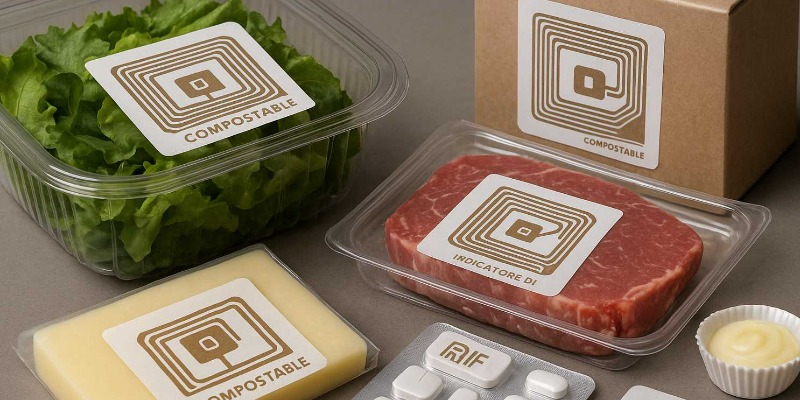
Despite these limitations, numerous success stories demonstrate that the compostable smart label revolution is already a reality. In the food sector, for example, some companies are experimenting with packaging for ready-to-eat salads, meat, and dairy products equipped with freshness indicators and compostable NFC tags, capable of monitoring the cold chain and ensuring quality all the way to the end consumer. In the pharmaceutical sector, too, blister packs and "smart" packaging are being equipped with compostable NFC tags, offering secure traceability and facilitating sustainable disposal. In logistics and e-commerce, compostable bags and boxes with integrated smart tags enable product authentication and tracking throughout the supply chain, without increasing the residual waste fraction.
Regulations and standards: a race towards compliance
Regulatory compliance represents a crucial step for the widespread use of smart and compostable packaging. The EN 13432 and ASTM D6400 standards are now the benchmark for certifying the compostability of materials, establishing precise limits on biodegradability, disintegration, the absence of heavy metals, and ecotoxicological safety. Certification bodies are updating their protocols to include electronic devices, paying particular attention to food safety and the environmental impact of the compost produced. The direction is clear: only devices that comply with these requirements can be fully integrated into organic waste collection flows.
Research perspectives and future scenarios
Research continues unabated; in fact, it accelerates on multiple fronts. The move toward transient and disassembled electronics , devices designed to dissolve spontaneously or be easily separated from compostable materials, is gaining traction. On-demand circuit printing on biodegradable materials is becoming increasingly popular, useful for customizing information throughout the supply chain. Solutions are being explored that integrate traceability with blockchain and IoT without compromising environmental compatibility. Finally, great attention is being paid to consumer education: clear instructions and intuitive symbols are essential for proper disposal and to avoid the risk of contaminating organic waste streams.
This revolution is supported by a strong collaboration between academia, industry, and regulators, with the aim of standardizing new technologies and accelerating the transition to smarter, more sustainable, and environmentally friendly packaging.
Conclusions: the future of smart packaging is compostable
Never before has packaging innovation faced such a crucial choice: continue to grow by focusing on intelligence, traceability, and interactivity, or stop to avoid increasing environmental pressure. The integration of RFID labels, NFC tags, and compostable freshness indicators represents the synthesis of these needs, demonstrating that it is possible to combine advanced technology and respect for the environment. Advances in materials, production processes, and regulations have paved the way for truly smart packaging that is simultaneously fully compatible with organic waste collection and the principles of the circular economy.
Technical and economic challenges remain, but the industry's direction is clear: the packaging of the future will be increasingly integrated, interactive, and sustainable. The challenge now lies in the speed of this transition and the ability to work collaboratively between research, industry, and policymakers to build an innovative, transparent, and truly green supply chain, without compromising the health of the planet.
© Reproduction Prohibited