- Construction history of Notre-Dame Cathedral: from its origins to the restoration by Viollet-le-Duc
- The 2019 fire and the collapse of the medieval wooden “forest” of Notre-Dame
- Guidelines and design decisions for the structural restoration of the roof
- Selection, felling and traceability of oaks for new trusses
- Digital technologies and 3D survey applied to the reconstruction of the wooden structure
- Historical carpentry techniques and assembly of oak trusses
- Protective wood treatments and fire prevention systems integrated into the restoration
- Professional training and transmission of artisanal knowledge at the Notre-Dame construction site
From the destruction of the medieval “forêt” to the rebirth of the oak trusses: a technical investigation into the timber restoration of Notre-Dame
by Marco Arezio
Notre-Dame Cathedral in Paris, the architectural and spiritual emblem of the city and of France as a whole, is one of the greatest masterpieces of European Gothic art. Its construction, begun in 1163 under Bishop Maurice de Sully, stretched over nearly two centuries and was completed around 1345. Such a long time span allowed successive layers of styles and technical solutions to overlap, mirroring the evolution of medieval architecture.
Work started in an era of intense ecclesiastical building activity across Europe. Notre-Dame was among the first cathedrals to adopt the new Gothic innovations on a large scale: flying buttresses, pointed rib-vaults and vast expanses of stained glass supported by light yet resilient vertical structures. Simultaneously, the earliest phases of the site still reveal Romanesque traits, visible in the rigid side aisles and the original choir layout.
The cathedral rose on a site already sacred in Gallo-Roman times, where first stood a pagan temple and later an early Christian basilica. Notre-Dame therefore embodies not only artistic but also stratified spiritual value.
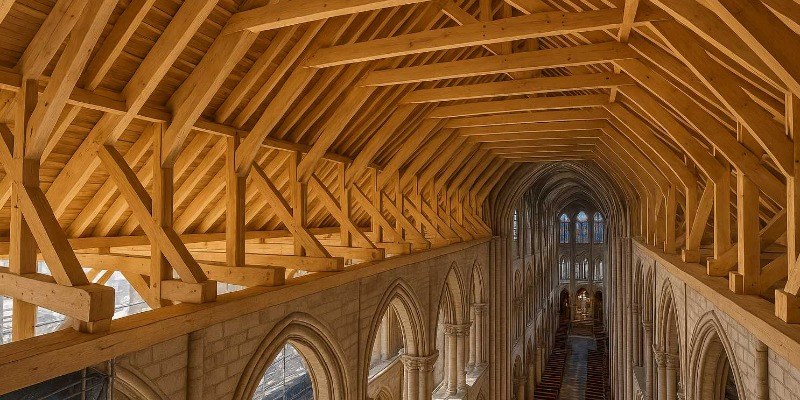
One of the most striking elements of the original fabric was the timber roof, nicknamed la forêt (“the forest”), made of more than 1,300 oak beams—many dating from the twelfth and thirteenth centuries. Trusses up to 14 metres long were crafted with mortise-and-tenon carpentry, entirely free of metal fasteners, in the manner of the age. The framework stretched for over 100 metres and was protected by a lead covering.
In the nineteenth century, after the French Revolution and decades of neglect, Notre-Dame underwent a major restoration led by Eugène Viollet-le-Duc, who added the celebrated Neo-Gothic spire that also perished in the 2019 fire. His intervention was one of the earliest examples of the “critical” restoration approach, in which the architect interpreted Gothic forms with an idealised yet coherent language.
Notre-Dame has stood witness to France’s pivotal moments: Napoleon Bonaparte’s coronation in 1804, the Te Deum celebrating Paris’s liberation in 1944, and state funerals for national figures. During the Revolution the church was de-consecrated and turned into a Temple of Reason, suffering heavy vandalism, but Victor Hugo’s 1831 novel Notre-Dame de Paris rekindled its symbolic importance, paving the way for renewal.
Through the twentieth century the cathedral faced restorations, wars and urban pollution, yet it remained the vibrant heart of the city. Every stone and every beam tells not only a religious story but also a civic, cultural and material history of Europe.
An architectural heritage reduced to ashes
On 15 April 2019 Notre-Dame Cathedral was ravaged by a fire that almost completely destroyed the roof and its original timber structures, the celebrated forêt. This extraordinary assembly of trusses and rafters, built between 1220 and 1240 from about a thousand felled oak trees, vanished in hours. The loss was at once tangible and symbolic, making an authentic yet technically sustainable reconstruction an urgent necessity.
From damage assessment to design choice
The first months after the blaze were devoted to analysing the stability of the masonry and gauging the residual damage caused by the roof’s collapse. At the same time, architects, heritage engineers, historians and public authorities debated the way forward: should they pursue an exact philological reconstruction of the wooden structures or choose a contemporary architectural solution?
The final decision—supported by President Emmanuel Macron and an interdisciplinary technical committee—was to rebuild the framework exactly as it had been, for both historical and structural reasons. This meant reinstating trusses, wind-braces, purlins and struts using the same materials and carpentry techniques that medieval builders employed.
The raw material: monumental oaks and forest traceability
The wooden restoration set in motion a controlled programme to select and fell more than 1,000 century-old oaks, gathered between 2020 and 2021 from public and private forests throughout France. Tree selection followed strict criteria:
- trunks straight and branch-free over the first 12 metres
- base diameter greater than 70 cm
- no internal flaws or structural knots
- dense growth rings ensuring mechanical strength
Every tree was geolocated, marked and tracked throughout cutting, seasoning and processing.
For structural and historical compatibility, the timber was not kiln-dried: beams seasoned in the open air for over a year, under continuous hygrometric monitoring at temporary depots.3-D survey, reverse engineering and historical digitisation
One of the project’s most innovative aspects was the use of digital technologies to re-create the original geometry of the forêt. Thanks to photogrammetric and laser-scanner surveys carried out before the fire (2010–2015) by scholars such as Andrew Tallon, and post-fire drone and lidar scans, technicians obtained an extremely precise three-dimensional “digital map” of the lost structure.
These models fed into a Building Information Modelling (BIM) environment, enabling integrated management of all dimensional, historical and technical data. Every designed beam was mapped in the system with details of its forest origin, mechanical properties and exact installation point.
Medieval carpentry: technique, craftsmanship and precision
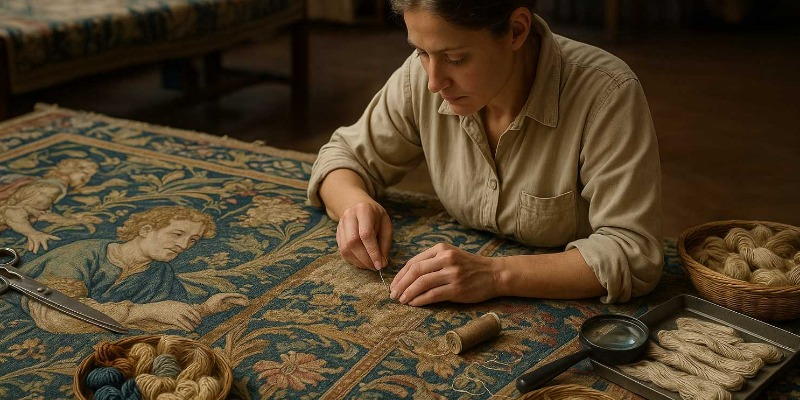
Restoring the trusses relied on thirteenth-century carpentry methods. Beams, hewn by hand by woodworkers skilled in ancient techniques—Compagnons du Devoir and specialist forest artisans—were worked with hand tools and joined by traditional carpentry joints: tenons, mortises and wooden pegs, with no screws or bolts.
After full-scale 1:1 layout on the piquetage (a life-size tracing on the workshop floor), the trusses were pre-assembled at ground level and then lifted with modern equipment, while meeting millimetric tolerances with the cathedral’s masonry.
Structural engineers oversaw the entire process, coupling traditional carpentry calculation with Finite Element Method (FEM) models to verify dynamic response to modern loads: wind, climate, and possible seismic events.
Protection, conservation and fire resistance
The new beams were treated with products compatible with monumental restoration:
- solvent-free impregnators against xylophagous insects and moulds
- non-invasive fire-retardant treatments, slowing flame spread without altering mechanical behaviour
- breathable protective varnishes to maintain the correct microclimate in the roof spaces
An innovative fire-detection and prevention system was designed, based on distributed thermal sensors and early-warning alarms discreetly integrated into the framework. A thin fibreglass mesh was inserted beneath the roofing to prevent localised collapses in any future emergency.
Rebuilding to hand on: the site as an open-air academy
The Notre-Dame timber site also became a vast open-air school for a new generation of carpenters, woodworkers and restoration technicians. Hundreds of apprentices from French wood schools worked side by side with master craftsmen, faithfully reproducing techniques at risk of extinction.
This transfer of knowledge is echoed in the exhaustive documentation of every phase: the entire process has been filmed, catalogued and archived in a public database for scientific, educational and future replication purposes.
Conclusion: a new forest above Paris
The restoration of Notre-Dame’s timber structures embodies an exemplary synthesis of historical rigour, sustainable resource management and cutting-edge heritage technology. The rebirth of the forêt is an act of identity reconstruction, a bridge between the thirteenth and twenty-first centuries in which structural engineering and woodworking mastery merge into a single gesture of cultural continuity.
Every beam raised back into place is more than a technical element: it is a symbol of memory, resilience and hope—hope that architecture, when treated with intelligence and care, can be reborn even after devastating destruction.
© Reproduction Prohibited