- Evolution of cleaning techniques in paper artefacts
- Biochemical principles of the use of enzymes in paper restoration
- Selection and types of enzymes for paper preservation
- Operating protocols for the application of enzymatic techniques
- Advantages of enzymatic methodologies compared to traditional treatments
- Practical cases of enzyme use in cleaning historical documents
- Innovation and new frontiers in enzymatic cleaning
- Conclusions on the effectiveness and future prospects of enzymatic techniques
Advantages, techniques and future prospects of using enzymes in the selective removal of stains and adhesives from ancient paper materials
by Marco Arezio
In the field of paper restoration, cleaning has always been a delicate and crucial step. The need to remove foreign deposits, stains, adhesive residues, or organic dirt often clashes with the need to preserve the physical, chemical, and aesthetic integrity of the substrate. Traditional methods based on the use of solvents, compresses, or chemical treatments present known limitations and risks, from the potential alteration of the paper fiber to the mobilization of inks, pigments, or watermarks.
In this context, scientific research and innovations in biochemistry have paved the way for a new approach: the controlled application of specific enzymes for the selective cleaning of stains and adhesives.
Biochemical foundations of enzymatic techniques
Enzymes are biological catalysts with extraordinary specificity, capable of accelerating targeted chemical reactions without affecting unwanted structures. In preservatives, enzymes such as proteases, amylases, lipases, and, in specific cases, cellulases are typically selected based on the nature of the substances to be removed. Their rationale for use is based on the possibility of selective action: proteases hydrolyze protein residues (such as animal glues or biological deposits), amylases degrade starch-based stains (typical of glues or plant residues), while lipases and cellulases are used in more specific cases on fatty substances or organic crusts.
The main advantage of enzymatic techniques lies in their ability to preserve the paper's cellulose matrix , acting only on the target molecules. This allows for extremely targeted treatment, minimizing the risk of accidental damage, such as hydrolysis of paper fibers or dissolution of sensitive pigments.
Operating methodologies and application protocols
The operational process of enzymatic techniques for paper cleaning begins with a careful diagnosis of the product, often using spectroscopic investigations, multispectral imaging, or non-invasive microchemical tests to identify the type of contaminant present. Once the nature of the deposit (protein, starch, lipid) has been identified, the most suitable enzyme category is selected and the application method is defined.
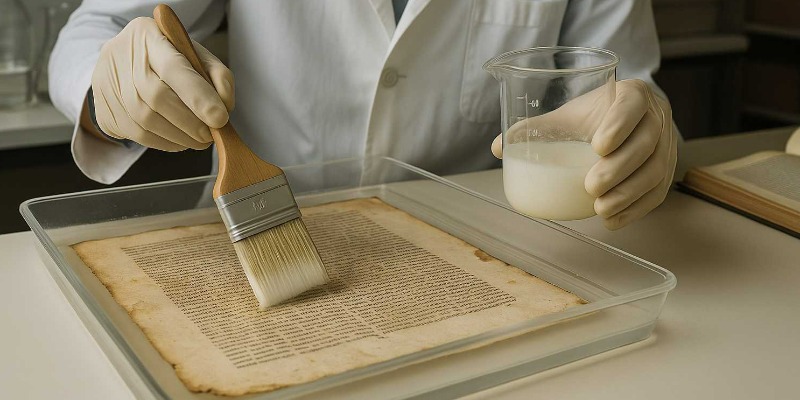
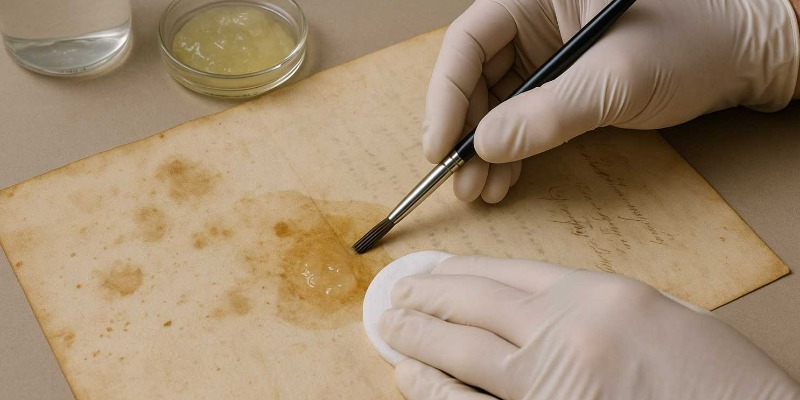
To ensure safety and control, the enzyme solution is generally delivered through gel-like supports (such as agar gel, carboxymethylcellulose, or state-of-the-art hydrogels) or with the aid of semi-permeable membranes that allow for gradual and localized release of the enzyme. This strategy limits the penetration of the solution into the depths of the paper, avoiding excessive imbibition and the risk of deformation or ink migration.
The exposure time is carefully monitored (usually ranging from 15 to 60 minutes) , depending on the reactivity of the selected enzyme and the sensitivity of the artifact. At the end, the gel is gently removed and the surface is lightly rinsed with deionized water or absorbent pads to completely eliminate any enzymatic residues and hydrolyzed substances. This final step is crucial to avoid secondary degradation processes or the permanence of residues that could negatively impact the long-term stability of the restored material.
Advantages of enzymatic techniques over conventional methods
The use of enzymes in the cleaning of paper artifacts introduces a series of significant benefits for restorers:
Selectivity: Enzymes work on specific chemical bonds, ensuring that only unwanted substances are removed, without damaging the paper or original graphic materials.
Delicacy: The action takes place mainly in an aqueous environment, often gelled, minimising the risk of physical alteration (such as browning, deformation, ink migration) compared to traditional solvents.
Environmental and operator safety: The enzymes are biodegradable, used in low concentrations and do not release toxic compounds, making the process environmentally sustainable and safe for personnel.
Effective on complex organic contaminants: Protein stains, animal glues and starches are often refractory to conventional physical and chemical treatments, but are rapidly degraded by targeted enzymes, restoring visual homogeneity and integrity to historical documents.
However, specific operator training is essential, not only to select the appropriate enzyme but also to avoid side effects due to misdiagnosis. An example is the presence of unstable organic pigments, which could be accidentally affected if the protocol is not chosen correctly. Controlling environmental parameters (temperature, pH, enzyme concentration) is also essential to achieving optimal results.
Practical applications and results obtained
The application of these techniques is rapidly gaining ground in leading restoration laboratories, with remarkable results on a wide range of artifacts: medieval manuscripts, incunabula, archival registers, drawings, and historical prints. In cases where the paper was affected by hardened animal adhesives or layered protein stains, the use of proteases has allowed the residues to be removed without the paper fiber losing cohesion or altering its original texture . Similarly, where starch encrustations from old gluing were present, amylases have allowed for complete and selective removal, restoring transparency and softness to the substrates.
Even issues related to the presence of mold, the results of biological attacks, or food contamination have been successfully addressed through the combined use of various enzymes, often in synergy with absorbent compresses and gentle final rinses. The result is a significant improvement in the aesthetic and functional aspects of the product, with a marked reduction in the risk of permanent damage.
Development prospects and new frontiers in enzymatic cleaning
The field of enzymatic cleaning is the subject of intense research and innovation. Increasingly stable formulations are being developed, with enzymes engineered to work in extreme environmental conditions or in the presence of particularly challenging substrates. Particular attention is being paid to controlled-release systems (nanogels, microcapsules, reactive hydrogels), which allow for even more precise and localized dosing, reducing the risk of nonspecific action.
The interdisciplinary approach between chemistry, biotechnology, materials science, and conservation is leading to the development of real-time monitoring techniques capable of non-invasively assessing reaction progress and detecting any critical issues, including through multispectral imaging and surface sensors.
The future of the sector sees the progressive integration of enzymatic techniques into standard restoration protocols, accompanied by a growing training offering for restorers and conservators, who will thus be able to operate independently, customizing the treatment based on the type of artefact and the type of contaminant.
Conclusions: a qualitative leap for paper conservation
The use of enzymatic techniques in cleaning paper artifacts represents one of the most promising innovations in the field of preventive conservation and restoration. Its high selectivity, gentleness on ancient media, and environmental sustainability make it an ideal solution for many problems traditionally considered intractable or high-risk. The dissemination of expertise and standardization of protocols will help make this methodology a stable reference, capable of ensuring the preservation of paper heritage for future generations, while fully respecting its material and historical authenticity.
© Reproduction Prohibited
Sources:
This article is based on specialist studies published by Laura Neri and Paolo Conti and on the analysis of the most recent technical research in the field of conservation.