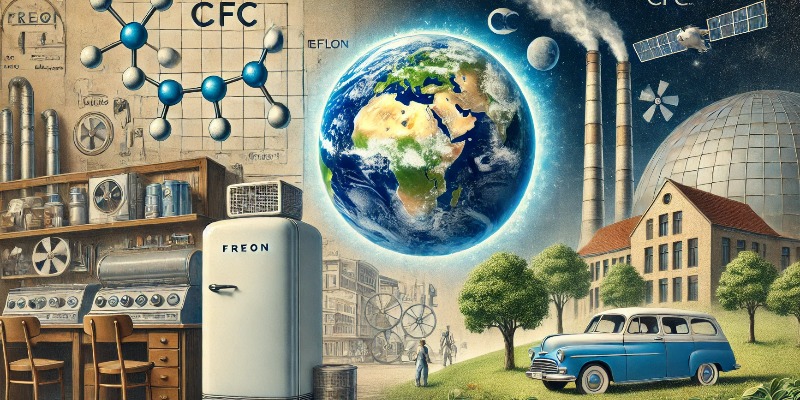
- The Invention of Freon: A Revolution in Refrigeration
- Thomas Midgley Jr. and the Birth of Freon
- The Rise of Freon in the Refrigeration Industry
- From Appliances to Industry: The Success of Freon
- Discovery of the Ozone Hole: The Fall of Freon
- The Montreal Protocol: The End of the CFC Era
- HFCs: A Temporary Solution to Freon's Problems
- Freon and Teflon: Two Revolutionary Discoveries from DuPont
- Freon's Environmental Legacy: Global Damage and Consequences
- The Future of Refrigerants: Beyond Freon and HFCs
How Freon Transformed the Refrigeration and Air Conditioning Industry, and Its Impact on Ozone Layer Depletion and Climate Change
By Marco Arezio
Freon is a family of chemical compounds, primarily chlorofluorocarbons (CFCs) and hydrofluorocarbons (HFCs), historically used as refrigerants, aerosol propellants, and foam blowing agents.
Their history is closely tied to the development of the refrigeration industry, as well as industrial chemistry, and in recent decades, to environmental concerns related to ozone layer depletion and global warming.
Origins of Freon
The discovery and development of Freon can be traced back to the early 20th century. Before their invention, refrigeration systems used dangerous substances such as ammonia, chloromethane, and sulfur dioxide, which were toxic or flammable, posing serious risks to public health and safety.
In 1928, chemist Thomas Midgley Jr., working for General Motors, developed the first compound in the Freon family, Freon-12 (dichlorodifluoromethane, CCl₂F₂).
This new compound was much less toxic and non-flammable compared to previous refrigerants, marking a breakthrough in the refrigeration industry.
The introduction of Freon made it possible to develop safe domestic and commercial refrigerators, and also revolutionized air conditioning systems.
General Motors and DuPont formed a joint venture called Kinetic Chemicals to produce these new compounds on a large scale.
Freon became synonymous with safe and reliable refrigeration, and its use rapidly expanded in the 1930s and 1940s, not only in household appliances but also in industrial and transportation applications.
Growth in Freon Use
During the mid-20th century, CFCs like Freon-12 became global standards in many sectors. The main applications of Freon included:
Domestic and industrial refrigeration: CFCs were used in refrigerators, freezers, and refrigeration systems for transporting perishable goods.
Air conditioning: From domestic and commercial air conditioning systems to air conditioning in vehicles.
Aerosol propellants: CFCs were used as propellants in spray cans for a variety of products such as paints, deodorants, and insecticides.
Foam blowing agents: Used in the production of plastic foams like expanded polystyrene, essential for thermal and acoustic insulation.
These applications led to a growing global dependence on CFCs, which became an integral part of everyday life.
The Beginning of the Environmental Crisis: The Ozone Hole
In the 1970s, some scientists began to worry about the environmental impact of CFCs. A 1974 study by chemists Mario Molina and Sherwood Rowland revealed that once released into the atmosphere, CFCs could reach the stratosphere and undergo photochemical decomposition, releasing chlorine atoms.
These chlorine atoms could destroy ozone (O₃) molecules, which protect the Earth from harmful ultraviolet radiation from the sun.
The discovery of an ozone hole over Antarctica in the 1980s confirmed the scientific community's concerns. This phenomenon became the catalyst for a series of international regulatory actions.
In 1987, the Montreal Protocol was signed by many countries to limit the production and use of CFCs, including those marketed under the Freon brand.
The Transition to HFCs and Climate Issues
Following the gradual ban on CFCs, the refrigeration and air conditioning industry switched to the use of hydrofluorocarbons (HFCs), such as Freon-134a. HFCs do not contain chlorine and thus do not contribute to ozone depletion.
However, it was later discovered that HFCs are potent greenhouse gases, with a high global warming potential (GWP), contributing to climate change.
In light of this, new regulations were adopted in the 2000s and 2010s to gradually reduce the use of HFCs.
The 2016 Kigali Amendment to the Montreal Protocol provides for a global reduction in HFC production and consumption, spurring the development of more eco-friendly refrigerants, such as carbon dioxide (CO₂) and ammonia, which have a lower environmental impact.
Freon Today
Today, the term Freon is mainly used to refer to the HFCs still in use, such as Freon-134a, but its presence is rapidly declining due to new regulations and the development of more sustainable alternatives.
Although Freon played a central role in the development of refrigeration and air conditioning technology, its negative environmental impact has led to a swift move away from these compounds.
The Relationship Between Freon and Teflon
Teflon, the trade name for polytetrafluoroethylene (PTFE), is another chemical compound discovered by DuPont. Its history is related to Freon only in terms of industrial context and the company that developed it.
Teflon was discovered by accident in 1938 by chemist Roy Plunkett, while working on the synthesis of refrigerant gases for DuPont, the same company involved in the production of Freon.
While trying to develop a new type of refrigerant (similar to Freon), Plunkett discovered that one of the gases he was studying, tetrafluoroethylene, spontaneously polymerized into a waxy substance that was heat-resistant and chemically inert: Teflon.
Although the chemical processes that lead to the production of Freon and Teflon are different, the discovery of both compounds occurred in a similar research context, driven by the expansion of industrial chemistry in the 1930s and 1940s.
Teflon later found applications in a wide range of products, including non-stick cookware, electrical cable coatings, and medical devices, thanks to its chemical resistance and low coefficient of friction.
There is no direct chemical relationship between Freon and Teflon, but both represent significant innovations in industrial chemistry and stem from the same research path into fluorine-based compounds.
Conclusions
The history of Freon represents one of the clearest examples of how a scientific discovery can transform everyday life, but also how technological progress must be accompanied by careful evaluation of long-term environmental impacts.
While Freon revolutionized the refrigeration and air conditioning industry, its legacy is also tied to the damage caused to the ozone layer and, subsequently, to climate change.
Today, the challenge is to find solutions that balance innovation, efficiency, and environmental sustainability, learning from the lessons of the past.
© Riproduzione Vietata