- Central Pillar of Freney: Geography and Characteristics of the Wall
- Mountaineering on Mont Blanc in the 1950s and 1960s
- The First Explorations and Attempts on the Freney Face
- The Tragedy of 1961: Chronicle of a Dramatic Rise
- The First Complete Ascent of the Central Pillar of Freney
- New Routes and First Repeats on the Central Pillar
- Tragedies, Accidents and Objective Risks on the Freney Face
- The Central Pillar of Freney in the Mountaineering Imagination
From the conquest of the Central Pillar of Freney to the legendary feats and tragedies that have marked mountaineering
by Marco Arezio
The immense mass of Mont Blanc , the highest mountain in the Alps, is composed of slopes and spurs that, throughout the history of mountaineering, have posed extreme challenges. Among these, the south face, or French side, has always been considered the realm of adventure and drama, with its pillars, seracs, and overhanging granite walls. In this setting, the Central Pillar of Freney, one of the most imposing and elegant structures at the head of the Vallée Blanche, stands as a legendary symbol of conquest, tragedy, and renewed hope, becoming the scene of some of the most famous and controversial events in world mountaineering.
Geographical and Mountaineering Framework
The Central Pillar of Freney is a granite pillar approximately 400 meters high, located in the center of the south face of Mont Blanc, between the Gervasutti Pillar (on the left, looking at the face) and the Central Pillar (on the right is the Angle Pillar). This rock formation, jutting like a blade toward the sky, rises from the Freney glacial basin, an austere and isolated basin reached from the Monzino refuge, after a long approach march over glaciers and snowfields. From a technical standpoint, the Central Pillar offers demanding climbing , primarily on compact granite, alternating with sections of mixed climbing and ice depending on the conditions and time of year.
In the 1950s and 1960s, Mont Blanc represented the pinnacle of European mountaineering: having surpassed the great classic routes on the Italian and French sides, the new generation of climbers sought challenges on increasingly difficult and demanding walls. It was the era of the birth of "modern" mountaineering, marked by the pursuit of technical difficulty and commitment on long routes, with bivouacs suspended on the face and extremely high objective risks.
The First Explorations and the Fame of the Unclimbed Wall
The Central Pillar of Freney had been observed, studied, and attempted several times since the 1930s, but its threatening appearance—verticality, instability of the seracs above, isolation, and difficulty retreating—discouraged any serious attempt at a direct ascent for decades. Mountaineers such as Giusto Gervasutti, Lionel Terray, and other leading figures of the era considered the pillar's line the massif's "great unfinished project," a sort of "last problem" of the Western Alps.
The first attempts, often poorly documented or aborted due to the objective risk posed by the looming seracs, never succeeded in reaching the summit, but they helped cement the face's reputation as a place of total adventure and extreme danger.
The Epic of 1961: Tragedy and Conquest
The history of the Central Pillar of Freney is irremediably marked by the dramatic epic of the summer of 1961, an event that left a profound mark on the history of world mountaineering.
In July of that year, two elite teams joined forces to attempt the first direct ascent of the Central Pillar: the Italian team of Walter Bonatti, Roberto Gallieni, and Andrea Oggioni, and the French team of Pierre Mazeaud, Pierre Kohlmann, Robert Guillaume, Jean Bianco, and Englishman Chris Bonington. After the first few days of bad weather and difficult progress up the face, the group was hit by one of the worst summer storms in recorded history, trapping them on the face with no possibility of a quick retreat.
Water and food supplies quickly ran out. The struggle against cold, hunger, and exhaustion continued for days, in desperate conditions. After repeated attempts to descend, four of the members—Oggioni, Kohlmann, Guillaume, and Bianco—died of exhaustion and frostbite during the retreat . Bonatti, Gallieni, Mazeaud, and Bonington, exhausted, finally managed to save themselves, reaching the base of the wall in dire conditions.
That episode, which went down in history as the "Fréney tragedy," was experienced as a true loss by the entire international mountaineering community. Walter Bonatti, who had already accomplished legendary feats such as the solo ascent of the Petit Dru, was deeply affected by the experience, which he recounted in his book "The Great Days" with great pathos and emotional intensity. Since then, the Central Pillar has been seen as a place of pain, courage, and redemption.
The Conquest: First Ascent to the Summit
It was only a few weeks after the tragedy, on August 9-10, 1961, that a team led by René Desmaison, along with Pierre Julien and other French climbers, finally managed to complete the first complete ascent of the Central Pillar, following a line similar to that attempted by Bonatti and his companions.
Their ascent, less dramatic but equally challenging, marked the end of an era of uncertainty and the consecration of the Pillar as one of the great classic routes on Mont Blanc.The feat, lauded throughout the international press, ushered in a period of intense interest for the face, which quickly became a testing ground for Europe's best climbing teams. The Central Pillar thus became a symbol not only of technical difficulty, but also of psychological endurance and absolute respect for the mountain.
New Routes and First Repeats
After Desmaison's ascent, the Central Pillar was repeated several times in the following years, becoming a sought-after destination for expert climbers. Historic repeats include those by Pierre Mazeaud and his companions (who had already been involved in the tragedy), who completed the route again in 1963, and those by other greats such as Gaston Rébuffat and René Desmaison himself, who in the 1970s helped establish variations and new routes on the pillar and adjacent structures.
In the 1970s and 1980s, the route was also repeated in a more modern style, with less use of bolts and a progressive reduction in fixed gear, anticipating the “by fair means” approach that would later dominate mountaineering in the 1990s and 2000s.
New routes, such as the "English Direct," opened in 1973 by a British team, and the "Swiss Route" in 1984 , testify to the technical evolution and the desire to tackle the challenges of increasingly untouched and challenging terrain. The Freney face, thanks to its technical and environmental qualities, became the training ground of choice for top-level European and international mountaineering.
Tragedies and Unforeseen Events: Freney as a Cursed Wall
Despite the passing of the years and advances in equipment, the Freney face has continued to claim victims. Several teams have been swept away by the shifting seracs in the upper basin, while others have been trapped on the face by sudden deteriorations in the weather, among the most treacherous in the entire Alpine region.
In 1997, a serac avalanche killed two young climbers, reminding us of the vulnerability of those who brave the rock face. Paying close attention to weather reports, snow conditions, and temperatures remains, even today, one of the main rules for those undertaking the climb. The evolution of safety has not erased the unpredictable and "wild" nature of the Freney area, which remains a haven for extreme challenges.
The Central Pylon in the Collective Imagination
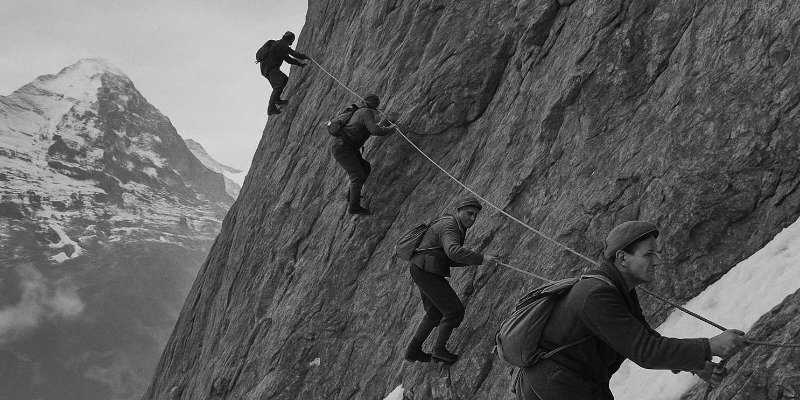
Beyond the documented facts, the Central Pillar of Freney has acquired a symbolic value in the mountaineering imagination: it represents the boundary between the "heroic" mountaineering of the early days and the technical, modern mountaineering, aware of the risks but determined to face them with respect and preparation. The black-and-white photographs of the first ascents, the stories of Bonatti and Desmaison, and the accounts of tragedies and successful climbs compose a mosaic that speaks of ambition, fear, greatness, and human fragility.
Even today, climbing the Central Pillar is not just a technical feat, but a journey through time and the spirit of mountaineering. Those who attempt this face become part of a collective history of attempts, setbacks, successes, and, sadly, even tragedies, where every step is dictated by the awareness of being guests in an extreme environment that allows no room for error.
Conclusions: The Freney Legacy
More than sixty years after its conquest, the Central Pillar of Freney remains one of the most coveted and respected objectives on Mont Blanc. Its history, studded with epic feats and human dramas, still represents one of the most intense chapters in world mountaineering. New generations approach the face with humility and respect, aware that, beyond the technical difficulty, the true test is the ability to understand limits, accept conditions, and know when to stop when the mountain demands it.
For mountain lovers, the Central Pillar of Freney continues to be much more than a simple rock face: it is the place where man encounters his limits and, at times, his destiny.
© Reproduction Prohibited