- Introduction to the Courrières disaster
- The historical context of coal mining in France
- The Compagnie des mines de Courrières: economy and safety
- Firedamp gas and the causes of the explosion
- The tragedy of March 10, 1906: dynamics and immediate consequences
- Rescue efforts and controversies over emergency management
- The social and political repercussions of the disaster
- The historical legacy of the Courrières disaster
Explosion in the Coal Mine of 1906: Causes, Consequences, and the Impact on Worker Safety
By Marco Arezio
The Courrières disaster, which occurred on March 10, 1906, is considered one of the greatest mining tragedies in European history. Located in the coal basin of Pas-de-Calais in northern France, the Courrières mine was one of the main extraction sites of its time, meeting the growing demand for coal in European industry. The catastrophe, which claimed the lives of approximately 1,099 miners, left an indelible mark on the industrial and social history of the country.
The Historical Context
At the beginning of the 20th century, coal was the driving force of European industrialization. Mines were an economic pillar for France, but mining work was extremely dangerous. Working conditions were precarious: tunnels were often poorly ventilated, the risk of grisou gas explosions was constant, and safety measures were rudimentary.
The Courrières mine was part of a vast mining complex managed by the Compagnie des mines de Courrières, one of the most powerful companies in the sector and a symbol of industrialization in northern France. Founded in the 19th century, the company controlled a network of mines and infrastructure that significantly contributed to the regional economy.
Despite its economic success, the company was often criticized for its treatment of workers, who were subjected to grueling shifts and operated in extremely unsafe conditions. The deep tunnels extended for kilometers, making the implementation of adequate safety systems difficult, and management prioritized productivity over worker protection. This imbalance between profit and safety would dramatically manifest during the 1906 disaster.
The Explosion
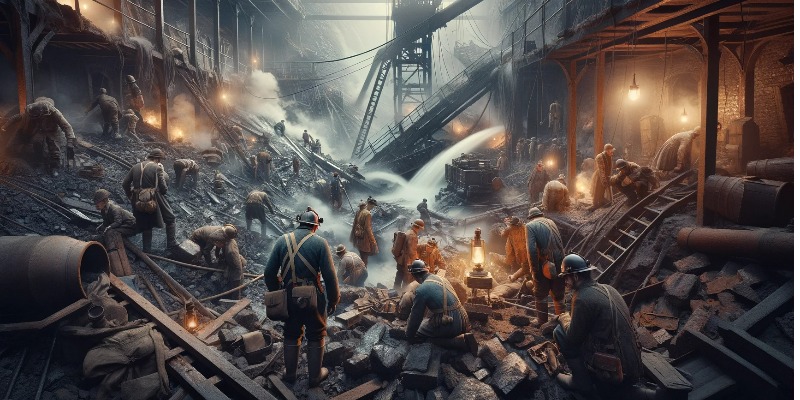
On the morning of March 10, 1906, a devastating explosion shook the mine. The event was attributed to a lethal mixture of grisou gas and coal dust, two elements known for their danger in mining environments. Grisou gas, composed mainly of methane, accumulates in poorly ventilated tunnels and becomes highly explosive when mixed with air in certain concentrations. This gas, likely ignited by a spark or open flame, triggered a shockwave that spread at an impressive speed through the tunnels, carrying with it clouds of coal dust that further intensified the explosion.
The power of the event destroyed supporting structures, buried workers under tons of debris, and ignited fires that were difficult to extinguish. The explosion affected four main sites of the mine, greatly complicating rescue efforts and highlighting the tragic vulnerability of the mining system of the time.
The scale of the tragedy was immediately evident. Of the approximately 1,800 people working in the mine that day, over a thousand died instantly or from subsequent collapses and fires. Many others were trapped underground with no possibility of escape.
Rescue Efforts and Controversies
Rescue operations were immediately challenging and chaotic. The rescue teams faced enormous difficulties due to collapses, high temperatures, and the presence of toxic gases. Despite their efforts, many survivors died from lack of oxygen or from their injuries.
One of the most controversial aspects was the decision by the Compagnie des mines to temporarily suspend rescue operations to protect other sectors of the mine. This choice outraged the victims' families and workers, fostering distrust toward employers and authorities.
The tragedy also brought to light extraordinary survival stories. A group of thirteen miners was found alive after twenty days, having survived by eating dead horses and drinking stagnant water. Their incredible resilience became a symbol of hope amid despair.
Social and Political Consequences
The Courrières disaster sparked a wave of protests across France. Unions, already agitated over the harsh working conditions, organized strikes and demonstrations demanding better safety standards in mines. The tragedy became a turning point for the French labor movement, pushing for legislative reforms to improve workplace safety.
Internationally, the disaster drew attention to miners' working conditions, sparking a debate on industrial ethics and the need for stricter regulations. Germany and other industrialized countries sent experts to study the event and prevent similar tragedies in their territories.
The Legacy of the Disaster
Today, the Courrières disaster is remembered as a cautionary tale about the risks of unchecked industrialization and the consequences of neglecting worker safety. Monuments and memorials have been erected to commemorate the victims, and the mine site has become a place for historical reflection.
The tragedy represents a painful chapter in French history but also serves as an example of how struggles for justice and workplace safety can arise from the worst catastrophes. Courrières is not just a memory of suffering but also a symbol of resilience and hope for a safer and fairer future for all workers.
© Reproduction Prohibited