This chapter traces the historical evolution of PVC, from its origins in industrial chemistry in the late nineteenth century to its full-blown use as an infrastructure material in the twentieth century. It analyzes the long journey that transformed an initially rigid and difficult-to-work polymer into an extremely versatile technological platform, thanks to the development of formulations and industrial processes. The text delves into the pioneering phase of regeneration, which began as an empirical practice within factories, highlighting its limitations, insights, and progressive learnings.
The chapter then describes the transition from informal waste reuse to the formation of specialized operators and the emergence of an initial independent market for recycled PVC. The chapter highlights how economic, technical, and cultural factors have contributed to the professionalization of the sector. Finally, the analysis extends to the global evolution of the last twenty years, demonstrating how recycled PVC has evolved from a marginal solution to a strategic resource. Overall, a historical interpretation emerges that coherently links the industrial past and the contemporary challenges of recycling.
Historical evolution of PVC, first regeneration techniques and the birth of the recycled PVC market
Recycled PVC – Technical Manual - Chapter 2: From basic chemistry to the circular supply chain: the long industrial history of PVC
The industrial history of vinyl chloride and the polyvinyl chloride derived from it is deeply intertwined with the evolution of twentieth-century industrial chemistry and the progressive emergence of polymeric materials as pillars of modern manufacturing. Unlike other polymers, which arose as direct responses to specific application needs, PVC initially developed as the result of basic chemical research, its industrial potential becoming apparent only at a later stage, through a lengthy process of experimentation and technological adaptation.
The monomer vinyl chloride was synthesized and studied as early as the second half of the 19th century, but the first observations of its polymerization date back to the early 20th century. In this pioneering phase, PVC appeared to be a promising but problematic material: rigid, difficult to work with, unstable at high temperatures, and poorly suited to the industrial processes then available. These limitations slowed its widespread adoption, relegating it for several decades to a marginal role compared to other emerging materials.
The industrial breakthrough occurred when research focused not only on the polymer resin, but on the entire formulation system. The discovery and introduction of thermal stabilizers and plasticizers allowed many of the initial difficulties to be overcome, transforming PVC from a laboratory curiosity to a processable industrial material. This transition marked a fundamental moment: PVC was no longer conceived as a "pure" polymer, but as a modular technological platform, capable of adapting to widely varying application needs.
In the 1930s and 1940s, PVC began to find its first significant industrial applications, especially in the electrical and coating industries. Its combination of good insulating properties, chemical resistance, and relatively low cost made it particularly attractive in an industrial context requiring reliable and easily produced materials. However, it was after World War II that PVC experienced a real global expansion.

The period of industrial and infrastructural reconstruction represented fertile ground for the emergence of PVC.
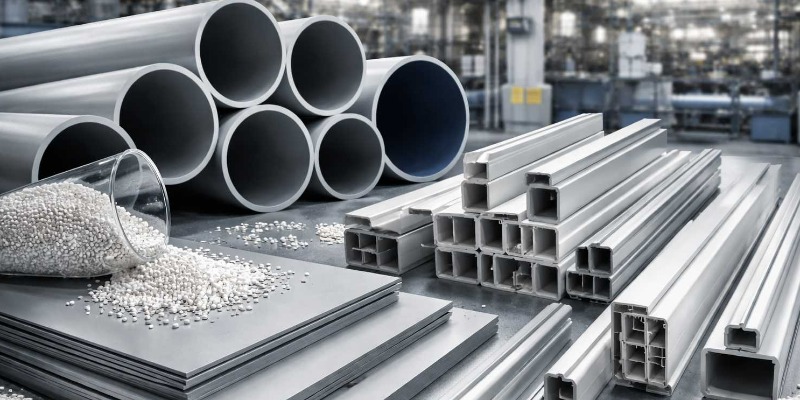
The need to rapidly construct networks, buildings, and facilities favored the adoption of versatile, standardizable materials compatible with high-productivity production processes. PVC responded particularly effectively to these needs, gradually establishing itself as the go-to material for pipes, profiles, flooring, cables, and numerous other products intended for long life cycles.During this expansion phase, PVC also stands out for its ability to integrate into complex industrial supply chains. Monomer production, polymerization, formulation, and final processing are structured as interconnected phases, giving rise to a complex industrial ecosystem. This ecosystem fosters incremental innovation, with continuous improvements in formulations, stabilization processes, and transformation technologies.